Although PIN detector is commonly used for short distance optical modules below 40km, such as 10km and 20km, APD photon detector is used for optical modules above 40km. However, in the actual market, there are indeed optical modules with a nominal 40KM but using PIN detectors. Why?
In fact, this is not a standard mistake, but a trade-off made by the manufacturer between cost, technical balance, and actual link loss.
Main Reason to Use PIN Dector for ER Modules
The ‘strong compensates for weak’ approach to laser power
- Logic: If the receiving end (PIN) is not sensitive enough, then increase the power of the sending end (Laser).
- Method: Manufacturers will use higher power EML lasers for better performance. Although the sensing ability of PIN is slightly inferior, if the light emitted by the transmitting end is strong enough, after 40 km of attenuation, the residual optical power can still reach the sensing threshold of PIN (usually around -16dBm to -18dBm).
- Project case: Yingda SFP-10G-ER-1550nm module.
Below is a comparison between SFP-10G-ER-1550nm and the ER-1310nm:
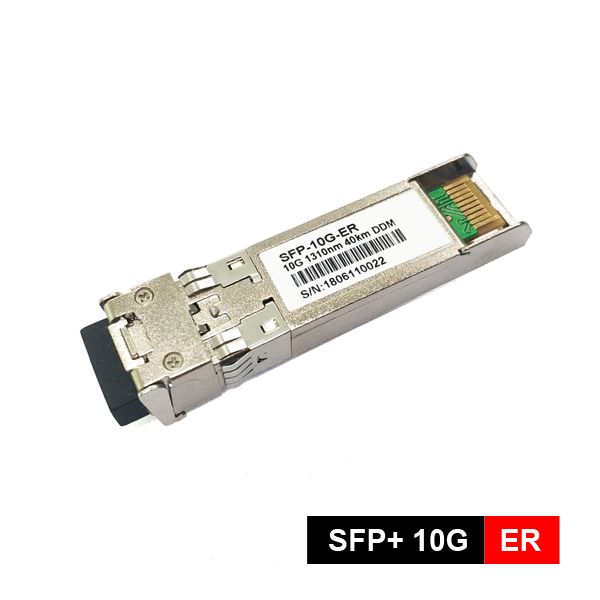
SFP-10G-ER-1310nm
- Transmitter: DFB laser
- Receiver: PIN photo-detector
- Wavelength: 1310nm
- Fiber attenuation loss: 0.35dB/km
- Dispersion tolerance: Better (O-band dispersion close to zero)
- Application: Huawei and other equipment manufacturers, non-standard models, but compatible with 10GBASE-R
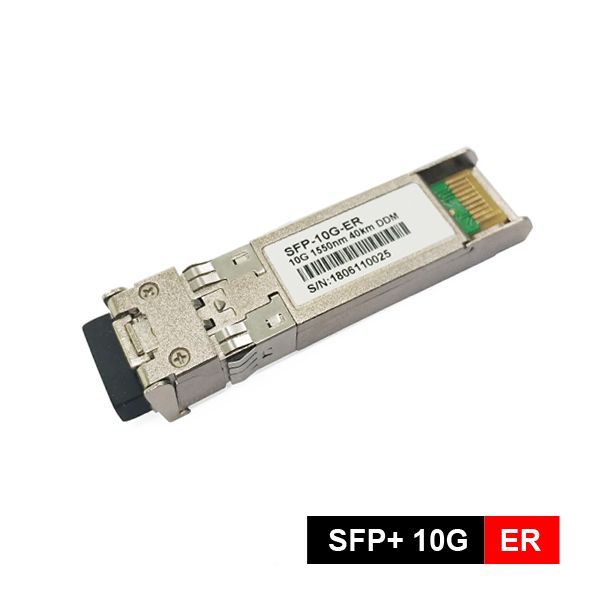
SFP-10G-ER-1550nm
- Transmitter: EML laser
- Receiver: PIN photo-detector
- Wavelength: 1550nm
- Fiber attenuation loss: 0.22dB/km
- Dispersion tolerance: Low (dispersion compensation required)
- Application: Scenarios with limited cost but sufficient link budget, universal cross vendor compatibility
Idealized assumption of link loss
- Theoretical calculation: The theoretical loss of 1550nm fiber is 0.22dB/km.
- 40km loss: 40×0.22=8.8dB
- PIN space: If the power at the sending end is 0dBm, there is still -8.8dBm at the receiving end. This is much higher than the sensitivity limit of PIN detectors (about -18dBm).
- Conclusion: In ideal links with excellent fiber quality and very few connectors, PIN detectors are more than sufficient to run 40KM.
Cost control (The most direct cause)
- APD detector price is expensive: APD detectors require high-voltage bias circuits, have complex production processes, and are usually much more expensive than PINs. APD detector price
- The competitiveness of PIN: For projects with limited budgets, if the actual loss of fiber optic link testing is not significant (such as only 10-12dB), using the EML+PIN solution can significantly reduce procurement costs.
SFP-10G-ZR-L (APD)
- Transmitter: EML laser
- Receiver: APD photo-detector
- Receiver sensitivity: Higher, -23dBm~-24dBm
- Wavelength: 1550nm
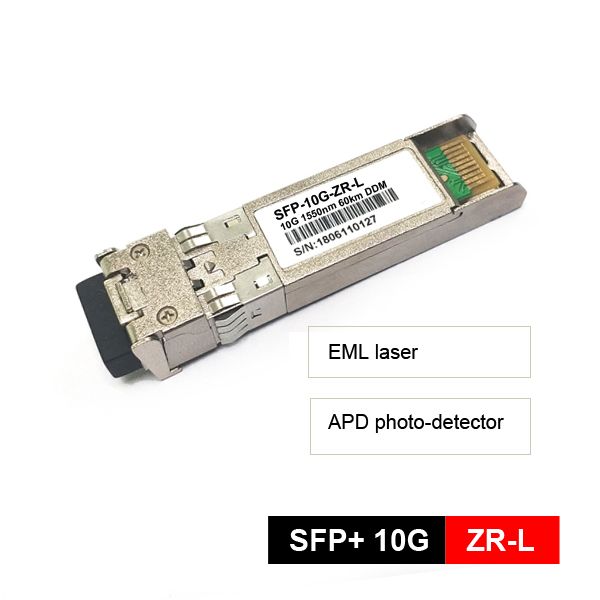
SFP-10G-ZR-L (PIN)
- Transmitter: EML laser
- Receiver: APD photo-detector
- Receiver sensitivity: Higher, -23dBm~-24dBm
- Wavelength: 1550nm
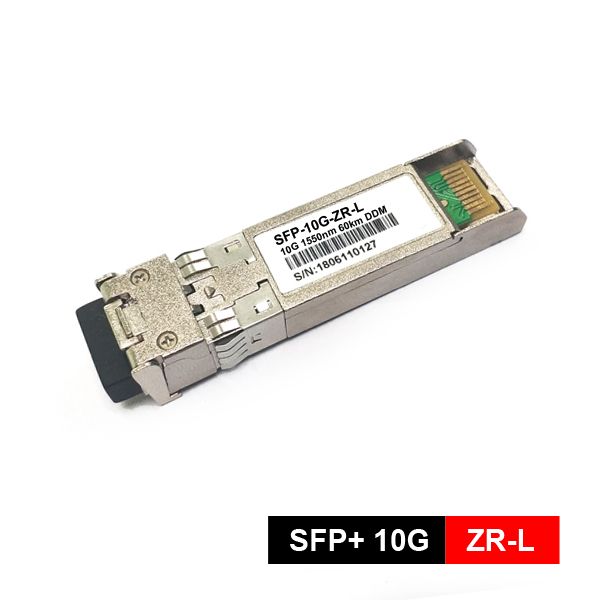
Avoiding the ‘fragility’ of APD
- Vulnerability: APD photon detector is very prone to burning out due to excessive optical power.
- Maintenance cost: In some environments where frequent plugging or maintenance is average, using a PIN detector may have lower sensitivity, but it is more robust and less likely to damage the module due to operational errors (forgetting to add attenuators).
Risk of using PIN version 40KM module
Although it can be used, you should pay attention to the following hidden dangers:
- Extremely low redundancy: Once the fiber optic cable ages, bends, or is contaminated by dust, the link will immediately disconnect. The APD version usually has a 5-8dB fault tolerance space.
- Non standard products: The IEEE standard 10GBASE-R explicitly requires higher levels of sensitivity. The use of PIN version modules may not pass some rigorous telecommunications inspections.
How to distinguish which type you are buying?
Please Refer to the “Receiver Sensitivity” on the module back sticker or in the specification sheet:
- -23dBm or lower: It must be APD.
- -16dBm to -19dBm: The highest probability is PIN.