Skip to content
As data centers transition to 40G, 100G, and 400G networks, managing high-density fiber becomes a major challenge. Enter the MPO Adapter Plate—a critical component in modern cable management. But what exactly does it do? How do you choose between Type A and Type B polarities? And what do those adapter colors mean?
In this comprehensive guide, we break down everything you need to know about MPO adapter plates, helping you simplify your next high-density fiber deployment.
Core Functions and Key Benefits
- High-Density Integration: Pack multiple MPO ports (typically 6, 8, or 12) into a compact footprint. This vastly reduces rack space (U-space) consumption.
- Precision Alignment: MPO adapters secure the connectors in place. They ensure the guide pins and holes align with micron-level precision to minimize insertion loss.
- Network Polarity Management: The panel controls the alignment of the adapter keys. This strictly maintains the correct Type A, B, or C polarity across the link so Tx always connects to Rx.
- Protection and Easy Maintenance: Features a modular, “plug-and-play” snap-in design. It allows for toolless installation, protects fibers from over-bending, and keeps dust out.
Adapter Plate Classifications
Now on market, the standard configuration is Simplex (Single-Port) Plates, which cutout holds one MPO adapter supporting 8, 12, or 24 fibers.

By Alignment Key and Polarity
To support different network cabling architectures, the adapters on the plate are configured in two primary ways:
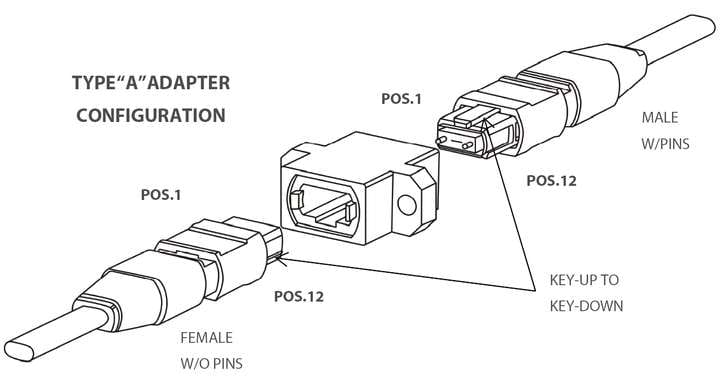
Type A Adapter Configuration
— Key-Up to Key-Down (Straight-Through)
- One key is up, and the other is down.
- The fiber positions are mirrored on each side (1-to-1, 12-to-12).
- It is widely used in single-mode systems.
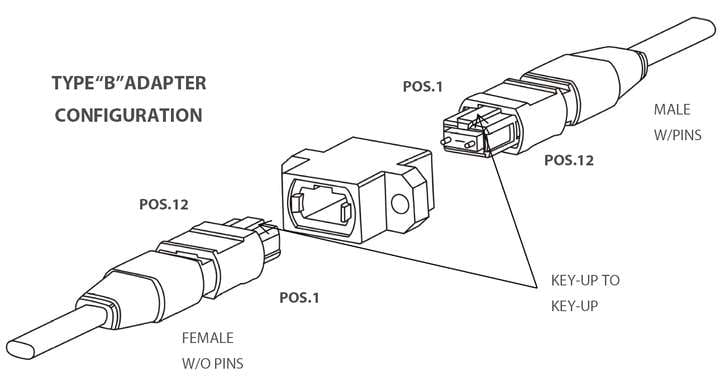
Type B Adapter Configuration
— Key-Up to Key-Up (Crossover)
- Both alignment keys face upward.
- The fiber positions flip entirely (1-to-12, 12-to-1).
- It is crucial for multi-mode parallel optics like 40G/100G.
By Mechanical Footprint (Dimensions)
- LGX Standard Plates: The most widely adopted generic standard size in the industry. They fit seamlessly into generic 1U/2U/4U LGX-compatible fiber patch panels.
- High-Density (HD / U-Series) Plates: Proprietary form factors engineered by specific manufacturers. They are smaller and denser than LGX plates. Like Yingda below types:
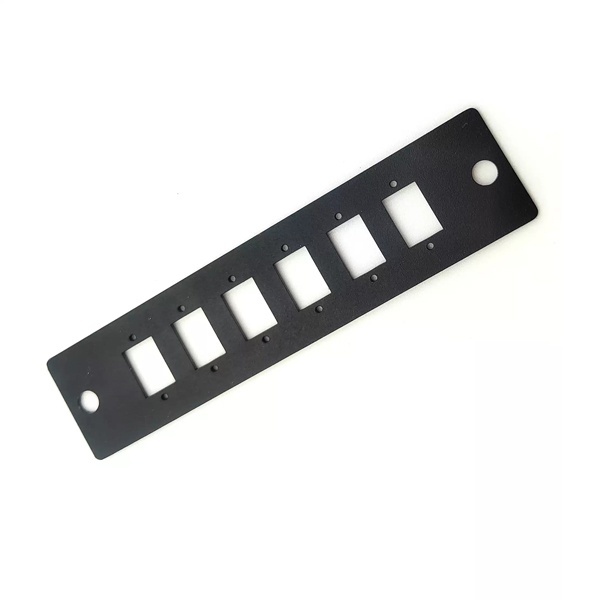
LGX Metal MPO Panel
- Size:130*29.3mm
- Material: Cold-Rolled Steel (SPCC)

Yingda High Density Fiber Panel
- Size:102*34mm
- Material:Plastic ABS
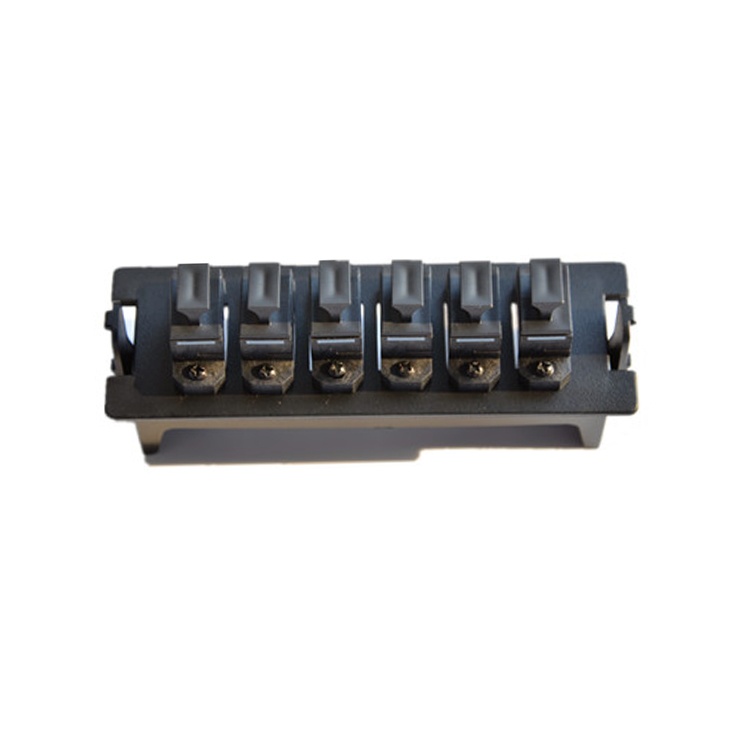
Yingda HD Plastic Fiber Panel
- Size:97*33mm
- Material:Plastic ABS
Materials and Engineering Design
- Plate Body Material:
- Cold-Rolled Steel (SPCC) / Aluminum Alloy: Finished with powder coating or anodization. It offers high impact resistance, anti-static properties, and corrosion resistance for backbone setups.
- Engineering Plastics (ABS/PC): Lightweight, rust-proof, cost-effective, and highly flame-retardant.
- Adapter Mating Sleeves: Unlike single-fiber adapters (LC/SC) that use ceramic alignment sleeves, MPO adapters do not contain internal sleeves. They rely entirely on the precise metal guide pins of the male MPO connector. The adapter plate simply provides the outer locking mechanism and mechanical guidance.

Adapter Color Code Specifications (TIA-568 Compliant)
The color of the MPO adapters on the plate instantly identifies the fiber type and polishing style inside:
- Aqua: Multi-mode OM3 / OM4 fiber. This is the gold standard for high-speed data center backbones.
- Magenta / Heather Violet: Multi-mode OM4 / OM5 fiber.
- Green: Single-mode fiber with APC (Angled Physical Contact) polish.
- Blue: Single-mode fiber with UPC (Ultra Physical Contact) polish.
- Gray / Black: Generic or customized ports used for proprietary applications.

Typical Application Scenarios
- Data Center Structured Cabling (MDA/EDA): Secures trunk cables coming from the main distribution area and manages distribution to server racks.
- 40G / 100G / 400G Network Migration: Acts as the physical patching layer for parallel optics transceivers like QSFP+, QSFP28, and OSFP.
- FTTx & Central Offices: Facilitates high-volume cross-connects within highly restricted spaces in telecom facilities.
- Spine Leaf Interconnection in Data Centers: As the core skip point of high-density fiber optic links, it is used to connect the backbone cable between Leaf switches and Spine switches.
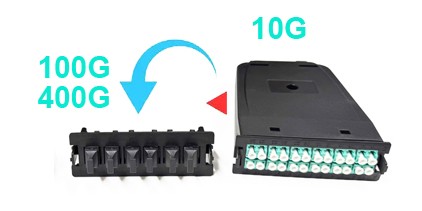
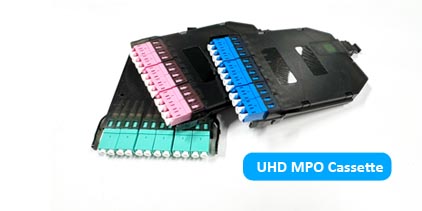
Core difference from MPO module box
| Item | MPO adapter panel | MPO module box (Cassette) |
| core functionality | MPO ↔ MPO direct connection | MPO → LC/SC interface conversion |
| interface type | Both front and rear ends are MPO interfaces | Backend MPO, Front end LC/SC and other interfaces |
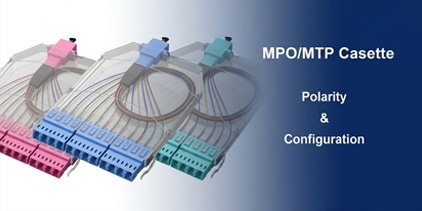
| internal structure | No internal connections, only physical channels | Internally, there is a MPO harness cable used for splitting signals |
| main function | Extend and schedule MPO links | Adapt high-density MPO interface to LC interface commonly used by user devices |
FAQ
What is the difference between MPO Type A and Type B adapters?
The primary difference between Type A and Type B MPO adapters is the orientation of the alignment key, which determines how the fiber positions are mapped: Type A is key up to key down, straight through fiber sequence, while Type B is key up to key down, crossover type fiber sequence.
Can I use an MPO adapter plate for MTP connectors?
Yes, certainly. MTP is high performance of MPO, it is compatible.
Can you provide US CONEC’s MTP adapter?
Sure, how much do you need?
How long is the delivery time for MPO adapters?
It depends. If you need original SENKO or USCONEC MPO/MTP adapter,,if no stock will depend on their agent time. If made in China adapters, generally in stock.
Can you custom color for MPO/MTP adapter housing?
Yes, customize is available like Aqua, Magenta, Beige or Green, the MOQ is 10000pcs. The standard is black color. How many pieces do you need?