Skip to content
In today’s data center architecture, space is money. As networks evolve towards 400G, 800G, and even higher bandwidths, 1U rack space is being squeezed to its limits. To cram more ports into limited space, MPO/MTP high-density cabling modules (Cassettes) have become the absolute mainstay of modular cabling.
However, many network engineers, while focusing on the port density of Cassettes, often overlook a crucial element hidden inside the box—the fiber type of the internal MPO harness cable.
If your high-density MPO/MTP module doesn’t use G.657.A2 bend-resistant single-mode fiber (BI-SMF), then this module could very well become a “time bomb” in your data center. Today, we’ll break down why G.657.A2 is an uncompromising, fundamental requirement for high-density modules.
Macrobending Loss: Curing the “Thalassophobia” of High-Density Fiber Management
In the ultra-high-density (UHD) era, MPO/MTP modules have become increasingly slim, making internal space a premium commodity. Multiple optical fibers within the module must navigate dense routing paths, sharp turns, and tight coiling in confined corners.
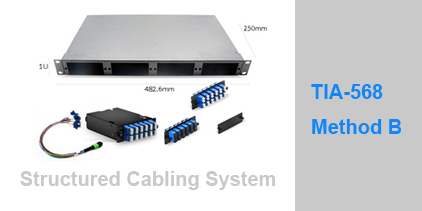
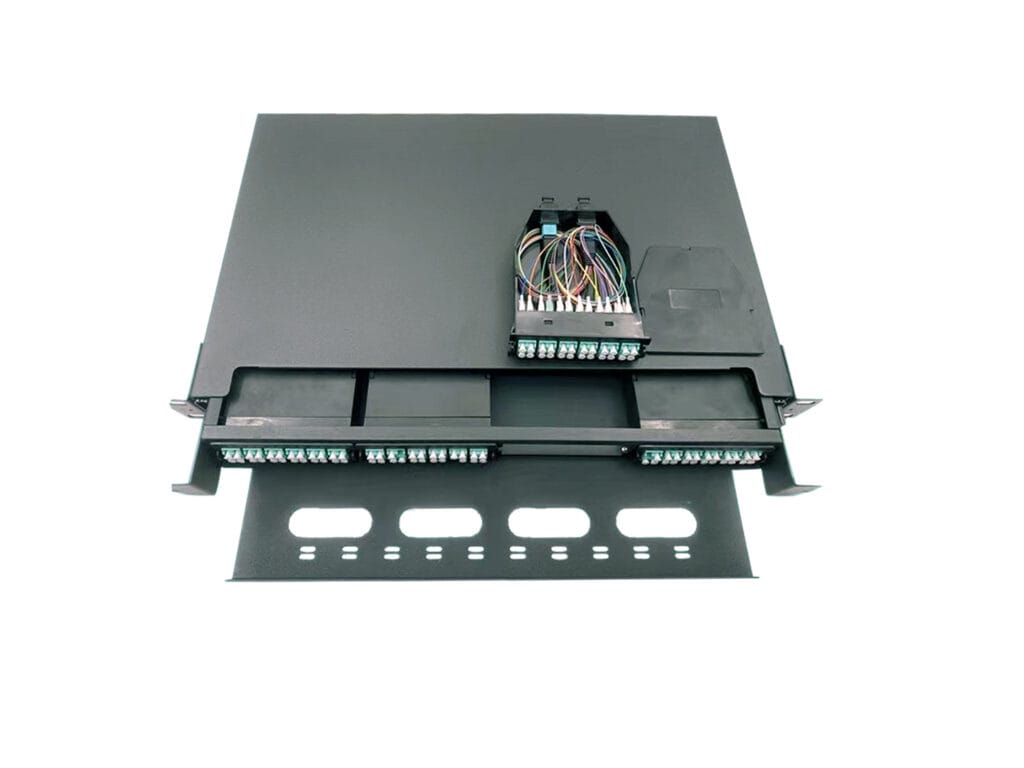
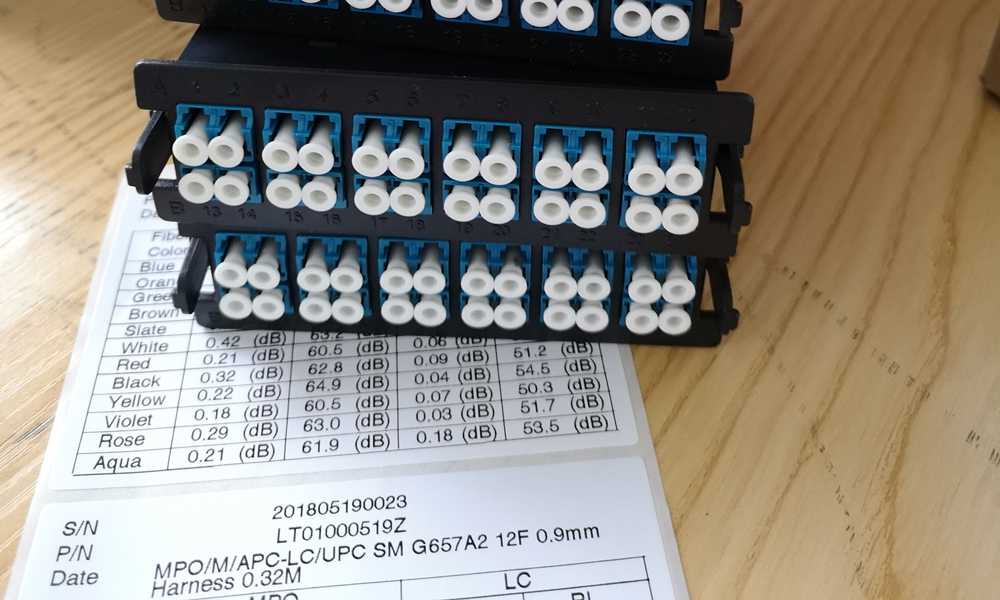
For example: inside a standard 1U patch panel (Part no.: FHD-1U-96C-04M1-LC02), 4pcs high-density MPO/MTP cassettes are packed closely together. The internal space of these modular cassettes is extremely confined, requiring the fiber patch cords inside to be routed with sharp turns and tight bends.
If a manufacturer uses legacy legacy single-mode fiber, such as standard G.652.D, these tight bends create a disastrous bottleneck. Standard G.652.D fiber is highly sensitive to bending. When forced into a tight radius, the light signal escapes from the fiber core into the cladding, causing a dramatic spike in Insertion Loss (IL). In high-speed 100G, 400G, or 800G networks, this added loss can cause intermittent packet drops, signal degradation, and even damage to expensive optical transceivers.
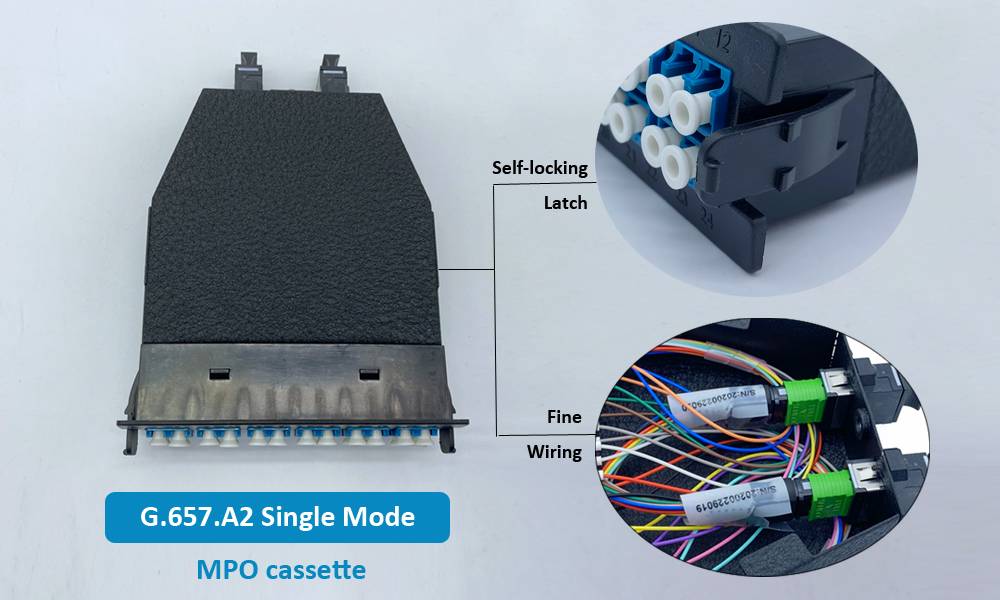
To eliminate this performance risk, Yingda has fully upgraded its standard single-mode manufacturing line to utilize premium G.657.A2 Bend Insensitive Fiber (BIF) inside all cassette modules.
Here is how G.657.A2 technology completely outperforms legacy fiber in high-density environments:
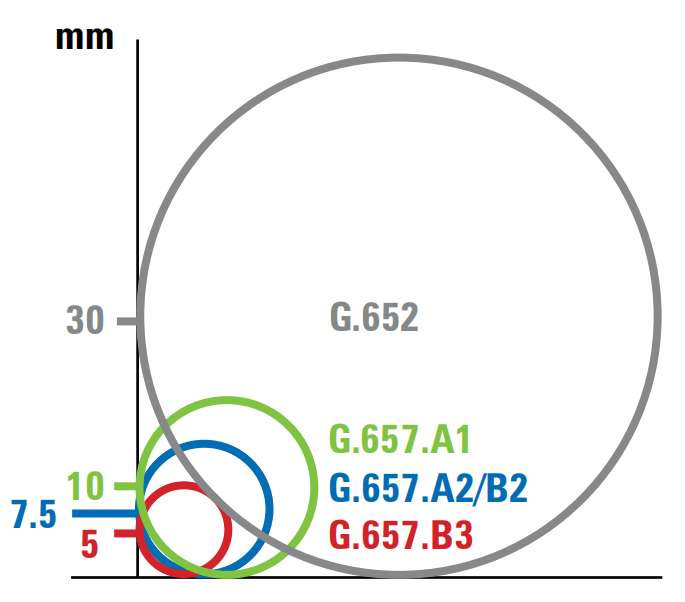
- Ultra-Small Bending Radius: Standard G.652.D fiber requires a minimum bending radius of 30mm to prevent signal loss. In contrast, G.657.A2 fiber features a specialized trench refractive index profile, allowing a minimum bending radius of just 7.5mm without any structural or optical damage.
- Near-Zero Added Loss: Even when wrapped tightly inside a compact LGX or FHD module, G.657.A2 fiber exhibits virtually zero macro-bending loss at critical wavelengths (1310nm, 1550nm, and 1625nm), keeping the overall cassette insertion loss strictly within the Elite Low Loss standard (≤0.35dB).
- Long-Term Reliability: Reducing the bend sensitivity significantly lowers the mechanical stress on the glass silica. This prevents micro-cracks over years of continuous operation, ensuring a stable lifespan of over 20 years for your data center infrastructure.
| Performance Metrics | Standard G.652.D Fiber | Premium G.657.A2 BIF (Yingda Standard) |
| Min. Bending Radius (Static) | 30 mm | 7.5 mm (4x Better Flexibility) |
| Max. Bending Loss at 1550nm | High (>0.5 dB per turn at 15mm radius) | ≤ 0.5 dB (Full turn at ultra-tight 7.5mm radius) |
| Application Suitability | Long-haul outdoor trunk cabling | UHD Data Centers & Modular MPO/MTP Cassettes |
| Compatibility with G.652.D | 100% | 100% Seamless Integration |
Moving Beyond “Technology Islands”: Seamless Compatibility with Existing G.652.D Networks
Many engineers worry that using specialized fibers—such as bend-insensitive variants—might compromise connectivity with the data center’s existing backbone cabling.
- Seamless, Loss-Free Connection: There is absolutely no need for concern here. G.657.A2 fiber is fully backward-compatible with standard G.652.D single-mode fiber in terms of physical characteristics.
- Identical Mode Field Diameter (MFD): G.652.D and G.657.A2 share the same mode field diameter, meaning that splicing or interconnecting module pigtails with backbone cables will not result in parameter mismatch or excessive insertion loss. This ensures a smooth transition during network upgrades.
Pushing Design Limits: The “Driving Force” Behind Ultra-High-Density Chassis
To maximize rack space utilization, modern 1U high-density patch panels typically house 4 to 12 MPO/MTP cassettes.
- Space Constraints: Inside each cassette, multiple breakout fibers must not only make near-90-degree turns but also accommodate slack fiber storage within the limited housing.
- Making the Physically Impossible Possible: Without the extreme bend-resilience of G.657.A2 fiber, such ultra-slim, ultra-high-density cassette designs would be physically unfeasible. G.657.A2 is what empowers hardware manufacturers to minimize space requirements and exponentially increase port density.
Eliminating “Physical Fatigue”: Preventing Micro-cracks Caused by Long-term Stress
Optical fibers are essentially silica glass fibers; prolonged exposure to physical compression or tension is detrimental to their integrity.
- Potential Fiber Breakage Risk: If standard optical fibers are forcibly bent and secured within high-density module enclosures, the outer surface of the fiber is subjected to sustained, extreme tensile stress. Over time, this microscopic stress can trigger structural micro-cracks, eventually leading to sudden fiber breakage and catastrophic system downtime.
- Long-term Reliability: G.657.A2 fibers are specifically engineered for small bend radii and feature superior material fatigue resistance. This ensures physical integrity and a long service life, even when deployed in compact spaces for extended periods.
Maximum Fault Tolerance: Safeguarding Against Human Error in High-Pressure Operations
Data center technicians often face immense time pressure when performing routine Moves, Adds, and Changes (MACs).
- Inevitable Rough Handling: Internal optical fibers are highly susceptible to accidental pulling or pinching when closing cassette covers, securing cable ties, or adjusting cables at the rear of the rack.
- A Safety Buffer: The superior bend and crush resistance of G.657.A2 fiber provides a high degree of fault tolerance for rushed on-site operations, preventing the awkward scenario where a minor bump or squeeze causes intermittent packet loss for live services.
Conclusion
As data center cabling evolves toward higher performance, MPO/MTP cassettes are far more than mere plastic housings for adapters; the quality of the internal optical fibers and the overall engineering design are critical to the stability of the entire cabling system. Opting for modules that utilize G.657.A2 bend-insensitive fiber throughout represents a high-return investment that ensures the long-term, stable operation of your data center.
If you are seeking a pre-terminated cabling solution that balances high density, longevity, and superior performance, Yingda product series offers groundbreaking improvements:
- Ultra-Low Loss: Featuring premium G.657.A2 fiber cores and high-precision MPO/MTP connectors, these modules keep insertion loss at industry-leading low levels, providing a more generous optical power budget for your network.
- Innovative Toolless Installation: The modules feature a quick-connect, toolless design, enabling rapid deployment and removal from patch panels with just one hand—significantly reducing the time required for on-site maintenance and capacity expansion.