Skip to content
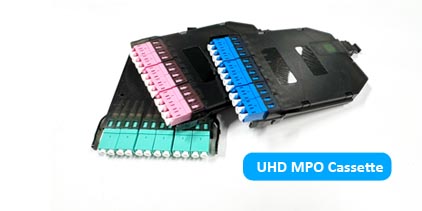
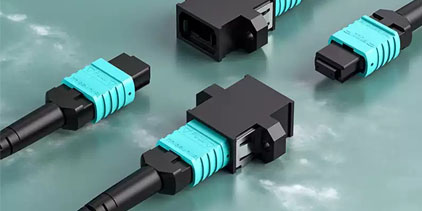
The core value of MPO MTP Cassette lies in its “high density” and “plug and play” capabilities. It is mainly used to interconnect and branch between backbone high core MPO cables and server/switch standard duplex LC/SC interfaces. Yingda can provide various MPO cassette types including 8 fiber cassette mpo, 12 fiber mpo cassette, mtp 16 cassette, 24 fiber mtp cassette, etc.
In such common MPO/MTP breakout boxes, we also noticed that regardless of its external shape, a module usually comes with regular single core connectors in front and MPO connectors at back, and the commonly used ones are one 12 core or two 12 core MPO/MTP connectors, not one 24 core MPO/MTP connector. Why is that?
Advantages of BASE-12 architecture
From the article “Why does a 24 Fiber MPO Cassette use 2x MPO-12 adapters instead of 1x MPO-24 adapter“, we can see that due to the Base-12 architecture being the most traditional and widely used cardinality standard in structured cabling for data centers, the core interfaces of all MPO trunk cables, MPO cassette modules, and MPO patch cords are designed and combined based on multiples of 12 cores (such as 12 cores, 24 cores, 48 cores to 144 cores). Although using only 8 cores in 40G/100G (SR4) business may result in 4 cores being idle, it is still the mainstream choice for enterprise level data centers and structured cabling due to its large existing installation base. Its main advantages are presented in the following aspects:
- MPO-12 technology is mature and has a large output, so the cost is lower.
- Single row 12 core grinding and alignment accuracy are high, and the fiber yield of low loss (Elite level) products is extremely high.
- The majority of existing conventional testers (such as Fluke MPO test modules) and one click cleaning pens are native to MPO-12.
- If one of the 2xMPO-12 backbone optical cables is damaged, the other can operate normally without affecting the overall link.
- 2xMPO-12 can connect backbone optical cables from two different regions or cabinets.
- The Base-12 structure can also be smoothly upgraded to high-speed networks such as 40G/100G/300G/400G without the need to replace modules.
The Guide to MPO/MTP Polarity: Eliminating Human Error
In fiber optic networking, the fundamental rule is simple: the transmitter (Tx) at one end must connect to the receiver (Rx) at the other. However, when dealing with arrays of 12 or 24 fibers inside a single high-density MPO/MTP cassettes module, managing this alignment becomes incredibly complex. If the internal fiber mapping is incorrect, you risk link failure or, worse, damaging expensive active equipment.
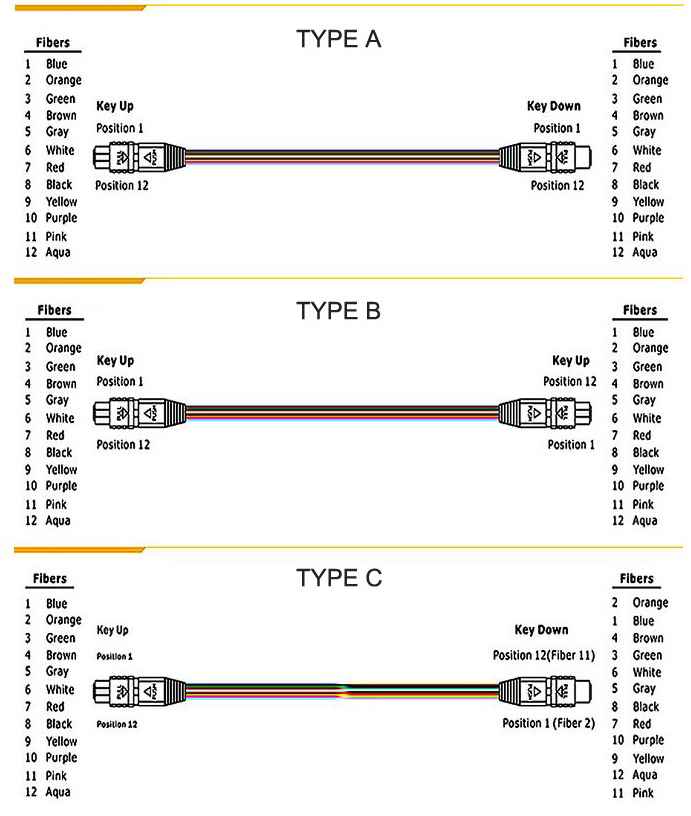
To maintain perfect alignment throughout your backbone, the industry defines three standard polarity methods—Method A, Method B, and C. Here is how they work in real-world deployments:
- Method A (Straight-Through): This method uses a 1-to-1 pin mapping. Fiber 1 arrives at Fiber 1 at the opposite end. It utilizes Key-Up to Key-Down adapters. While the trunk cable is simple, it requires different patch cords on each end (A-to-A on one side, A-to-B on the other) to complete the Tx/Rx flip.
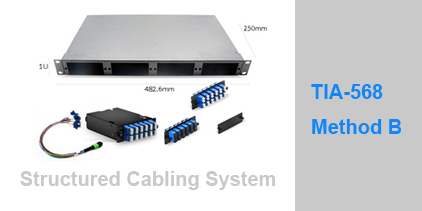
- Method B (Fully Reversed): This method flips the fiber sequence entirely. Fiber 1 connects to Fiber 12, and Fiber 2 connects to Fiber 11. It uses Key-Up to Key-Up adapters. Method B is highly recommended for direct 40G/100G/400G single-mode links because it allows identical, standard A-to-B patch cords to be used on both ends of the channel, drastically simplifying field installation.
- Method C (Pairs Flipped): This method flips adjacent pairs of fibers (1-to-2, 2-to-1, 3-to-4, 4-to-3). It mimics traditional duplex patch cords and is commonly found in legacy 10G/25G enterprise campus networks. However, it is less ideal for seamless scaling to higher parallel optics like 400G.
⚠️ To simplify your procurement process, you can use our dynamic questionnaire on our dedicated MPO MTP cassette module page to auto-match your network polarity.
Understanding Male vs. Female Alignment Pins
Beyond line sequence, the physical alignment gender is where most on-site deployment errors occur. MPO/MTP connectors require one side to be Male (with alignment guide pins) and the other to be Female (with alignment holes).
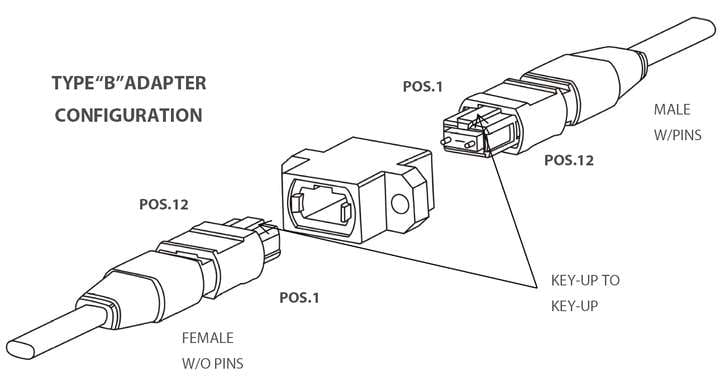
As a manufacturer standard, Yingda pre-configures our pre-terminated MPO cassette modules with Male ports on the rear. This aligns perfectly with standard backbone trunk cables, which are typically Female. By locking this configuration down at our factory and verifying it via automated testing, we remove the guesswork from your site technicians, ensuring a true plug-and-play installation.

Conclusion
Intelligent network, physics comes first. The Base-12 architecture has long dominated due to its large installed base and extremely high stability. Practice has proven that using 2x MPO-12 instead of a single MPO-24 in a 24 core MPO cassette module box is the best balance between performance and cost – it achieves lower three-dimensional interference test insertion loss (Elite loss ≤ 0.35dB) and extremely low tool ecosystem cost, in exchange for redundant rigidity with halved fault radius and physical routing flexibility across cabinets. Through 100% polarity locking and precise male and female alignment at the factory, MPO MTP cassette have successfully transformed the complex risks of on-site welding into a plug and play experience with zero configuration and zero failure.
⚠️ Proper polarity management is the foundation of network scalability. Learn how this applies to real-world infrastructure in our guide to migrating from 10G to 100G networks.