Skip to content
The PIN photodiode and APD (avalanche photodiode) detector of the optical module are the core components of the optical communication receiver (ROSA) that convert optical signals into electrical signals. PIN has a simple structure and stable performance, suitable for high-power short distance transmission; APD has high sensitivity and is suitable for long-distance or high loss weak light detection through an internal gain mechanism. Hereafter is their specific analysis:
PIN Photodiode
Structure and principle: P-type, I-type (intrinsic layer), and N-type three-layer structure. The incident light generates a photocurrent in the I layer.
Features:
- No internal gain: Good linearity of photoelectric conversion.
- Low noise, low power consumption: Due to its simple structure, good temperature adaptability, and low operating voltage.
- Fast response speed: suitable for high-speed communication over medium to short distances.
Applicable scenarios: PIN detector is suitable for short distance and high-speed transmission scenarios, such as gigabit and ten gigabit optical modules, data centers, and short-range optical access networks.

APD (Avalanche Photodiode)
Structure and principle: On the basis of PIN structure, an “avalanche multiplication zone” is added to achieve electron avalanche multiplication under high reverse bias, providing 10-100 times internal gain. The specific explanation is that PIN is like a regular solar panel, producing as much electricity as the light shines. Inside APD, there is a high-voltage electric field. When photons enter and generate electrons, due to the extremely strong electric field, these electrons will snowball and collide with more electrons. This allows it to sense extremely weak light signals.
Features:
- High sensitivity: capable of detecting weak optical signals, significantly extending transmission distance.
- High gain: amplifies the signal beyond thermal noise, suitable for weak light detection.
- High complexity: requires high voltage operation and is extremely sensitive to temperature, usually requiring temperature compensation circuits.
Applicable scenarios: APD photon detector are suitable for ultra long distance transmission, high-speed optical access networks, reception after fiber amplifiers, high loss environments (such as OLT end in FTTH).
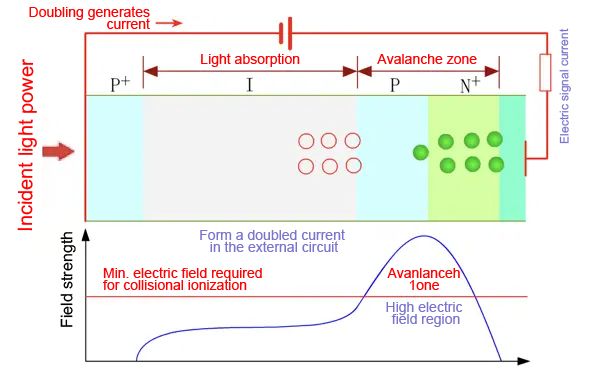
The Difference Between PIN and APD
Directly speaking, the core difference between PIN and APD lies in their receiving sensitivity. Simply put, PIN is a “regular microphone”, while APD is a “microphone with built-in amplification function”.
- PIN has a simple structure and stable performance, suitable for high-power short distance transmission;
- APD has high sensitivity and is suitable for long-distance or high loss weak light detection through an internal gain mechanism.
| Item | PIN (ordinary detector) | APD (Avalanche Detector) |
| Full name | Positive-Intrinsic-Negative | Avalanche Photodiode Detector |
| Amplification factor (internal gain) | 1: 1 (One photon to one electron) | 1: M (One photon triggers an avalanche to produce multiple electrons, 10-1000 times) |
| Working Voltage | Low (a few volts) | High (tens to hundreds of volts) |
| Receiver sensitivity | Lower (usually within -20dBm) | Extremely high (5-10dB higher than PIN) |
| Noise | Low | Higher (multiplicative noise) |
| Transmission distance | Short/medium distance (<40km) | Long distance (≥ 40km, such as ER/Zr) |
| Temperature stability | Good | Poor (requires temperature compensation) |
| Cost/Price | Cheap | Expensive (complex process) |
| Tolerance | Strong and not easily burned | Very fragile (easily burned by strong light) |
How to Choose PIN or APD Detector?
The transmission distance is the watershed that determines which detector to use. Usually divided by 40 km, PIN is used for short distances and APD is used for long distances.
- Transmission distance <40km: PIN detector, due to its short transmission distance and strong enough light, does not require additional amplification.
- Transmission distance ≥40km: APD photon detector, due to the long distance of several tens of kilometers, the light becomes very weak, and it is necessary to use APD, a “high-sensitivity capture device”, to read the data and ensure the bit error rate.
YINGDA has compiled a list of optical module models using PIN and APD detectors for easy comparison and analysis.
PIN detector module (short-medium distance)
| 10G SFP+ Series: 10GBASE-SR (300m,MMF) 10GBASE-LRM(220m,MMF) 10GBASE-LR (10km,SMF) | 25G / 40G / 100G Series: SR4 / SR10 (short distance, MMF) LR4 / CWDM4 (2km / 10km, SMF) | BiDi Series: 10km/20km Single Fiber Bidirectional transceiver |
APD detector module (Long distance)
| 10G SFP+ Series: 10GBASE-ER (40km) 10GBASE-ZR (80km) 10G SFP+ 60KM / 100KM (Non standard long-distance module) | 25G / 100G Series: 100G ER4 / ZR4 (40km-80km) 25G ER (40km) | PON network (FTTH): The module at the OLT end (in order to cover up to 32 or 64 users and ensure 20 km optical transmission, APD must be used) |
Key reminder
Judgment criteria: Refer to the “Receiver Sensitivity” section in the instruction manual.
- If the value is around -14dBm to -18dBm, it is usually a PIN.
- If the value is around -23dBm to -30dBm, it is definitely APD.
Operation taboos: Due to the extremely sensitive nature of APD, if you use a short patch cord to directly connect two ultra long distance modules (such as an 80km module), APD will be instantly overloaded and permanently physically damaged. Long distance modules must be equipped with 10dB-15dB optical attenuators during testing.
Conclusion
If the total loss of your link is high (fiber length, many solder joints), APD is the only option; If it’s just internal interconnection within the computer room, PIN is cost-effective.
The above models are for reference only. If there are any differences, please make a specific analysis based on the actual situation. For example: why do some SFP-10G-ER 40KM optical modules use PIN detectors?