Skip to content
10GBASE-ZR, 10G CWDM-SFP 80km, SFP+ DWDM 80km, and SFP+ 10G BIDI 80km are all 10Gb single mode SFP modules with a transmission distance of 80km. They use EML electro absorption modulation lasers and jointly comply with the IEEE 802.3ae standard and related MSA multi-source protocols. Except for some bands of BIDI, they mostly operate around 1550nm (C band) where fiber loss is minimized. The attenuation rate of optical signals in this band is extremely low (about 0.2dB/km) in optical fibers, which is the physical basis for achieving 80km transmission.
In addition, all four modules support DDM (Digital Diagnostic Monitoring) function, and users can view the real-time transmission/reception optical power, temperature, working current, and voltage in the switch background.
It is worth noting that in order to run 80km, the transmission power of these SFP modules is very strong. If conducting short distance testing (such as laboratory docking, with a distance of less than 20km), a 10dB-15dB optical attenuator must be added at the receiving end. Because if the attenuator is not added and directly connected, strong light will instantly burn out the receiver of the opposite module.
Brief Overview of Four Module Types:
10GBASE-ZR (Standard Long-Reach)
- Features: The most basic 80km module.
- Principle: Utilizes a single 1550nm wavelength.
- Advantages: Mature technology and relatively low cost.
- Disadvantages: A single pair of fibers can only carry 10G traffic, offering no capacity for expansion.
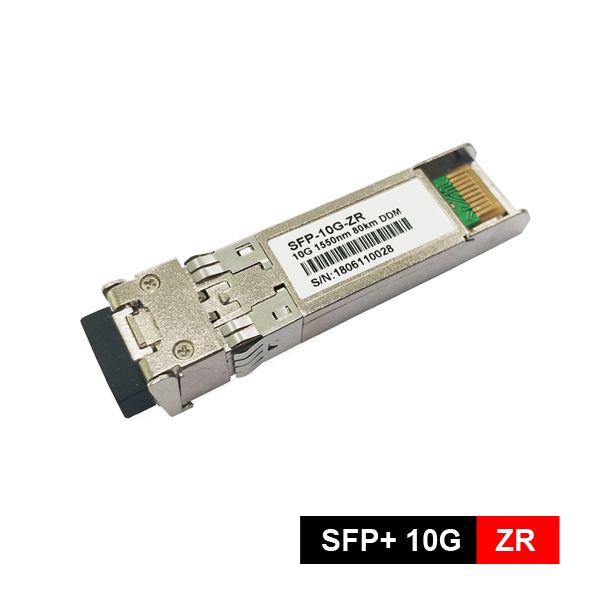
10GBASE-ZR (Standard Long-Reach)
- Features: The most basic 80km module.
- Principle: Utilizes a single 1550nm wavelength.
- Advantages: Mature technology and relatively low cost.
- Disadvantages: A single pair of fibers can only carry 10G traffic, offering no capacity for expansion.
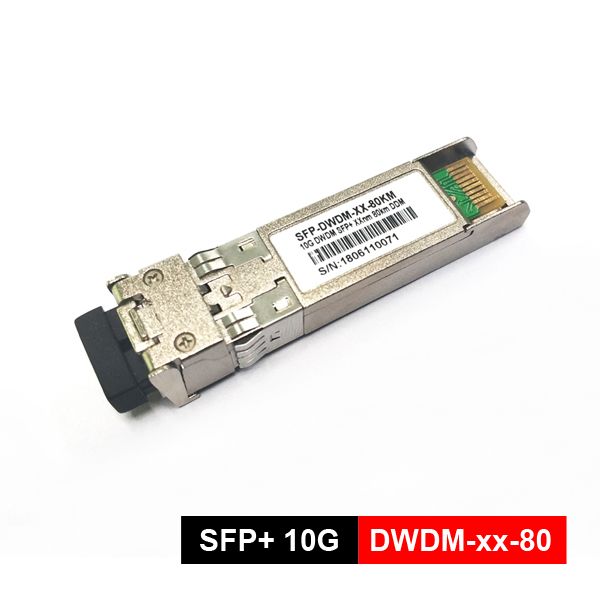
SFP+ DWDM 80km (Dense Wavelength Division Multiplexing)
- Features: Extremely narrow wavelength spacing (0.8 nm).
- Principle: Operates within the C-band, utilizing highly dense wavelengths.
- Advantages: Offers the greatest capacity expansion potential, supporting 40–96 wavelengths or even more.
- Disadvantages: Highest cost, imposes stringent requirements on environmental conditions and equipment precision.
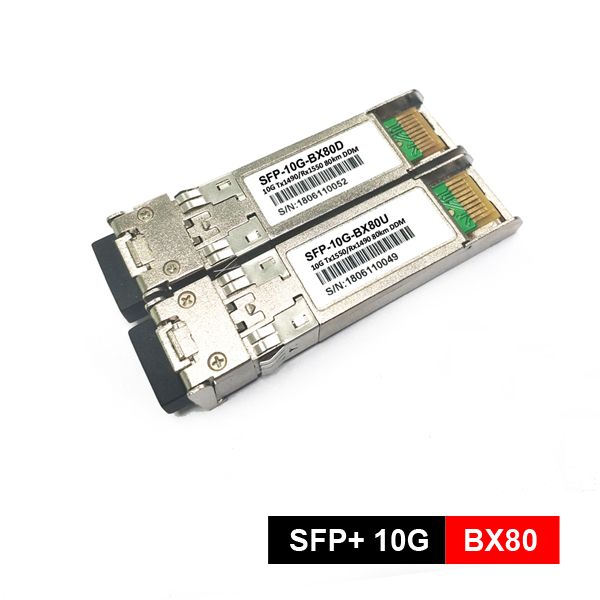
SFP+ 10G BiDi Transceiver (Single-Fiber Bidirectional)
- Note: Must be used in pairs (if Side A transmits at 1270nm, Side B must transmit at 1330nm).
- Feature: Enables bidirectional transmission over a single optical fiber.
- Principle: Transmission and reception utilize different wavelengths (e.g., TX 1270nm/RX 1330nm, TX 1490nm/RX 1550nm).
- Advantage: Directly reduces physical fiber cabling costs by half.
Four Types of Module Difference
The primary distinctions among these four module types lie in their wavelength allocation, transmission capacity, and fiber utilization efficiency, and their approaches to solving problems differ significantly.
Simply put, 10GBASE-ZR serves as a foundational single-wavelength solution; BIDI-80 utilizes single-fiber bidirectional technology to reduce fiber usage by half; while CWDM-80 and DWDM-80 dramatically boost fiber transmission capacity by multiplexing multiple distinct wavelengths onto a single fiber. The key difference between the latter two solutions lies in the number of channels they can support and their respective costs.
| Item | 10G BASE ZR | SFP+ 10G BIDI-80 | 10G CWDM SFP 80KM | SFP+ DWDM 80km |
| Core Technology | Standard Long-Distance Transmission | Single-Fiber Bidirectional (BiDi) | Coarse Wavelength Division Multiplexing (CWDM) | Dense Wavelength Division Multiplexing (DWDM) |
| Operating Wavelength | Fixed 1550 nm | TX/RX utilizes a pair of wavelengths (e.g., 1490nm/1550nm) | 1270–1610 nm, 18 wavelengths; features multiple discrete wavelengths with wide channel spacing (20 nm) | C-Band (approx. 1528–1560 nm); features multiple dense wavelengths with extremely narrow channel spacing (e.g., 0.8 nm / 0.4 nm) |
| Typical Range | 80 km | 80 km | 80 km | 80 km |
| Required Fiber | 2-Fiber (1 Tx, 1 Rx) | 1 Core (Single-fiber bidirectional; must be used in pairs) | 2 fibers (capable of carrying up to 18 service channels) | 2 Fibers (capable of carrying up to 40, or even 80, service channels) |
| Key Advantages | Standardized, Lowest Cost | Conserves fiber resources | Enables cost-effective, substantial capacity expansion; conserves fiber resources; requires no cooling | Massive capacity expansion, ultra-high channel density, and support for ultra-long-distance transmission |
| Applicable Scenarios | Simple Point-to-Point Long-Distance Connection | Suitable for Metropolitan Area Networks (MANs) and Access Networks with limited fiber resources | Suitable for Metropolitan Area Networks (MANs) and Enterprise Networks with moderate capacity requirements | High-capacity scenarios, such as backbone networks and data center interconnects (DCIs) |
Important Note: The model suffix “-80” you mentioned is, strictly speaking, not part of the 10GBASE-ZR specification. The ZR standard itself already defines an 80-kilometer range; this designation originated from a proprietary Cisco standard. When purchasing modules, the actual transmission distance should be determined solely by the product’s technical specifications.
Selection Recommendations
You may make your selection based on your specific requirements by following these guidelines:
| Project Case | Best choice |
| I want to set up a simple 80 km point-to-point link, with cost-effectiveness as my top priority | Choose 10GBASE-ZR. |
| I have an 80 km connectivity requirement, but fiber resources are scarce—leasing fiber is too expensive—and I want to maximize the utilization of my existing fiber infrastructure. | Choose SFP+ 10G BIDI-80. If you need to expand the capacity of multiple links, consider the options listed below. |
| I need to expand network capacity between two sites; the number of links required is no more than 18, and I have a limited budget. | Choose 10G CWDM SFP 80KM; it also offers very low power consumption. |
| I am currently building out a backbone network or a large-scale data center interconnection, and I require ultra-high bandwidth and massive channel capacity. | Choose SFP+ DWDM 80km. |
Consider Compatibility
Beyond technical specifications, it is typically necessary to consider compatibility with existing vendors. Optical modules must be correctly recognized by devices such as switches and routers.
Currently, some equipment from major vendors (such as Cisco, Huawei, etc.) is certified to work only with modules listed in their official catalogs or compatibility lists. Consequently, you will typically encounter the following options:
- Original Modules: These offer guaranteed quality and compatibility, but come at a higher price point.
- Compatible Modules: Produced by third-party manufacturers like Yingda, thus modules achieve compatibility by emulating the coding of original modules. The SFP 10GBE modules by yingda are cost-effective, please inform us your brand of switch, server, internet card, then we can ensure it is compatible with your equipment.