Skip to content
Three lasers of DFB, DML, and EML for fiber optic transceiver do not represent mutually exclusive categories; rather, there is an overlap among them. DFB refers to a specific structural design—characterized by an internal grating that enables the stable output of a single wavelength—whereas DML EML lasers refers to two distinct modes of operation: DML is direct current modulation, and EML is an external modulator.
Their relationship between DFB, DML and EML are as follows: a laser built with a DFB structure can operate in the DML mode, or it can serve as the light source component within an EML system.
Here are their most intuitive differences:
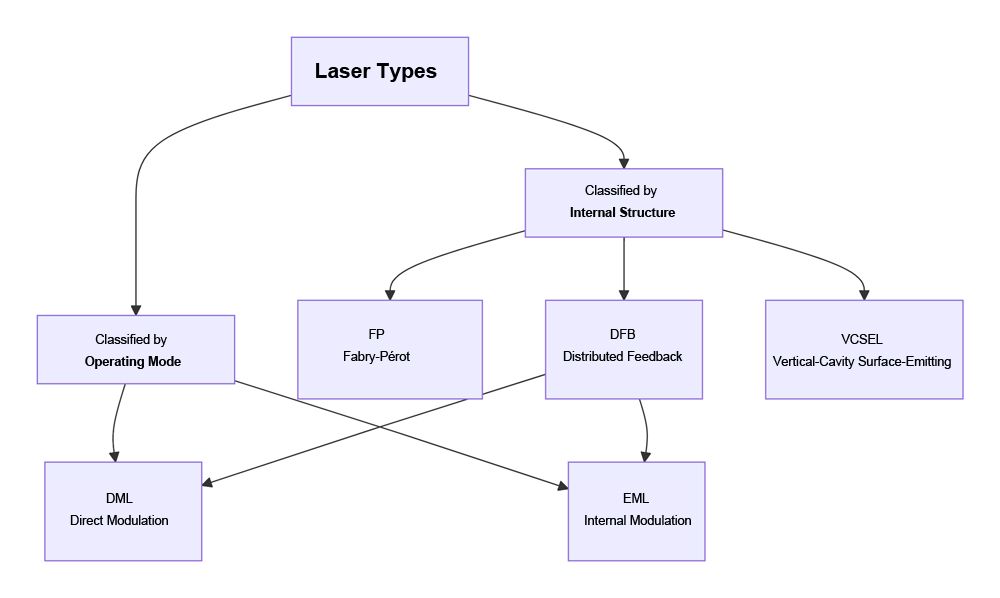
Features and Performance Comparison DFB vs DML vs EML Laser
DFB (Distributed Feedback Laser):
The core of DFB laser is engraved with a “grating” on the chip, like a precise filter that only allows stable wavelength output.
- The biggest advantage: DFB laser is excellent wavelength stability and narrow spectral lines, which are the basis for achieving wavelength division multiplexing (CWDM/DWDM).
- Character: It is an excellent “wick” that provides pure light. But how it “blinks” (whether it is a direct switch or an external switch) determines whether it is DML or EML.
DML (Directly Modulated Laser):
DML is a working mode that directly applies data current signals to the laser, with high current representing light intensity (1) and low current representing light intensity (0).
- The biggest advantage: simple structure, low cost, and low power consumption.
- The biggest disadvantage: When switching at high speed, the wavelength of light will be unstable, resulting in chirp effects. This leads to signal distortion during high-speed (such as 50G or above) or long-distance transmission.
EML (Electro-absorption Modulated Laser):
EML is an integrated component of “laser+modulator”. The DFB laser is responsible for continuously and stably emitting light, while the preceding electroabsorption modulator (EAM) acts as a high-speed shutter, responsible for the passage or non passage of light and generating signals. The laser itself never shuts off.
- The biggest advantage: There is almost no chirp effect, the signal quality is extremely high, and it supports ultra high speed (single wave 100G or more) and long-distance transmission.
- The biggest disadvantage: EML laser is complex structure, high cost, and relatively high power consumption.
Technical Parameters and Performance of Three Lasers
| Laser type | DFB (as a light source) | DML (Working Mode) | EML (working mode) |
| Core structure | Built in wavelength grating | Directly modulating current | DFB+electroabsorbent modulator |
| Working method | Constant brightness or direct modulation | Current directly changes light intensity | Constant brightness, external shutter modulation |
| Chirp effect | None (as a light source) | Major (major drawback) | minimal |
| Output optical power | High (10-20mW) | moderate | moderate |
| Modulation rate | Up to 25G (NRZ) | 25G/50G (PAM4) commercial | 100G (PAM4) commercial |
| Transmission distance | Depending on the modulation method | ≤20km (usually 10-15km) | ≤80km |
| Cost/power consumption | middle | low | tall |
Why are three lasers easily confused?
This is precisely the key to the problem. The term ‘DFB laser’ is often used in the market, but the actual product may be:
- DFB laser (chip bare chip): refers to the semiconductor chip itself engraved with a grating. It cannot work on its own and needs to be encapsulated as a TOSA (Light Emitting Component).
- DFB+Direct Modulation (DML): Load data current directly onto the DFB chip. This is the most common and standard “DFB optical module”, such as most 25G 10km and 100G CWDM4 modules.
- DFB+external modulation (i.e. EML): Integrate and package DFB chip with EAM modulator. This type of module manufacturer usually clearly labels it as EML instead of just saying “DFB”.
Conclusion
When you hear ‘DFB’, you can understand that it is the structural foundation of a high-performance laser, while DML and EML are two specific methods for generating signals using it, DML laser is simple and inexpensive (for short distances), and EML laser is complex and excellent (for long-distance and high-speed).
FAQ
Which laser is mainstream in SFP+ transceiver module?
For sfp+ transceiver modules, VCSEL is used for short distances (<300 meters) to achieve the ultimate cost and power consumption; Beyond 2 km, DFB/DML is the absolute mainstay covering almost all mainstream scenarios from parks to urban areas. Only in a few ultra long haul PON applications that require extreme performance, will the EML solution be adopted at any cost.
Which laser is the mainstream in the 25Gbps SFP modules?
For 25Gbps SFP modules, VCSEL is the main focus within 200m. DML (based on DFB) has the highest cost-effectiveness for 10-40 km. For distances of 80 km and above, EML is required to ensure performance.
Which laser is mainstream in 40G SFP+?
For 40G SFP+ optical modules, VCSEL dominates short distances within 100 m, while DFB (and its direct modulation form DML) has become the only choice for all mainstream standards (such as LR4, ER4, PSM4) within distances of 100 m to 40 km due to its extremely high cost-effectiveness.
Which laser is mainstream in a 100Gig SFP module?
For 100Gig SFP module, VCSEL dominates the multi-mode short-range within 100 m, DML becomes the king of 2km mid-range transmission with unparalleled cost-effectiveness, and EML firmly holds the long-distance market of 10 km and above with the strongest performance.
Which laser is the mainstream in the 200Gbe transceiver?
VCSEL lasers are the absolute mainstream for 200Gbe transceivers within 100m; For 2-10 km, choose DML (25G DFB+PAM4) for cost-effectiveness, and CW-DFB laser for performance and integration; For distances over 10 km, EML laser must be used. Compared with the 100G era, EML’s position in the 200G long-distance scene is more stable, and silicon photonics solutions are also beginning to compete with DML in the mid-range market.
Which laser is the mainstream in the 400Gb SFP module?
The EML and silicon photonics scheme (CW-DFB) are complementary rather than substitutive in the 400Gb SFP era. Long distance (over 2km) and high reliability transmission are required: EML scheme is a more reliable and mainstream choice. Pursuing high cost-effectiveness and high integration over medium to short distances (500m-2km): Silicon photonics solutions (CW-DFB) are becoming the preferred choice for more and more manufacturers.
Which laser is the mainstream in the 800Gbps transceiver?
For 800Gbps transceiver, EML (Electro Absorption Modulation Laser) is still the most mature mainstream solution, but the silicon optical solution (using high-power CW-DFB as an external light source) is rapidly rising and is expected to become the market leader by 2026.