Skip to content
Based on transmission distance and cost requirements, the primary cabling methods for SFP 25G bps optical modules are divided into two categories:
short-distance direct connections (DAC network cable or SFP+ AOC cable) and medium-to-long-distance fiber interconnections (optical modules + optical fiber cables).
SFP+ 25Gbps Cabling Options
In practical applications, the choice of solution depends primarily on transmission distance, budget, and cabling density. The table below provides a quick overview of the positioning of the various solutions:
| Cabling methods | Detailed Plan | Max transmission distance | Core Features | Application |
| Copper Cabling Solution | DAC Network Cables | 1–7 m | Lowest cost, zero power consumption, and plug-and-play functionality. | The preferred choice for interconnecting in-rack servers with ToR switches. |
| Fiber Optic Cabling Solution (Short-Distance) | SFP+ AOC Cables | 7–100 m | Lighter and more flexible than DACs, offering longer transmission distances. | Interconnections between adjacent racks. |
| 25Gbase SR SFP module + LC Duplex Multimode Fiber Patch Cords | Within 100 m ; within 300 ~400 m (ESR) (OM3/OM4) | Standard short-range optical module solution with stable performance. | Used for connecting ToR switches within the same equipment room, or for connections between different cabinets. | |
| Fiber Optic Cabling Solution (Long-Distance) | SFP28 LR Modules + LC Duplex Singlemode Fiber Patch Cords | 10 km | Standard long-range solution, widely adopted across various applications. | Used for inter-building or campus network connections. |
| ER Optical Modules + LC Duplex Singlemode Fiber Patch Cords | 40 km | Enhanced long-range solution. | Used for extending Metropolitan Area Networks (MANs) or backbone networks over longer distances. | |
| BiDi Optical Modules + LC Singlemode Fiber Patch Cords | 10–20 km | Enables bidirectional transmission and reception over a single optical fiber, effectively saving half of the fiber cabling. | Suitable for scenarios where fiber optic resources are scarce. | |
| Architecture Upgrade Plan | 100G QSFP28 to 4x25G SFP28 | Depends on the optical module | Utilizes breakout cables to split a single 100G port into four 25G ports. | Used for the smooth evolution from 25G to 100G. |
Overview of Main Cabling Solutions
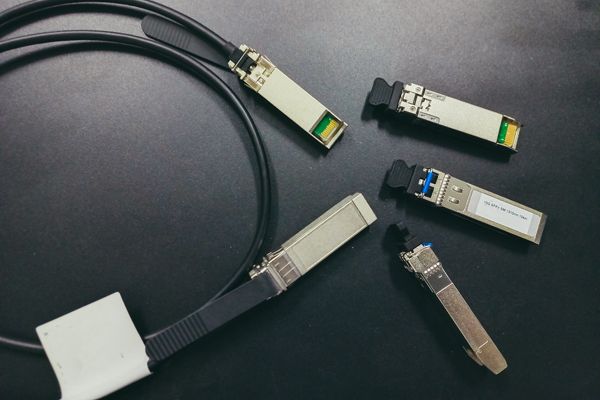
Copper Cabling Solution: DAC network cables
- Connection Distance: Up to 5–7 meters.
- Why Choose It: This is the most cost-effective solution for short-distance connections. Resembling a standard network cable, it features integrated SFP28 connectors at both ends and consumes no power for optical-to-electrical conversion.
- Typical Scenario: Within a single cabinet, server network interface cards (NICs) connect directly to the top-of-rack (ToR) switch.
Fiber Optic Cabling Solution: Comprehensive Coverage of Mainstream Distances
Based on years of practical experience, YINGDA has summarized various fiber optic cabling schemes in the table below:
| Solution | Cable / Interface Type | Key Advantages | Typical Scenarios |
| SFP+ AOC cable | Multimode Fiber cable | Softer, Lighter, and Longer than DACs | Connections between adjacent cabinets |
| SFP28 SR Optical Module + Multimode Fiber | Duplex LC | Standardized Solution with High Compatibility | Between different rows of cabinets within the same equipment room |
| SFP28 25G Base LR Optical Module + Singlemode Fiber | Duplex LC | Widely Adopted Standardized Solution | Connections between different buildings or campus networks |
| 25Gbase ER Optical Module + Singlemode Fiber | Duplex LC | Ultra-Long Reach | Metropolitan Area Networks (MAN) and remote access |
| 25G SFP28 BiDi Optical Module + Singlemode Fiber | Duplex LC | Conserves Fiber Resources | Scenarios with limited fiber availability |
- Cables and Interfaces: Multimode fiber is typically used for short-distance connections, while single-mode fiber is mandatory for long-distance links; the physical interfaces are all duplex LC connectors.
- BiDi transceiver principle: It utilizes two distinct wavelengths (e.g., TX 1270 nm / RX 1330 nm) to transmit and receive data bidirectionally over a single optical fiber, thereby reducing the required number of fibers by half.
Future-Ready Cabling for Architectural Upgrades: 100G QSFP28 to 4x SFP28 breakout
QSFP28-to-SFP breakout cabling is designed to facilitate the smooth upgrade of network architectures. By utilizing a MTP breakout cable —featuring an MPO/MTP connector at one end and four duplex LC connectors at the other—you can connect a single 100G QSFP28 port to four 25G SFP28 ports, thereby enabling a seamless transition from 25G to 100G.

How to choose SFP 25Gbps cabling methods?
Yingda suggest to select the most suitable and cost-effective solution based on your specific distance requirements and core needs:
- For distances within 7 meters, DAC network cable is the preferred choice.
- For distances between 7 and 30 meters, SFP+ AOC cable can be used.
- For longer distances, optical transceivers paired with single-mode or multi-mode fiber optic cables are required.