The application scenarios of 40Gbe QSFP Transceiver are mainly concentrated in enterprises, data centers, and network aggregation layers that have high requirements for bandwidth and port density. In scenarios where 10G is not enough, but 100G is a bit wasteful, 40G is the golden choice.
The following are the main application scenarios of 40Gbe QSFP Transceiver:
Internal Data Center: Switch Interconnection and Server Access
This is the main application market for 40Gbe QSFP Transceiver. In cloud service providers and large enterprises’ self built data centers:
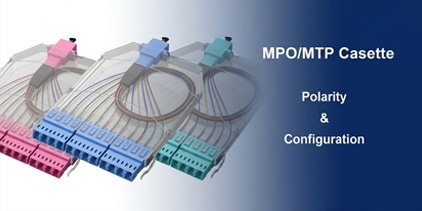
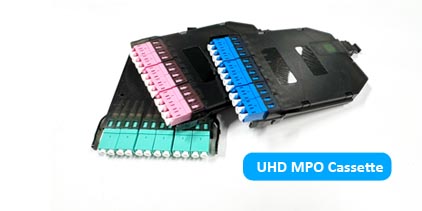
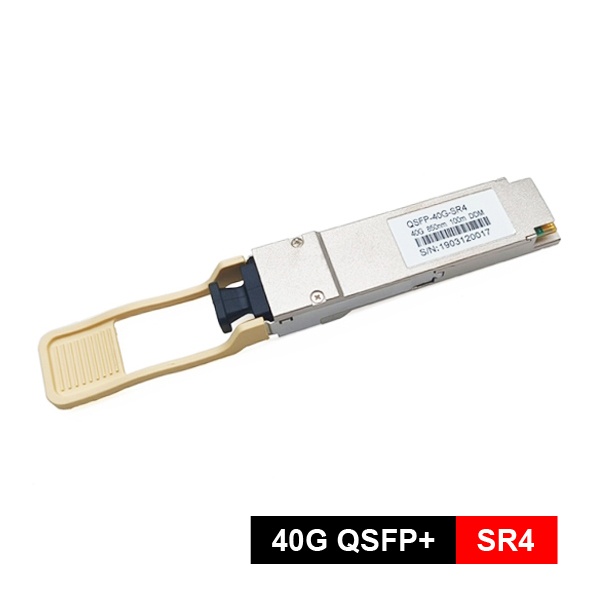
- ToR switch uplink: The 48 port 10G switch on the top of the cabinet (connecting to the server) needs to be connected upstream to higher aggregation or core switches through several 40G ports. Usually, 40G SR4 or eSR4 is used here, paired with MPO om3 om4 patch cords, with a transmission distance of generally 100-400 meters.
- Spine Leaf architecture: In a two-layer spine network, a large number of 40G/100G links are required between Leaf switches and Spine switches. 40Gbe QSFP Transceivers are used to construct this non blocking, low latency switching matrix.
- Computing and storage cluster: High performance computing (HPC), distributed storage (such as Ceph) backend network, requiring 40G bandwidth between nodes to reduce data I/O bottlenecks.
Campus Network Aggregation and Core Layer
In the campus networks of enterprises, universities, and governments, when access layer switches (aggregating a large number of gigabit/ten gigabit users) need to connect upwards:
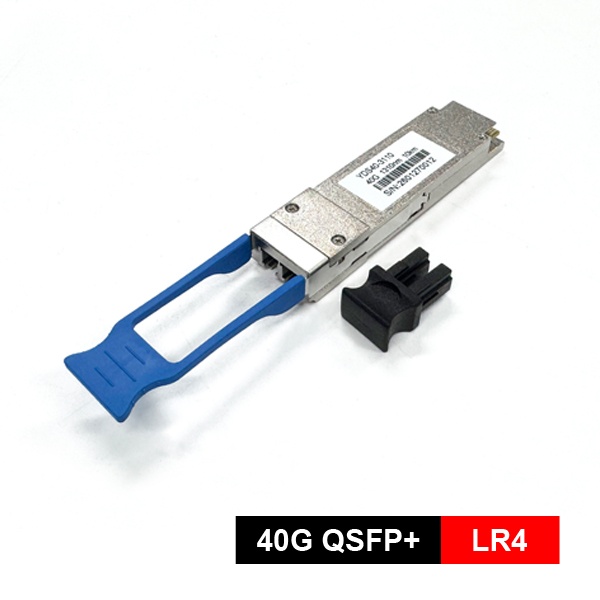
- Building aggregation to core switch: The aggregation switch in Building A is connected to the core switch in Building B through a 40G link. The distance is usually within 2 km, commonly using QSFP 40G PSM4, 40G QSFP LR4 S (2km) or QSFP LR4 10km single-mode modules.
- Dense user scenarios: such as university libraries, large office areas, where a large number of users are simultaneously conducting online video conferences or transferring large files, the upstream of the aggregation switch must use 40G to avoid congestion.
High Performance Computing (HPC) and Research Networks
- High speed interconnection between nodes: In scenarios such as meteorological simulation, gene sequencing, and physical simulation, dozens or even thousands of servers require parallel computing. 40G InfiniBand or Ethernet optical transceivers are used to connect computing nodes and reduce MPI (Message Passing Interface) communication latency.
- Distributed storage network: Storage protocols such as NVMe over Fabrics require low latency and high bandwidth, and 40Gbe QSFP transceiver can connect storage controllers and computing nodes.
Video Transmission and Broadcasting Production
- 4K/8K uncompressed video: One uncompressed 4K video requires approximately 12G bandwidth, and a 40G link can simultaneously transmit multiple 4K or one 8K videos, in conjunction with specialized SDI over IP devices.
- Live broadcasting vehicle: The baseband video matrix inside the broadcasting vehicle is developing towards IP, and 40G switches are used to connect the IP gateway, switching station, and recording server of the camera.
Testing and Measuring Equipment
- Network tester: When manufacturers produce or test 40G switches, routers, and network cards, they use 40Gbe QSFP transceiver to connect the devices to the optical ports of testers such as Spirent and IXIA for traffic generation and analysis.
- Protocol analyzer: used to capture data packets on 40G links for monitoring and troubleshooting.
Traditional Operators’ Metropolitan Area Edge Networks
- Base Station Backhaul Aggregation: Although 5G fronthaul is 25G, some 4G upgrades or edge computing sites still use 40G (e.g., 40G ER4, 40km) in their aggregation layer to connect multiple base station gateways within the area.
- Enterprise and Government Leased Line Access: Providing 40G-level point-to-point access for users such as banks and stock exchanges that require high-bandwidth leased lines.
Application Reference Table for 40Gbe QSFP Transceiver
| Typical Scenarios | Common QSFP transceiver types | Typical distance | Fiber type |
| Inside/Adjacent racks in a data center | 40G QSFP SR4, eSR4 | 100m – 400m | Multimode fiber (OM3/OM4) |
| Data center utilizing legacy 10G cabling | 40G QSFP+ SR-BD | 100m – 150m | Multimode Duplex LC interface |
| Between buildings in a campus (<2km) | 40G QSFP+ LR4 S, 40G QSFP+ PSM4 | 2km | Single-mode fiber |
| Large campus span (10km) | 40G QSFP+ LX4/LR4 | 10km | Single-mode fiber |
| Metropolitan area edge (40km) | 40G QSFP+ ER4 | 40km | Single-mode fiber |
| HPC/Storage clusters | 40G QSFP+ SR4 / Dedicated IB Cable | Tens of meters to hundreds of meters | Multimode fiber / Active Optical Cable |
The Status and Evolution of 40G
- Clear Niche: While 100G is now widespread within data centers, 40G still offers advantages in cost and port density. For small to medium-sized networks that don’t require an upgrade to 100G, 40G remains a cost-effective choice.
- Backward Compatibility: A single 40G port can connect to four 10G ports via a 1-to-4 breakout cable (such as an MPO to 4xLC or a 1-to-4 DAC 40G direct attach copper cable), which is highly practical in scenarios involving mixed-rate upgrades.
Conclusion
If you see a large number of servers needing to connect to a 10 Gigabit network, or if buildings in the park need to connect to a 2 kilometer upstream bandwidth of over 20 Gigabit (20G), then a 40Gbe QSFP transceiver is a natural option.
After understanding these main scenarios, if you want to determine whether your specific environment really needs to use 40G, or consider whether to directly switch to a higher speed 100G.