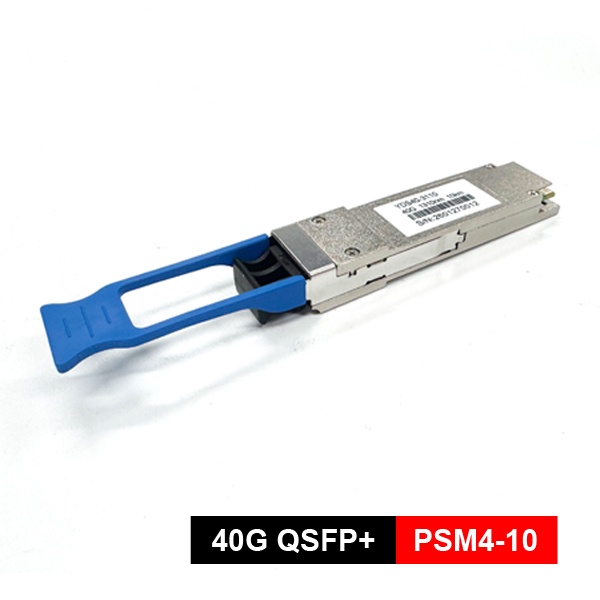
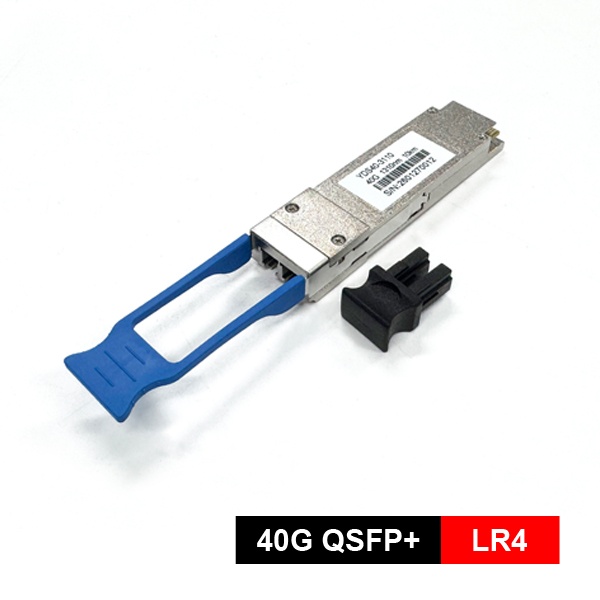
QSFP 40GBASE PSM4 (parallel single-mode) and QSFP 40GBASE LR4 (wavelength division multiplexing long-distance) are two types of 40G SFP+ modules that can achieve 10 km transmission, but they have essential differences in technical principles, fiber usage, interface types, and upgrade paths. The following is a detailed comparative analysis:
| Item | QSFP 40GBASE PSM4 | QSFP 40GBASE LR4 |
| Technical principle | Parallel transmission: 4 independent channels, each using a pair of optical fibers | Wavelength Division Multiplexing (WDM): Four wavelengths are multiplexed on one fiber |
| Interface type | MPO-12 (12 core MTP/MPO connector) | Duplex LC (standard LC connector) |
| Number of optical fibers | 8-core single-mode fiber (4 transmitter and 4 receiver) | 2-core single-mode fiber (1 transmitter and 1 receiver) |
| Operating wavelength | 1310nm (4-channel at the same wavelength) | 1271/1291/1311/1331nm (4 CWDM wavelengths) |
| Transmission distance | 2km(IR4)/ 10km(LR4) | 2km (Lite)/10km (Standard)/20km (Enhanced) |
| Power consumption | <2.5W | <2.5W |
| Laser type | 4 x 1310nm DML/DFB laser | 4 x CWDM DFB laser (uncooled) |
| Fiber optic adapter | MPO adapter | LC Duplex Adapter |
| 4 x 10G branch capability | ✅ Support (in conjunction with branch cables) | ❌ Not supported (wavelength cannot be split) |
The working principles of the two schemes
Working principle of QSFP+ 40Gbase PSM4
40GBase PSM4 adopts parallel optical transmission technology, with four independent channels each using a pair of optical fibers:
- Transmitting end: 4 channel 10G electrical signal → 4 1310nm lasers → 4 core optical fibers simultaneous transmission
- Receiver end: 4 additional optical fibers→ 4 PIN receivers → 4 channels of 10G electrical signals
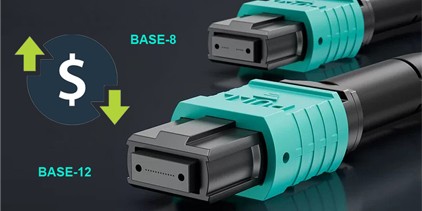
- Total number of fiber cores: 8 core single-mode fiber (BASE-8 MPO connector)
Working principle of QSFP+ 40Gbase LR4
40Gbase LR4 adopts coarse wavelength division multiplexing technology, combining four wavelengths on one fiber:
- Transmitting end: 4 channels of 10G electrical signals → 4 CWDM lasers (1271/1291/1311/1331nm) → MUX multiplexing → 1-core optical fiber
- Receiver end: 1-core fiber → DEMUX splitter → 4 PIN receivers → 4 channels of 10G electrical signals
- Total number of fiber cores: 2 core single-mode fiber (standard LC duplex interface)
Cost and deployment differences
| Item | PSM4 | LR4 |
| Module cost | Low (without MUX/DEMUX devices) | High (requiring wavelength division multiplexing/demultiplexing) |
| Wiring cost | Higher (requires 8-core MPO cabling system) | Low (2 core LC wiring, reusable 10G infrastructure) |
| Fiber utilization rate | Low (8 cores/port) | High (2-core/port) |
| Upgrade from 10G to 40G | MPO cable needs to be re laid | No need for modification, replace 10G SR/LR module directly |
Key feature comparison: 4 x 10G breakout capability
QSFP to 10G SFP+ breakout ability is one of the most important functional differences between the two transceivers.
The core reason why 40Gbase PSM4 supports breakout is that its four channels are completely independent and can be directly split into 4 pairs of LC interfaces through fanout cable, while the 4 wavelengths of 40Gbase LR4 are multiplexed together and cannot be split without adding complex equipment.
| Item | PSM4 | LR4 |
| Does it support 4 × 10G breakout | ✅ Support | ❌ Not supported |
| Implementation method | MPO → 4 x LC breakout cable | Wavelength cannot be separated |
| Application scenarios | 1 x 40G port connected to 4 x 10G devices | Can only connect point-to-point 40G |
How to choose?
In the following situations, it is recommended to choose QSFP+ 40Gbase PSM4 transceiver:
| Scene | Reason |
| Requires 4x10G breakout capability | One 40G port can connect to four 10G devices |
| New data center with MPO cabling as the main focus | QSFP+ PSM4 module has lower cost |
| MPO parallel cabling system has been deployed | Fully utilize existing infrastructure |
| Not sensitive to fiber optic resources | 8 core/port, low wiring pressure |
In the following situations, it is recommended to choose QSFP+ 40Gbase LR4 transceiver:
| Scene | Reason |
| 10G to 40G network upgrade | Reusing the existing LC cabling eliminates the need to lay new MPO cables |
| Fiber optic resources are in short supply | 2 cores/port, saving 75% fiber resources |
| Point-to-point 40G long-distance connection | Standard LC interface with strong compatibility |
| The future evolution towards 100G | Technologies such as BIDI can continue to reuse LC cabling |
Conclusion
The main difference between 40Gbase PSM4 and LR4 is that PSM4 uses 8 core fiber optic parallel transmission, supports 4 × 10G breakout, it has low module cost but high wiring cost; while 40Gbase LR4 uses 2 core fiber optic wavelength division multiplexing transmission and does not support breakout. The module cost of QSFP 40Gbase LR4 is high, but it can seamlessly multiplex 10G LC cabling systems, making it the preferred solution for 40G upgrade scenarios.