40 Gig QSFP transceiver can be docked with 10G SFP transceivers, but this has specific requirements and not all models support it.
The key to compatibility lies in the technical principles of the 40 Gig QSFP transceivers. The modules that can achieve docking are usually those that split 40G signals QSFP+ to 4 SFP+ independent 10G channels for parallel processing, that is, optical modules based on QSFP 40G to 10G parallel design.
Feasible solutions for docking
According to the different types of optical fibers and optical transceivers, there are mainly the following mature solutions:
| Solution Type | 40G side module | 10G side module | Core connector | Main scenes and distance |
| Multi mode scheme | 40G SR4 (MPO interface) | 10G SR (LC interface) | MPO to 4xLC multimode fanout cable (OM3/OM4) | Short distance |
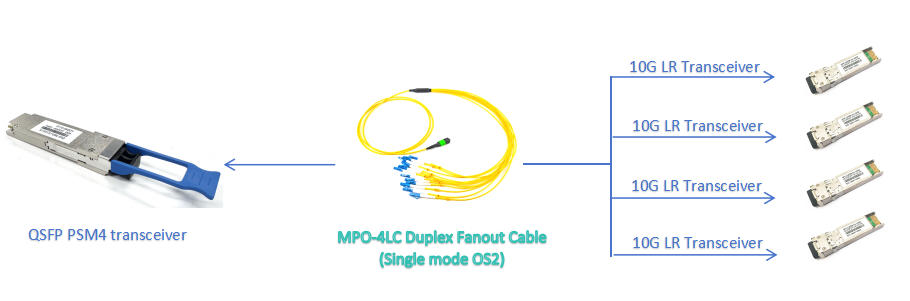
| Single mode scheme | 40G PSM4 (MPO interface) | 10G LR (LC interface) | MPO to 4xLC single mode fanout cable (OS2) | 100-150 m |
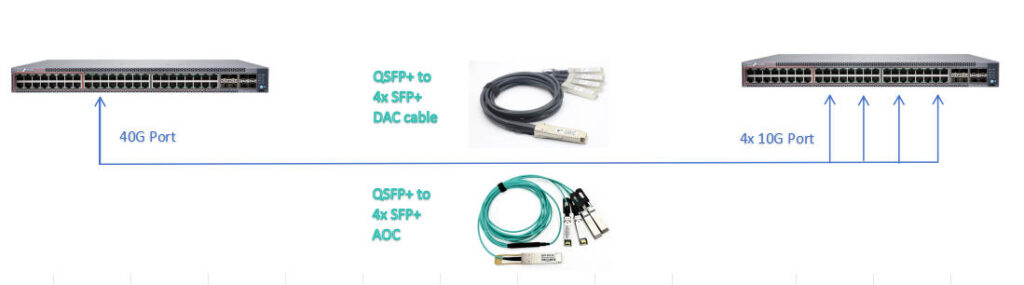
| Cable scheme | 40G QSFP+port | 10G SFP+port | High-speed QSFP to 4 SFP+ breakout cable (DAC/AOC) | Long distance |
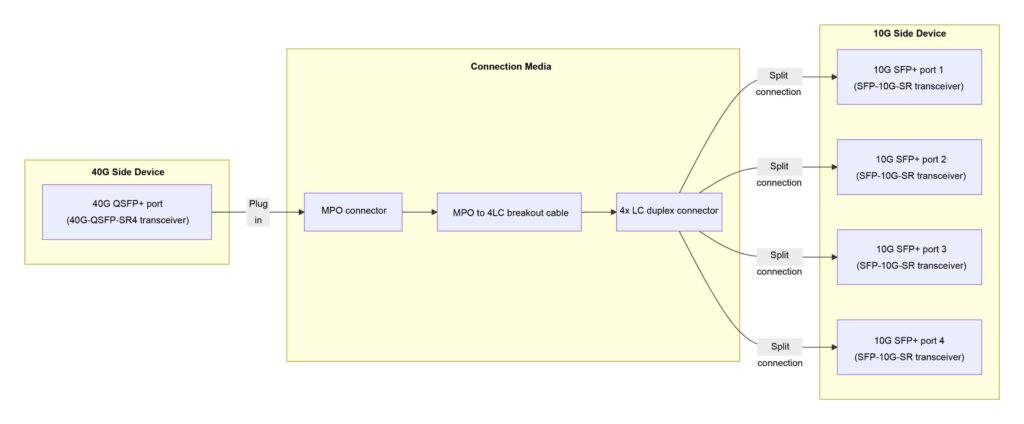
Detailed explanation of three schemes
Below are some brief explanations on the operational points and key limitations of the three schemes:
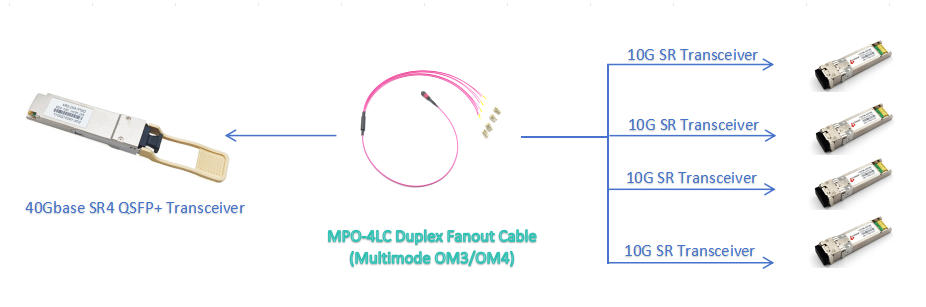
Solution 1: 40G SR4 ↔4 x 10G SR – This is the most common docking method.
The 40Gbase SR4 QSFP+ transceiver is equipped with four 850nm 10G channels, which can be connected to up to four 10G SFP+ SR transceiver through MPO to 4xLC fanout cable. However, it should be noted that if only one 10G optical transceiver is connected, the actual bandwidth of the link is only 10G.
Solution 2: 40G PSM4 ↔4 x 10G LR – This is the solution for single-mode fiber scenarios.
The working wavelength of both QSFP PSM4 transceiver and 10GBASE LR SFP+ transceiver is 1310nm, and they are backward compatible with 10G Ethernet protocol. Transmission up to 10 km can be achieved through single-mode mpo to lc cable.
Solution 3: Use high speed SFP breakout cables to directly connect switches
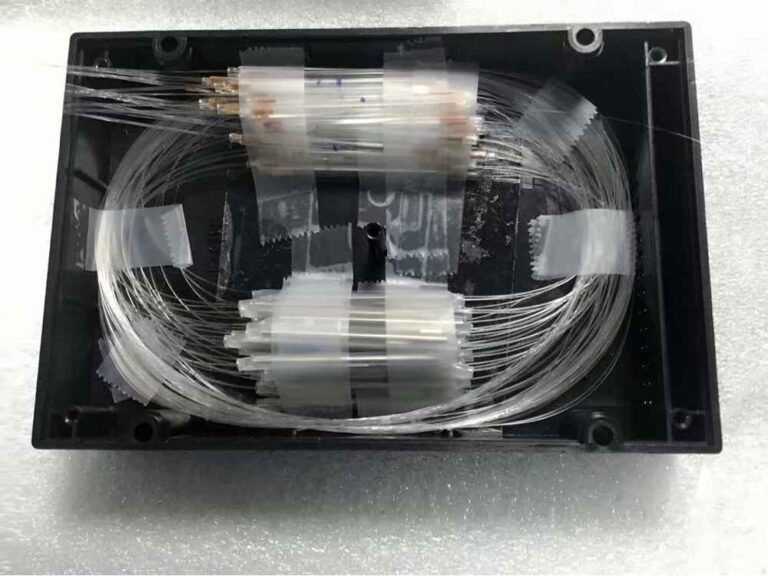
Within a short cabinet, QSFP to 4 x SFP+ DAC (direct copper cable) or AOC (active optical cable) breakout cables can be directly used to convert 40G ports into 4 x 10G ports.
Operation precautions
- Switch port mode: the most critical step! Before operation, the working mode of the 40G QSFP+port of the switch must be manually changed from “40G mode” to “4x10G mode”. Otherwise, the port cannot recognize the four 10G links on the backend.
- MPO polarity requirements: When using MPO-LC fanout cable, it is necessary to choose cables with a polarity of Type B (cross type) to ensure that the transmitting end (Tx) of the 40G optical transceiver can be correctly connected to the receiving end (Rx) of the 10G SFP transceiver.
- Cannot mix modules: It is strictly prohibited to directly mix a 40G module with another 40G module of a different wavelength/technology without understanding compatibility. The docking must strictly follow the above combination.
FAQ
Can 40G BiDi (bidirectional transceiver) directly interface with 10Gb SFP+ SR transceiver?
No, the 40G BiDi transceiver uses dual wavelength bidirectional technology, while the 10Gb SFP+ SR transceiver uses single wavelength, and the optical signal characteristics of the two are completely incompatible, making it impossible to establish a link.
Can 40Gbase LR4 directly dock with SFP 10G LR module?
No. Although the names all include “LR”, the 40Gbase LR4 uses CWDM (coarse wavelength division multiplexing) technology internally to multiplex four different wavelengths (1270/1290/1310/1330nm) of light onto a single optical fiber for transmission. It cannot communicate with SFP 10G LR modules that only use a single wavelength (1310nm).
Does Yingda provide MPO to LC cable?
Yes, Yingda make and supply various MPO to LC cables for single-mode and multi-mode. Please contact our sales representative directly for a quotation.