According to years of industry experience and practice, the wiring methods for 40Gb SFP optical modules are mainly divided into three types: QSFP DAC cable, 40G AOC cable, and QSFP fiber module + fiber patchcords. You can quickly judge based on your own transmission distance, cost budget, and wiring environment, referring to the core solutions in the table below:
| Wiring scheme | Key component | Interface type | Applicable scenarios | Core advantage |
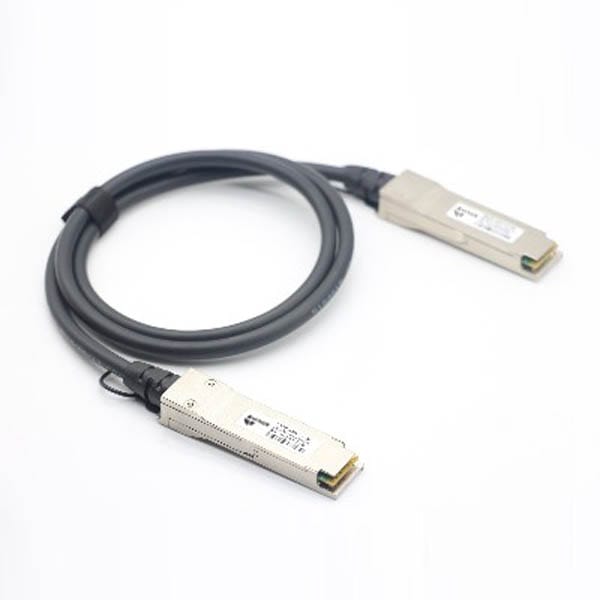
| QSFP DAC Cable | Copper cable with integrated modules at both ends | QSFP+to QSFP+ | Short distance connections within cabinets or between adjacent cabinets (≤ 7 meters) | Lowest cost, near zero power consumption, ultra-low latency |
| 40G AOC Cable | Fiber optic cable with integrated modules at both ends | QSFP+to QSFP+ | Within the same row of cabinets, the distance is slightly longer (1-100 meters) | Cables are lighter and softer, easier to manage, and resistant to electromagnetic interference |
| QSFP fiber module+fiber patchcords | Independent QSFP+ fiber modules + fiber optic patch cords | 12 core MPO or duplex LC | Full coverage, especially suitable for long-distance (up to 40 kilometers, such as LR4/ER4) or mixed networking with 10G devices | Strong flexibility, longest transmission distance, supports 10G branch connections |
How to choose the most suitable plan for you?
After understanding the basic framework, you can make decisions based on the following specific needs:
✅ Option 1: QSFP DAC Cable – the king of short distance cost-effectiveness
DAC is the best choice within the cabinet (such as between servers and ToR switches) or between adjacent cabinets, the distance should be within 7 meters.
Disadvantages: the DAC copper cable is thick and heavy, and the transmission distance is short. If it exceeds 7 meters, the signal will be significantly attenuated.
Why choose it: the most cost-effective. Because DAC cable is essentially a copper cable with optical modules directly pre-made at both ends, saving the cost of purchasing independent optical modules. At the same time, the power consumption is extremely low (almost zero), and the latency is also the lowest among all schemes.

✅ Option 2: 40G AOC Cable – Elegant Choice for Cabinet Wiring
For scenarios where the distance is within 100 meters but the cable is softer and easier to organize and route in a small space, the AOC cable is the best choice.
Disadvantage: The cost of AOC is higher than DAC, but lower than the “optical module+fiber” solution.
Why choose it: It is lighter, thinner, and has a smaller bending radius than DAC cables, making it easier to navigate through dense cable trays. It also integrates modules, plug and play, without the need to purchase separate optical modules.
✅ Solution 3: QSFP Fiber Module + Fiber Patchcords – The Ultimate Solution for Flexibility and Long Distance
This is the most traditional and flexible way, which can be further divided into several situations based on the different interfaces of the optical module and fiber types:
1. Interconnection of 40G devices of the same type (QSFP+ to QSFP+):
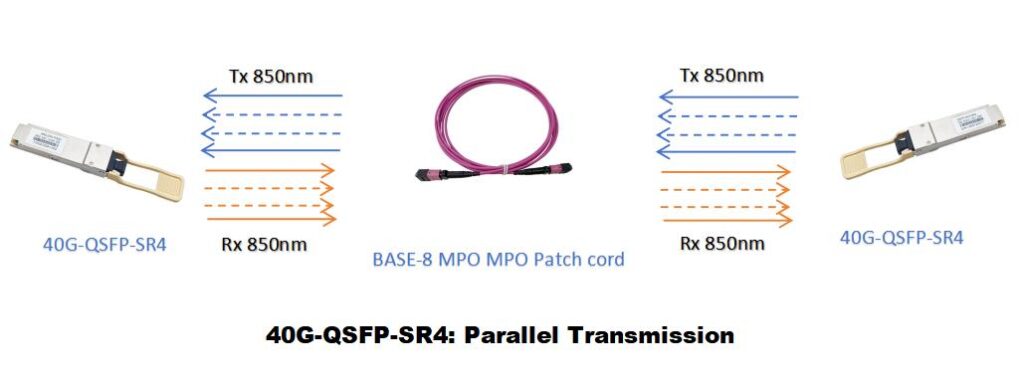
① Short distance (≤ 150m): Use a 40G QSFP SR4 module and MPO multimode fiber patch cord. This is the most mainstream 40G cabling method within data centers.
② Medium to long distance (2km/10km/40km): Use LC Duplex single-mode fiber patch cords with QSFP 40G LR4 S or ER4 optical modules.
2. Interconnection with existing 10G devices (40G to 10G): This is a common requirement in network upgrades.
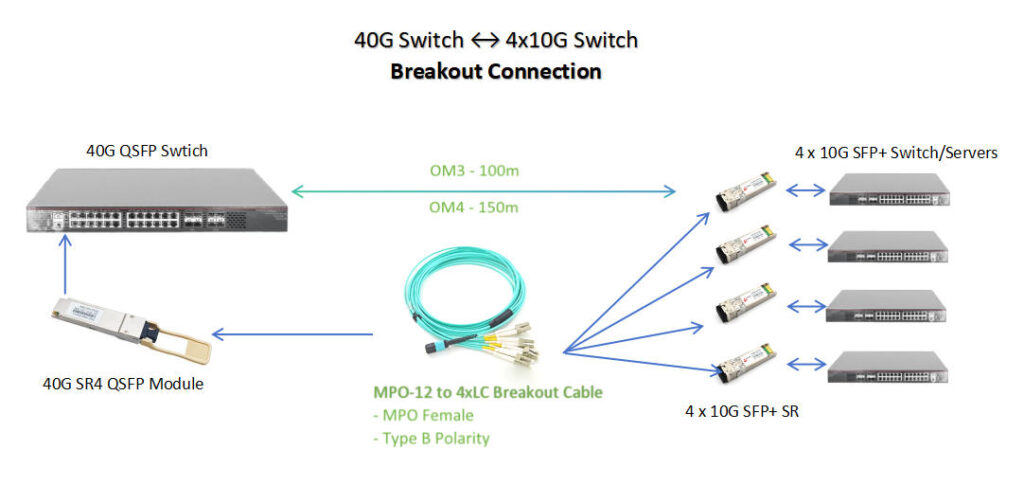
① Using MTP breakout cable: Connect the QSFP 40Gbase SR4 module with MPO/MTP interface on the 40G side to four 10G SR modules using MPO to 4x LC fanout cable (mpo qsfp om3 8lc 3m). This way, a 40G link can simultaneously serve 4 x 10G devices. Note: This operation requires setting the switch port to “4x10G breakout mode”.
② Using high speed SFP breakout cable: Purchase a QSFP 40G SR4 breakout cable directly, eliminating the need to purchase modules and fiber patchcords separately, making it easier to use.
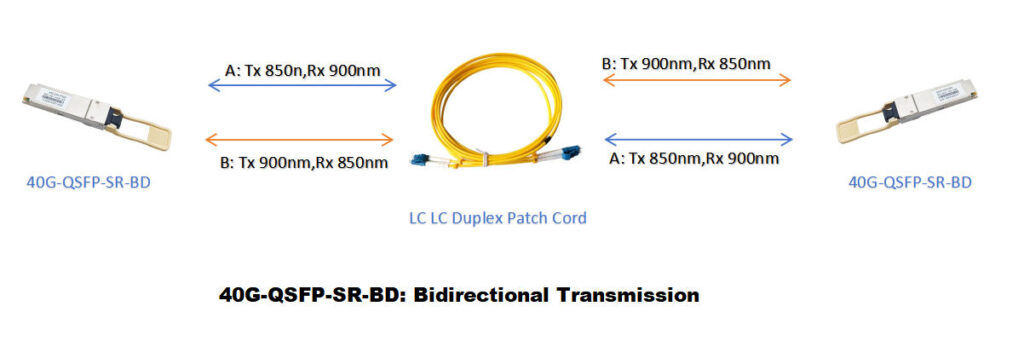
③ Upgrade compatibility solution: If you originally used LC interface multimode fiber for your 10G network and want to downgrade it to 40G without rewiring, you can use 40G BiDi transceiver or 40G LX4 optical modules. They can work directly by plugging into the existing LC interface, which is very convenient.
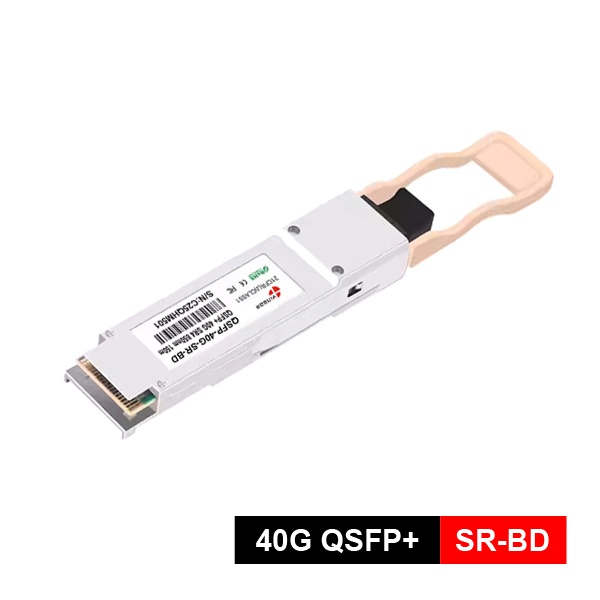
40G Bidi Transceiver
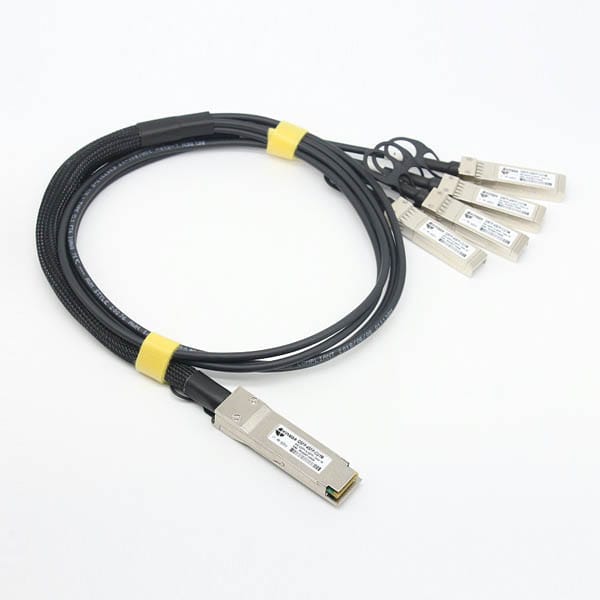
QSFP 40G SR4 breakout cable
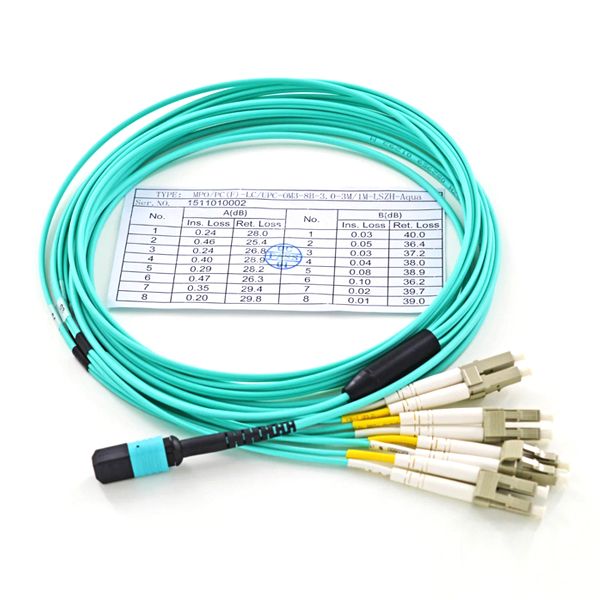
MPO QSFP OM3 8LC 3M
A key wiring detail: MPO fiber polarity
If you choose the MPO interface cabling method (such as SR4 or PSM4), there is a small detail worth noting: be sure to use MPO trunk cable with a polarity of Type B.
This involves the working principle of the 40Gb SFP optical module: the 40G SR4 module transmits through 8 optical fibers, of which 4 are used for transmission (Tx) and 4 are used for reception (Rx). Type B cables can perfectly achieve “send receive crossover”, ensuring correct docking of devices at both ends.
Conclusion
To help you compare more intuitively, here is also a comparison of key parameters for each scheme from Yingda:
| Item | QSFP DAC cable | 40G AOC cable | QSFP fiber module+fiber optic patch cords |
| Transmission distance | ≤ 7 m | ≤ 100 m | 100 m to 40 km |
| Power consumption | Extremely low (~0W) | Lower (~1-2W/end) | Higher (≥ 1.5W/end) |
| Flexibility | Poor (coarse and heavy) | Okay (light and fine) | Best (module optional) |
| Cost | minimum | moderate | Higher (especially long-distance) |