 Skip to content
QSFP+ 40G SR4 and QSFP 40G SR4 BD (BiDi) are two mainstream short distance 40G QSFP transceiver solutions. Both 40G SFP can achieve a transmission distance of 100-150 meters on multimode fiber, but there are essential differences in interface type, working principle, number of fibers used, and upgrade convenience.
| Item | 40G-QSFP-SR4 | 40G-QSFP-SR-BD |
| Package type | QSFP+ | QSFP+ |
| Optical interface type | MPO-12 (12 core MTP/MPO connector) | Duplex LC (standard LC connector) |
| Fiber type | Multimode optical fiber (OM3/OM4) | Multimode optical fiber (OM3/OM4) |
| Transmission distance | OM3:100 m / OM4:150 m | OM3:100 m / OM4:150 m |
| Operating wavelength | 850nm (4 channels with the same wavelength) | 850nm/900nm (dual wavelength BiDi) |
| Optical channel architecture | 4 send 4 receive parallel (using 8 cores) | 2 × 20G bidirectional (each LC port bidirectional) |
| Required number of fiber cores | 8-core | 2-core |
| Power consumption | < 1.5W | < 3.5W |
| 4 X10G breakout capability | ✅ Support (MPO to 4 LC breakout cable) | ❌ Not supported |
| Upgrade from 10G to 40G | MPO cable needs to be re laid | No need to modify wiring, plug and play |
Differences in working principles
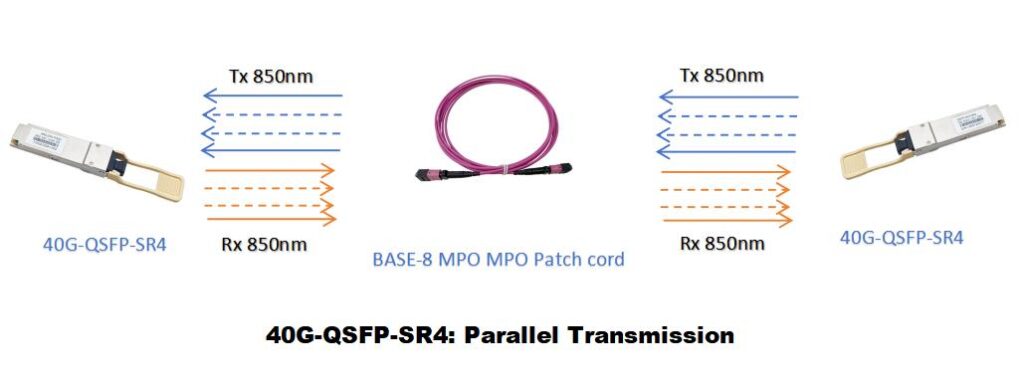
40G-QSFP-SR4: Parallel Transmission
QSFP SR4 adopts a 4-channel parallel transmission architecture:
- 4 send 4 receive: 4 cores for sending, 4 cores for receiving, a total of 8 cores of optical fiber
- Same wavelength: All 4 channels use 850nm wavelength
- Interface: Connected to 8 core multimode fiber patch cord through MPO 12 connector
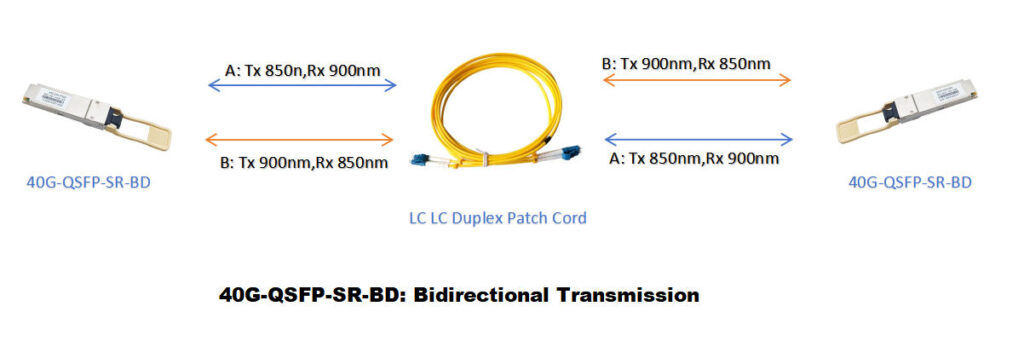
40G-QSFP-SR-BD: Bidirectional Transmission
40GBASE BiDi adopts a dual fiber bidirectional architecture:
- Channel aggregation: Combine 4 x 10G electrical signals into 2 x 20G signals
- BiDi technology: In each LC port, different wavelengths are used to simultaneously transmit and receive on the same optical fiber
- Channel 1 (LC port A): TX 850nm/RX 900nm
- Channel 2 (LC port B): TX 900nm/RX 850nm
- Interface: Only 2 core standard LC duplex fiber patch cord is required
How to choose between 40GBASE SR4 or SR-BD?
10G → 40G network upgrade: 40GBASE SRBD is a better choice
The biggest advantage of QSFP BiDi transceiver is to protect existing investments. The existing 10G network generally adopts LC duplex cabling system. When upgrading to 40G:
| Plan comparison | upgrade operation | time cost | wiring renovation cost |
| BiDi | only needs to replace the optical modules at both ends | a few hours | without additional cost |
| SR4 | needs to re lay MPO cables and replace the distribution frame | several days to several weeks | costly and requires rewiring |
In a structured cabling system, the BiDi scheme only requires replacing the modules at both ends, and other devices (LC patch cords, optical distribution boxes, MTP trunk cables) can be reused.
New 40G data center: QSFP SR4 is a better choice
For new networks, the advantages of QSFP SR4 are more obvious:
| Advantages | Remark |
| Lower power consumption | <1.5W vs 3.5W for BiDi, with lower heat dissipation pressure during high-density deployment |
| Lower cost | The module itself is priced lower than BiDi |
| Support branches | 40G → 4 x 10G connection can be achieved through branch cables |
Fiber optic resource scarcity scenario: QSFP+ BiDi has more advantages
QSFP+ BiDi only requires 2-core fiber to achieve 40G transmission, with fiber utilization efficiency four times that of SR4 (2-core vs 8-core), making it very suitable for data centers with tight fiber resources.
Based on the detailed description above, we have learned that different optical fiber modules can be selected for different usage scenarios. According to actual needs, yingda summarizes the following table:
| Application | Recommend solution | Reason |
| 10G LC cabling → 40G upgrade | 40G BiDi | No need to modify wiring, plug and play, protecting existing investments |
| New 40G Data Center | 40G SR4 | Lower power consumption (<1.5W), supporting 4 × 10G branches, and lower module cost |
| Requires 4 x 10G branch connections | 40G SR4 | BiDi does not support branching function |
| Fiber optic resources are scarce | 40G BiDi | 2-core 40G, fiber utilization efficiency is 4 times that of SR4 |
| High density switch deployment (heat sensitive) | 40G SR4 | The power consumption is only 43% of BiDi, and the heat dissipation is better under high-density conditions |
Conclusion
SR4 is the preferred choice for new 40G data centers (low power consumption, low cost, support for branches); BiDi is a tool for upgrading 10G networks to 40G (reusing existing LC cabling without the need to modify fiber infrastructure). Both have their own focuses on fiber utilization efficiency and upgrade convenience, and the selection should be based on actual scenarios.
| Item | 40G-QSFP-SR4 | 40G-QSFP-SR-BD |
| Technical route | Parallel transmission | Bidirectional transmission (BiDi) |
| Interface | MPO-12 | Duplex LC |
| Number of fiber cores | 8-core | 2-core |
| Power consumption | <1.5W (lower) | <3.5W |
| Breakout ability | Support 4 x 10G | not supported |
| 10G upgrade | Need to rewire | No need for modification |
| The most suitable scenario | New Network | Upgrade and renovation/fiber optic shortage |