The core difference between the 1000BASE-T SFP transceiver and the 10/100/1000BASE-T copper SFP module lies in the supported speed ranges and the communication interface with the host device, as detailed in the following comparison:
Core Differences Comparison
| Item | 1000BASE-T SFP (pure gigabit) | 10/100/1000BASE-T SFP (adaptive) |
| Supported rates | Only 1000Mbps (gigabit) | 10/100/1000Mbps three speed adaptive |
| Host Interface Protocol | SerDes(1000BASE-X) | SGMII (Serial Gigabit Media Independent Interface) |
| Rate negotiation | Does not support speed reduction negotiation, can only work at gigabit | Support negotiating speed with peer devices |
| Applicable scenarios | Pure gigabit network environment | Mixed rate network (coexistence of 10/100/1000M devices) |
| Typical model of brands | SFP-GE-TS / GLC-T | SFP-GE-TM/Partial GLC-T |
Detailed Explanation of Technical Principles
The Internal Differences
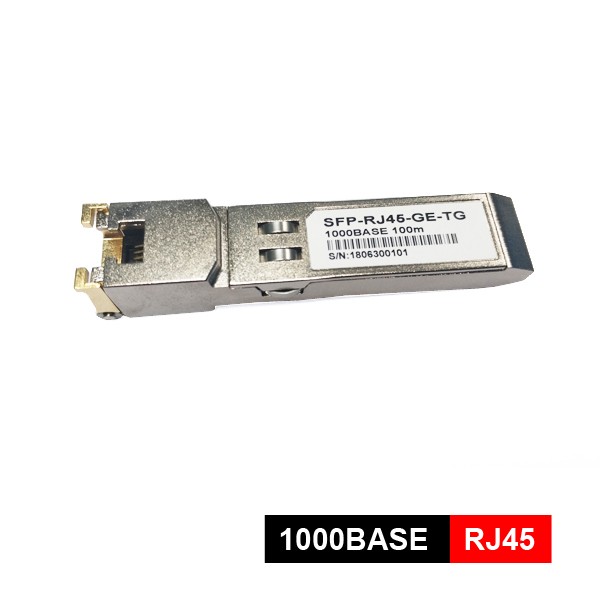
Although these two RJ45 SFP module have the same appearance (both are SFP package + RJ45 interface), their internal circuits and communication methods with the switch are different:
1. 1000BASE-T SFP (pure gigabit)
- Host interface: SerDes interface, using 1000BASE-X protocol
- Working principle: Data is converted from serial to parallel on the SerDes interface, but there is no encoding or decoding process, which belongs to transparent transmission
- Speed limit: Due to the use of transparent transmission, the speed on the host side and line side must be the same, so it can only support gigabit
- Typical application: pure gigabit switch port
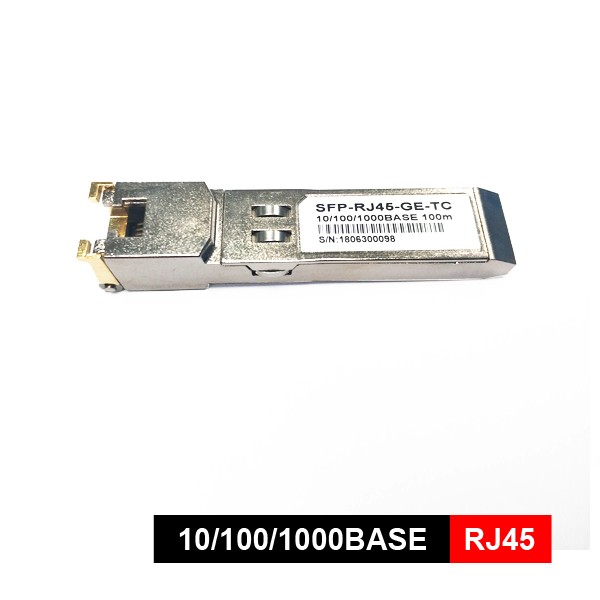
2. 10/100/1000BASE-T SFP (adaptive)
- Host interface: SGMII (Serial Gigabit Media Independent Interface) interface
- Working principle: SGMII supports 8B/10B encoding and decoding, and can transmit rate information (10/100/1000M) through control registers
- Rate negotiation: When the peer device only has 100Mbps, the module will communicate with the host through SGMII, and the host will adapt to low-speed transmission through “frame extension” technology (copying each byte 10 or 100 times)
- Typical application: Mixed rate network, requiring compatibility with outdated 10/100M devices
How to choose the best RJ45 SFP module?
The choice of module depends on what interfaces your switch supports and whether there are low-speed devices in the network:
The Interface of the Switch Supports
| Switch interface type | Module should be selected | Explanation |
| SGMII interface | Adaptive module (10/100/1000BASE-T) | The switch supports rate negotiation and can be connected to 10/100M devices |
| SerDes interface (1000BASE-X) | Pure Gigabit Module (1000BASE-T) | The switch only supports gigabit and cannot slow down |
| Simultaneously supporting both | Both are acceptable | Flexible selection based on actual needs |
Actual Application Scenarios
| Scene for example | Recommendation module | Reason |
| Pure gigabit network, switches only support gigabit SFP ports | 1000BASE-T pure gigabit | Good compatibility and lower cost |
| There are 10M/100M old devices in the network | 10/100/1000BASE-T adaptive | Compatible with devices of different speeds |
| Uncertain about switch support | 10/100/1000BASE-T adaptive | Wide compatibility and strong downward compatibility capability |
Conclusion
The 1000BASE-T module is a “dedicated line” (only running gigabit), while the 10/100/1000BASE-T module is an “intelligent lane” (automatically adjusting the rate according to switch port) – the 1000BASE-T module has a simple structure, low cost, strong compatibility, and wide applicability. The choice depends on the interface type of the switch SFP port (SGMII or SerDes) and whether there are low-speed devices in the network. Mainstream models such as Cisco GLC-T now support both modes, but some older devices or specific switches still need to be distinguished.