Skip to content
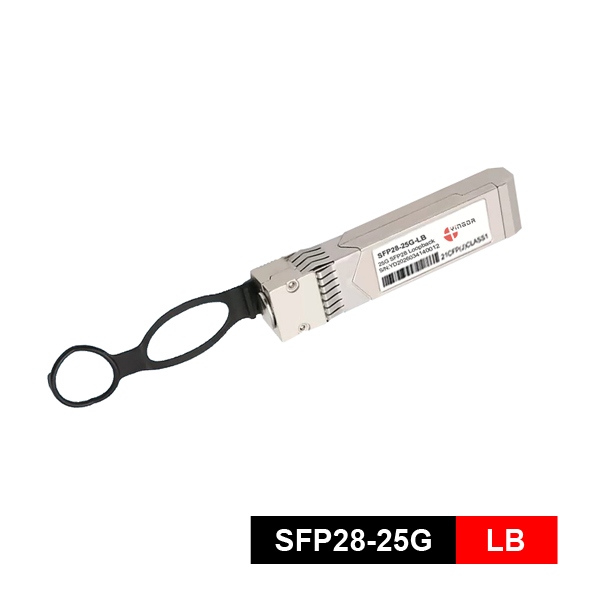
The 25G SFP28 Loopback module has significant differences from ordinary SFP+ 25G LR modules in essence, and they belong to two categories: “testing tools” and “transmission components”:
Difference Between Function and Usage
- Ordinary SFP+ 25G LR module: This is a complete functional optical module used for 25Gbps long-distance data transmission between two network devices. It needs to be connected to an external duplex LC single mode fiber patch cable to work.
- 25G SFP28 Loopback: This is a specialized testing and diagnostic tool. Its internal structure is to “short-circuit” the electrical signal from the transmitting end (TX) directly back to the receiving end (RX).
Key Differences
| Item | SFP28-LR 25G Transceiver | SFP28-LB Loopback Module |
| Key Features | Network Communication and Data Transmission | Port Self-Testing, Troubleshooting, and System Verification |
| Internal Structure | Includes components such as lasers, detectors (PDs), and driver chips | Typically features a purely circuit-based structure (electrical loopback) and contains no lasers. |
| Connected Devices | Must be connected to another module via a fiber optic patch cord | Requires only direct insertion into the port; no external fiber optic cables are needed. |
| Transmission Distance | Supports physical distances of up to 10 km | Achieves signal loopback exclusively within the device port (zero distance). |
| Typical Scenarios | Metropolitan Area Network (MAN) interconnection and inter-building fiber links | Ideal for R&D testing, production line inspection, and preliminary fault screening in data centers. |
Unique Features of Loopback
- ModulesSimulating Real-World Environments: Advanced 25G loopback modules can simulate varying power consumption levels (e.g., 1W/2W) and optical attenuation (e.g., 0dB/5dB). This allows for testing the performance of switch ports under extreme load conditions without the need to deploy actual lengths of fiber optic cable.
- Cost-Effectiveness: Since SFP+ loopback module do not contain complex optical transceiver components, they are typically significantly less expensive than standard LR optical transceivers, making them an ideal choice for large-scale equipment power-on testing.
Conclusion
- If you need to connect two devices, you must purchase a standard SFP28-LR module.
- If you simply wish to verify whether a port on the switch is faulty, or to simulate traffic in the absence of a fiber optic connection, then you will need to use a loopback module.
FAQ
What is electrical loopback?
Electrical loopback is typically a physical “short circuit” implemented inside the optical module, directly returning the electrical signal from the transmitting end to the receiving end. It is mainly used to test the functionality of switch/host ports and the electrical interface sections of the optical module.
What is optical loopback?
Optical loopback (such as loopback patch cords or loopback connectors) reflects the optical signal emitted by the optical module back to its own receiving end through optical fiber. It is mainly used to test the overall performance of the optical module (including the laser and detector) and the transceiver functionality of the entire port.