The QSFP28 100G ZR, ZR+, and ZR4 all belong to the 100G QSFP28 optical transceiver module with a transmission distance of 80km or more, but they exhibit significant differences in technical principles, transmission distance, application scenarios, ands power consumption. Simply put:
- ZR/ZR+ are coherent transceivers, more advanced, based on coherent optical technology solutions for ultra-long-distance transmission (80km-1000km+), enabling longer reach and higher performance.
- The ZR4 is a direct detection optical transceiver that achieves metropolitan area long-distance transmission (≤80km) by utilizing four wavelengths.
100G ZR (Coherent Transceivers)
The 100G ZR transceiver is a representative work of coherent optical technology “sinking” to pluggable transceivers, marking a technological leap in 100G long-distance transmission.
- Technical principle: Using coherent light technology, based on QSFP28, CFP2-DCO or QSFP-DD packaging. It is completely different from ZR4, using “coherent detection” technology. Simply put, it no longer simply uses light intensity to represent 0 and 1, but utilizes multiple dimensions such as phase and polarization state of light waves to load information. At the same time, the internal tunable laser can flexibly select the operating wavelength within the C-band (the commonly used band for dense wavelength division multiplexing DWDM).
- Transmission distance: Coherent technology itself has a strong tolerance for damage such as dispersion and noise in optical fibers. Therefore, the 100G ZR module has the ability to transmit signals over distances of 300 kilometers or even further, making it suitable for intercity transmission of DCI (Data Center Interconnection).
- Market positioning: 100G ZR technology is an ideal choice for implementing IP over DWDM architecture. It can directly integrate complex DWDM transmission functions into router ports, eliminating the need for independent transmission devices and simplifying network structure. Its power consumption control is also quite excellent, for example, Coherent’s product has a power consumption of less than 5W. At the same time, it has strong dispersion compensation capability and native support for DWDM (Dense Wavelength Division Multiplexing), carrying multiple 100G channels on a single fiber, greatly improving fiber utilization.
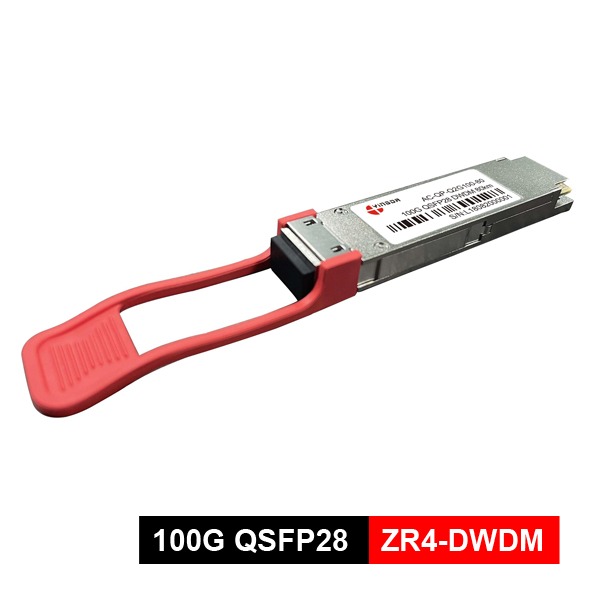
100G ZR+ (Enhanced Coherent Transceivers)
ZR+is not a strict industry standard, but a broader and more powerful product category primarily driven by the Open ZR+MSA organization.
- Technical principle: Based on 100G ZR coherent technology, 100G ZR+ adopts a more powerful DSP (Digital Signal Processor) chip and oFEC (Optimized Forward Error Correction) algorithm, usually with higher transmission power and better reception sensitivity.
- Transmission distance: With stronger DSP and error correction capabilities, ZR+can operate normally under conditions of worse optical signal-to-noise ratio (OSNR), supporting longer transmission distances (such as over 1000 kilometers at 400G rate), typically used in land backbone networks or submarine cables ranging from hundreds to thousands of kilometers, with better performance than ZR. At the same time, it can flexibly support multiple rates such as 100G, 200G, 400G, etc. But this usually comes at the cost of higher power consumption, for example, AddOn’s 100G ZR+QSFP-DD module has a power consumption of 16.5W.
- Market positioning: QSFP28 ZR+ targets scenarios with extreme performance requirements, such as ultra long distance DCI or long-distance backbone networks of operators. It usually uses larger packages such as QSFP-DD to meet the needs of heat dissipation and higher integration.
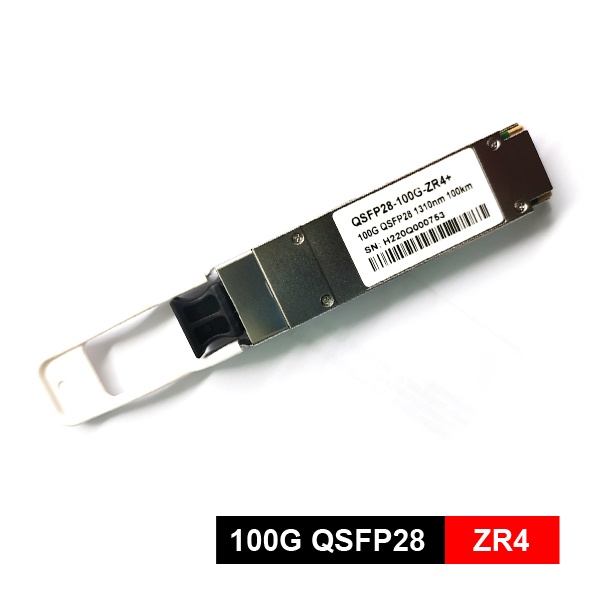
100G ZR4 (Direct Detect Optical Transceiver)
QSFP 100G ZR4 is the earliest and most common type in the ZR series. It uses a traditional technique called ‘incoherent’.
- Technical principle: Non coherent direct detection technology is adopted, usually QSFP28 package, using 4x25G or single wave 100G PAM4 technology, and combined with SOA (semiconductor optical amplifier) to enhance the signal.
- Transmission distance: limited to around 80km, it is a low-cost solution for upgrading traditional 10G 80km links to 100G. In order to achieve long-distance transmission of 80 kilometers, the ZR4 transceiver has added a semiconductor optical amplifier (SOA) at the receiving end to enhance weak signals, and must rely on the switch to enable FEC (Forward Error Correction) function to correct errors generated during long-distance transmission. Without FEC, it usually only reaches 40-60km.
- Market positioning: QSFP28 ZR4 is a solution with mature technology, relatively low cost compared to ZR/Zr+, and low power consumption, which is very suitable for point-to-point data center interconnection (DCI) or metropolitan area network access network construction within a distance of 80 kilometers.
Comparison Table: 100G ZR, 100G ZR+, 100G ZR4
| Item | 100G ZR (coherent) | 100G ZR+ (enhanced coherent) | 100G ZR4 (direct detection) |
| core technology | Coherent light (DP-QPSK)+tunable laser | Coherent Optical (DP-QPSK), Performance Enhanced Edition | Non coherent (4x25G NRZ)+LAN-WDM |
| boxed type | QSFP28 /QSFP-DD/CFP2 | QSFP-DD/CFP2 | QSFP28 |
| Typical distance | Up to 300 kilometers or more | 80km-1000km+, Supports multiple speeds of 100G-400G | ≤ 80km (FEC enabled) |
| Dispersion tolerance | Extremely high (no need for optical compensation) | Extremely high (no need for optical compensation) | Low (requiring SOA amplification) |
| optical interface | Duplex LC | Duplex LC | Duplex LC |
| cost | tall | highest | lower |
| Typical power consumption | <5W | ~16.5W (100G) | <6W |
| Main standards | IEEE 802.3ct 100GBASE-ZR | Open ZR+ MSA | Manufacturer’s universal |
| Main applications | Regional/long-distance backbone network, long-distance DCI | Submarine cable, ultra long haul DCI, operator grade backbone network | Metropolitan area network and data center interconnection (80km level) |
How to choose 100G ZR transceivers?
Yingda can provide all above 3 types of QSFP28 100G 80km transceivers, when you plan to buy, please comprehensively consider which ZR transceivers to choose based on our actual application scenarios, existing equipment, transmission distance requirements, and budget.
- l If the distance is less than 80km and the budget is limited, and QSFP28 equipment needs to be compatible, choose 100G ZR4 transceiver;
- l For distances greater than 80km, requiring ultra long distances and supporting DWDM, choose 100G ZR/ZR+ coherent transceivers.