The 100G QSFP28 ER4 optical module is a telecommunications grade single mode optical module designed specifically for metropolitan area networks and data center interconnect (DCI). It can achieve a transmission distance of 40km on single-mode fiber and is a mature solution for connecting data centers located 10km to 40 km apart.
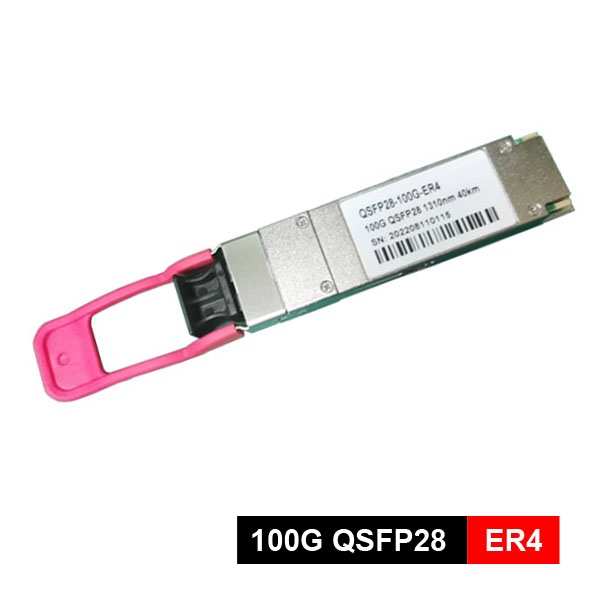
100G ER4 specifications
| Model | 100G QSFP28 ER4 |
| Package type | QSFP28 |
| interface type | Duplex LC |
| Fiber optic type | Single mode fiber (SMF, G.652) |
| transmission distance | 40km (with host FEC enabled) / 30km (without FEC) |
| working wavelength | 4 LAN-WDM wavelengths: 1295.56nm, 1300.05nm, 1304.58nm, 1309.14nm |
| modulation scheme | NRZ (Non Return to Zero Encoding) |
| Rate per channel | 25.78Gbps (100GE mode) / 27.95Gbps (OTU4 mode) |
| emitter type | 4 x LAN-WDM EML (electroabsorption modulated laser) |
| Receiver type | SOA+PIN (semiconductor optical amplifier + photodetector) |
| power consumption | Typical value 4.5W -6W |
| FEC requirements | Host FEC must be enabled during 40km transmission |
| Operating Temperature | Commercial grade: 0 ℃ ~ 70℃ |
Working principle: 4 × 25G NRZ+LAN-WDM+SOA amplifier
Unlike the previously introduced 10km LR4 scheme, ER4 aims to achieve 40km transmission by adding an SOA semiconductor optical amplifier at the receiving end to enhance sensitivity
Transmitting end:
- Four 25Gbps electrical signals (from the switch) drive four cooling type EML lasers with LAN-WDM wavelengths
- The laser operates at four specific wavelengths: 1295.56nm, 1300.05nm, 1304.58nm, and 1309.14nm
- Combine the optical signals of four wavelengths through a multiplexer (MUX) and output them through a duplex LC interface
Receiver end:
- The input optical signal has been severely attenuated after a 40km long-distance transmission
- Firstly, pre amplify weak signals through SOA semiconductor optical amplifiers
- The amplified signal is separated into four wavelengths by a splitter (DEMUX)
- PIN photodetectors convert optical signals of various wavelengths into electrical signals
This combination of “high-power EML emission+SOA preamplifier” is a key technology for achieving stable transmission over 40km.
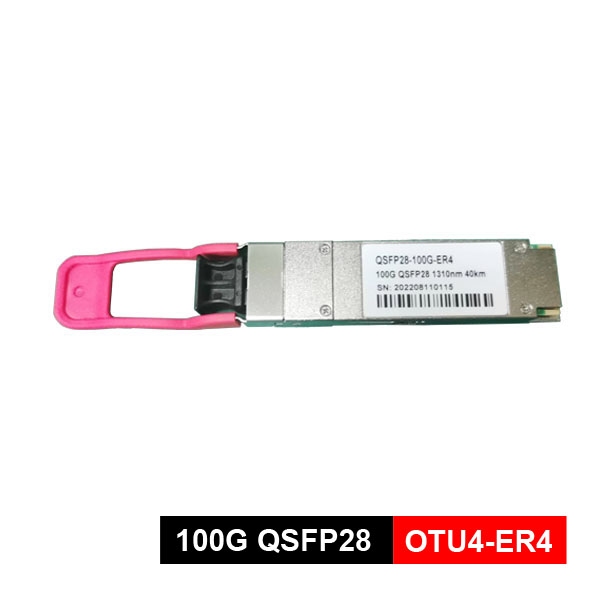
OTU4 dual rate option
Some ER4 modules offer dual rate versions, often marked with the “OTU4” symbol in the model:
| Working mode | Rate | Application scenarios |
| 100GE mode | 103.125 Gbps (4×25.78 Gbps) | Standard Ethernet Interconnection |
| OTU4 mode | 111.8 Gbps (4×27.95 Gbps) | OTN optical transmission network |
This OTU dual rate optical module can be used for both Ethernet switches and OTN transmission equipment, reducing spare parts inventory costs.
Comparison: Standard ER4 vs ER4 Lite
They are two 40km level 100G ER4 optics solutions on the market. And the core difference between 100G QSFP28 ER4 and ER4 Lite lies in the transmission distance and the degree of dependence on FEC (Forward Error Correction) function. ER4 Lite is the “lightweight version” or “conditional compliance version” of ER4. When FEC is not enabled, it can only run for 25km. If you want to reach 40km, the quality requirements for the fiber optic link are extremely high (with very low loss), and it is mandatory for the host device to enable RS-FEC.
| Item | 100G ER4(standard) | 100G ER4 Lite(lite version) |
| Transmitter | EML (Electro Absorption Modulation Laser) | DML (Direct Modulation Laser) |
| Receiver | SOA + PIN | APD (Avalanche Photodiode) |
| 30km transmission (without FEC) | support | support |
| 40km transmission (FEC required) | support | support |
| Power consumption | Approximately 4.5W-6W | <3.8W (lower) |
| Cost | higher | lower |
| Typical Applications | Telecommunications grade long-distance, OTN network | Data center interconnection, cost sensitive scenarios |
Selection suggestion:
- For Telecom OTN networks, it is recommended to choose standard QSFP28 ER4 (EML+SOA) for more reliable performance;
- 100G ER4 Lite (DMZ+APD) can be selected for DCI scenarios in data centers, with lower power consumption and cost.
Comparison: ER4 vs LR4 vs ZR4
| Item | 100G LR4 | 100G ER4 | 100G ZR4 |
| Transmission distance | 10km | 40km | 80km+ |
| Core component | DML/EML + PIN | EML + SOA+PIN | High power EML + SOA+PIN |
| FEC requirements | No need | Required at 40km | Required |
| Typical power consumption | ~3.5W | ~4.5-6W | ~5.5-6.5W |
| Typical scenario | Between computer rooms/Building rooms | Metropolitan Area Convergence/DCI | Inter city/Regional DCI |
Application scenarios and deployment requirements
Typical application scenarios:
- Metropolitan Data Center Interconnection (DCI): Connecting data centers within the same city that are 10-40km apart
- Park interconnection: cross park and cross campus data center connections
- Telecom metropolitan area network: 100G long-distance interconnection of metropolitan backbone network
- 5G backhaul network: the intermediate/backhaul link between 5G base stations and the core network
Key deployment requirements:
- FEC recommendation: For 40km transmission, it is recommended to enable KP4 FEC defined by IEEE 802.3bj to ensure bit error rate [cite: 10]
- Fiber type: Standard G.652 single-mode fiber should be used
- No need for external amplifier: Unlike the DWDM PAM4 scheme, ER4 is a point-to-point direct drive scheme that does not require external optical amplification and dispersion compensation, making deployment simpler
100G ER4 QSFP28 40KM Buying Advice
- Confirm transmission distance: Choose LR4 within 10km, 100G ER4 distance is 10-40km
- Confirm ER4 type: Choose QSFP 100G ER4L, if cost is sensitive and within 30kmdistance, its with lower power consumption; for Telecom 40km applications, please choose standard 100G ER4.
- Confirm FEC capability: 40km transmission requires device support and FEC enabled. Before deployment, please confirm that the switch supports this feature
- Confirm dual rate requirement: If an OTN device needs to be connected, the OTU4 dual rate version can be selected
- Compatibility verification: It is recommended to confirm the compatibility list with the device manufacturer. Mainstream 100G QSFP28 ER4 modules support devices from brands such as Huawei, Cisco, Arista, Juniper, etc
Conclusion
The 100G QSFP28 ER4 module is a mature and reliable medium to long distance transmission solution. It adopts 4 × 25G NRZ modulation+LAN-WDM wavelength+SOA preamplifier technology, and achieves 40km transmission in the QSFP28 small package.
- Compared to longer ZR4 solutions, ER4 has the advantages of lower power consumption, simpler deployment, and better cost-effectiveness;
- Compared to LR4, it provides four times the transmission distance. ER4 has been proven to be an ideal choice for metropolitan DCI and park interconnection scenarios within a range of 10-40km.