 Skip to content
The QSFP28 100Gbase LR1 transceiver is a high-performance, medium to long distance transmission (10km) high-density optical module based on Single Lambda technology. It adopts QSFP28 packaging and achieves 100Gbps transmission on single-mode fiber through 1310nm wavelength. It simplifies the internal design by converting the four 25G channels on the electrical side into a single 100G signal on the optical side, making it an economical choice for data center interconnect (DCI) and 5G carrier network.
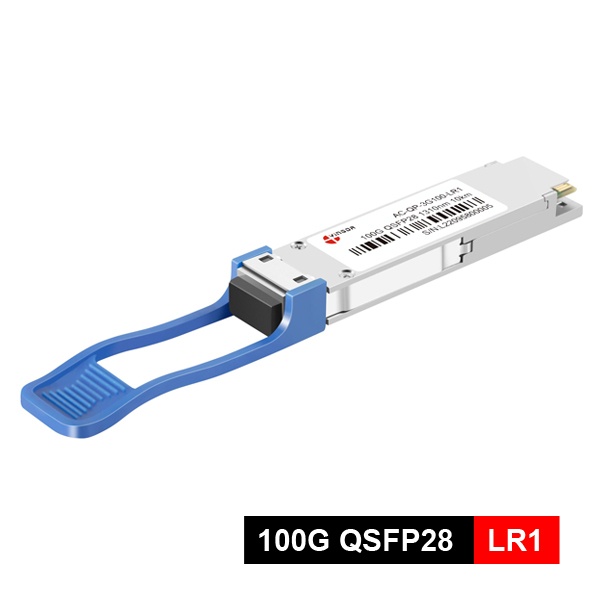
100G LR1 Optics Specifications
| Model | QSFP28-100G-LR1 |
| Package type | QSFP28 (same packaging as 100G SR4/LR4) |
| transmission rate | 106.25Gbps (1 x 53.125GBd PAM4), effective data rate 100G |
| Optical interface type | Duplex LC |
| Fiber type | Single mode fiber (SMF, G.652) |
| Transmission distance | 10 kilometers (standard)/20 kilometers (enhanced version, FEC needs to be enabled) |
| Working wavelength | 1310nm (single wavelength) |
| Emitter type | EML (Electro Absorption Modulation Laser) or Silicon Optical Scheme |
| Receiver type | PIN photodiode |
| Power consumption | <4-4.5W (typical 3.5-4.5W) |
| Operating Temperature | Commercial grade 0 ℃ to 70 ℃ |
| Electrical interface | CAUI-4(4 x 25.78Gbps NRZ) |
| Protocol standard | IEEE 802.3cu 100GBASE-LR1、100G Lambda MSA、QSFP28 MSA |
Single wavelength 100G PAM4:
- QSFP28 100Gbase LR1 adopt PAM4 (4-stage pulse amplitude modulation) technology with a single channel symbol rate of 53.125GBd
- Compared to traditional 4 × 25G NRZ schemes (such as LR4 100G), the number of optical devices is reduced by 75%, resulting in lower costs and better power consumption
100G LR1 FEC requirements:
- KP-FEC (Forward Error Correction) needs to be enabled for 10 km transmission to ensure bit error rate performance
- FEC can correct bit errors in transmission and is the key to achieving 10km transmission with a single wavelength 100G scheme
Power consumption performance:
- 100G LR1 SFP typical power consumption<4W, some optimized products can reach<3.5W
- Compared to the traditional 100G QSFP28 LR4 (10 km, 4 wavelengths) scheme, the power consumption of 100G QSFP28-LR1 is comparable or slightly lower, but the cost advantage is obvious
Electrical interface:
- The host side of LR1 adopts CAUI-4 interface: 4-channel 25.78Gbps NRZ signal
- Internally, the LR1 transceiver module converts 4 × 25G NRZ to 1 × 100G PAM4 using Gearbox DSP
Technical architecture and working principle
Core Architecture: 4 x 25G NRZ ↔ 1x100G PAM4
The core of 100Gbase LR1 is the Gearbox DSP chip inside the transceiver, which completes the rate conversion between the electrical interface and the optical interface:
Sender (TX):
- Electrical interface input: 4-channel 25.78Gbps NRZ signal (CAUI-4)
- DSP processing: Convert 4 × 25G NRZ to 1 × 53.125GBd PAM4 signal
- Optical output: Drive 1310nm EML laser and output 100G PAM4 optical signal
Receiver (RX):
- Optical input: PIN detector receives 1310nm PAM4 optical signal
- DSP processing: Recover and convert PAM4 signal into 4 × 25G NRZ signal
- Electrical interface output: CAUI-4 output to the host device
Two main technologies
| Technology | Features |
| EML scheme | Traditional mature technology, stable performance, using refrigerated EML laser, supporting 10-20km |
| Silicon Light Solution | High integration, controllable cost, suitable for large-scale deployment, also supports 10km |
Silicon photonics technology integrates optical and electronic components on a single chip, demonstrating cost advantages in large-scale deployment scenarios such as AI data centers.
Single Lambda 100G DR1 LR1 FR1
The 100G QSFP28 LR1 is a long-distance transceiver designed for 100G Ethernet interconnection within 10 km of data centers and campus networks, using single wavelength 100G PAM4 technology. It belongs to the single wavelength 100G product family along with DR1 (500 m) and FR1 (2 km), and LR1 is the model with the longest transmission distance in this series. Below are the specific differences between the following three models:
| Item | 100G DR1 | 100G FR1 | 100G LR1 |
| transmission distance | 500 m | 2 km | 10 km( 20km optional) |
| core technology | 1×100G PAM4 | 1×100G PAM4 | 1×100G PAM4 |
| interface type | Duplex LC | Duplex LC | Duplex LC |
| Fiber optic type | single-mode fiber | single-mode fiber | single-mode fiber |
| transmitter | EML/Silicon optics | EML/Silicon optics | EML(enhanced) |
| FEC requirements | KP-FEC | KP-FEC | KP-FEC |
| power consumption | <4W | <4.5W | <4-4.5W |
| protocol standard | IEEE 802.3cu 100GBASE-DR1 | IEEE 802.3cu 100GBASE-FR1 | IEEE 802.3cu 100GBASE-LR1 |
Difference 100G LR1 vs LR4
Although both 100G LR1 and LR4 can run 10 km, the core of LR1 lies in its “single wavelength”, which significantly reduces the number of optical components, lowers fault points, and production costs. LR4, on the other hand, has four parallel wavelengths and a significantly different internal structure.
| Item | 100G LR1(single wave) | 100G LR4(4 wavelengths) |
| Technical Architecture | 1×100G PAM4 | 4×25G NRZ + WDM |
| Number of wavelengths | 1 (1310nm) | 4 (LAN-WDM, approximately 1295-1310nm) |
| Number of optical components | 1 EML | 4 DFB/EML+AUX/DEMUX |
| internal components | Integrated DSP chip for signal processing | No need for complex DSP processing |
| interface type | Duplex LC | Duplex LC |
| Number of optical fibers | 2-core | 2-core |
| transmission distance | 10 kilometers (optional 20km) | 10 kilometers |
| power consumption | <4W | <4.5W |
| cost | Lower (fewer components) | higher |
| FEC requirements | Need KP-FEC | No need |
| Interoperability | Incompatible (the two cannot communicate directly) | incompatible |
| Applicable scenarios | New network, cost sensitive | Compatibility with existing networks |
Selection suggestion:
- New data center/campus network → LR1 (lower cost, more advanced technology)
- Need to be compatible with existing LR4 infrastructure → LR4 (no need to modify the peer device)
BiDi LR1 – Bidirectional transceiver
In addition to the standard dual fiber LR1 (one transmitter, one receiver, using 2-core fiber), there is also a BiDi LR1 (single fiber bidirectional) version, This transceiver bidi needs to be used in pairs.
| Model | QSFP28-100G-BIDI-10 |
| Technical Principle | Using two different wavelengths (1271nm and 1331nm) to simultaneously transmit and receive on one optical fiber |
| interface type | Single LC (1-core fiber) |
| transmission distance | 10 kilometers |
| Paired use | Must be paired, with one end using TX1271/RX1331 and the other end using TX1331/RX1271 |
| Applicable scenarios | In scenarios where fiber optic resources are extremely scarce, save 50% fiber optic |
100G QSFP28-LR1 Applications
Data Center Interconnection (DCI)
100G LR1 is an ideal solution for 10 km interconnection between data centers:
- Scenario: Main Data Center and Disaster Recovery Center, Same City Dual Active Data Center
- Distance: 10 km, covering most of the same city DCI requirements
- Advantages: Single mode fiber+duplex LC, 2 cores are sufficient, and the cost is better than traditional LR4
Core interconnection of park network
For 100G core links between different buildings in large parks
- Scenario: University Park, Science and Technology Park, Corporate Headquarters Park
- Distance: 2-10 kilometers, sufficient LR1 distance
- Value: The cost of a single wave rectangular plan is controllable, making it the preferred choice for upgrading the park to 100G
Metropolitan area access/aggregation
In the telecommunications metropolitan area network, 100G LR1 can be used for long-distance interconnection between the access layer and the aggregation layer:
- Scenario: 100G link between stations
- Distance: 10 km, covering urban edge scenes
- 20km version: 20km version is available, suitable for longer distances
400G DR4 Breakout
100Gbase LR1 (replacing 100G DR1) is used in conjunction with 400G DR4 to achieve 1 to 4 breakout:
- 400G DR4 MPO module: 4 × 100G parallel, MPO-12 interface
- Branch scheme: 400G DR4+MPO-12 to 4 x LC breakout cable → 4 units of 100G LR1 equipment
- Value: 1pc 400G port can serve 4 x 100G devices, flexible expansion

How to choose the appropriate 100G QSFP28 LR1 version?
| Scenario requirements | Recommended Solution | Reason |
| Data center interconnection (≤ 10km) | 100G LR1 | Single wavelength technology, lower cost than LR4, 2-core single-mode fiber |
| Data Center Interconnection (10-20km) | 100G LR1 20km version | 20km enhanced version optional |
| Core interconnection of the park (2-10km) | 100G LR1 | Adequate distance, power consumption<4W, high cost-effectiveness |
| Fiber optic resources are extremely scarce | 100G BiDi LR1 | Single fiber bidirectional, saving 50% fiber, needs to be used in pairs |
| Must be compatible with existing LR4 devices | 100G LR4 | LR1 and LR4 have different wavelength schemes and cannot directly communicate with each other |
| Pursuing the lowest power consumption | Low power version LR1 (<3.5W) | For example, CIOE exhibitors provide optimized versions |
Conclusion
The 100G QSFP28 LR1 is a single wavelength rectangular scheme for 10 km long-distance interconnection, using 1 × 100G PAM4 technology and 1310nm EML laser. It achieves 10 km (optional 20 km) transmission on single-mode fiber through duplex LC interface, with a power consumption of less than 4.5W.
Compared with the traditional 4-wavelength LR4, LR1 has become a new generation standard solution for 100G long-distance interconnection with a simpler architecture and lower cost.
For scenarios where fiber optic resources are extremely scarce, the BiDi LR1 version can also be used to achieve bidirectional transmission over a single fiber.