 Skip to content
The core differences between 100G LR1 and LR4 lie in the number of wavelengths (single wavelength vs. four wavelength), modulation scheme (PAM4 vs. NRZ), and internal architecture.
Although they can both run 10km on single mode fiber, their technical paths are completely different:
| Item | QSFP28 100G LR1 (Single Lambda) | QSFP28 100G LR4 |
| Number of wavelengths | 1 channel (single wavelength 1310nm) | 4 channels (LAN-WDM 1295-1309nm) |
| Modulation scheme | 100G PAM4 (Pulse Amplitude Modulation 4-level) | 25G NRZ (Non-Return to Zero) |
| Physical interface | Duplex LC | Duplex LC |
| Internal chip | DSP (performs NRZ-PAM4 conversion) | CDR (Clock Recovery) |
| Number of lasers | 1 piece | 4 piece |
| 400G interoperability | Support (fan out compatible with 400G LR4) | not supported |
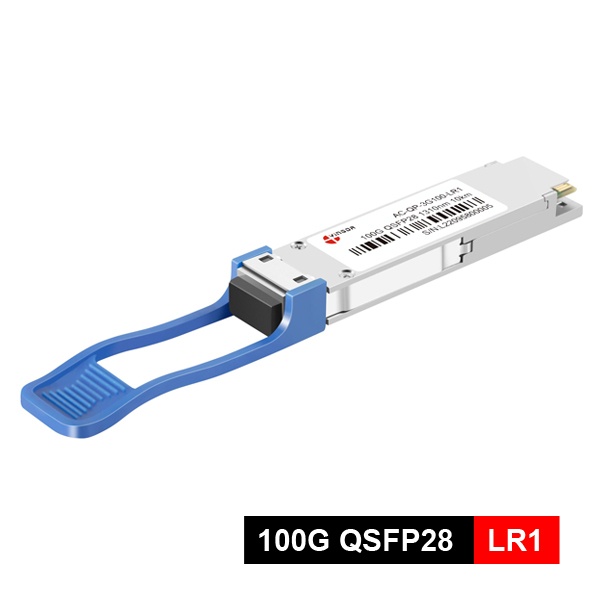
100G LR1 (Single Lambda)
Disadvantages: DSP chips have slightly higher power consumption and may generate small processing delays.
Working principle: 100G LR1 10km use a DSP chip to re encode the 4x25G NRZ electrical signal on the switch side and convert it into one 100G PAM4 optical signal.
Advantages: The internal optical structure is extremely simple (1 laser+1 detector), and theoretically higher reliability; It is the key to implementing a 400G Breakout connection and can communicate with 400G LR4 ports (via 1 to 4 MTP fanout cable).
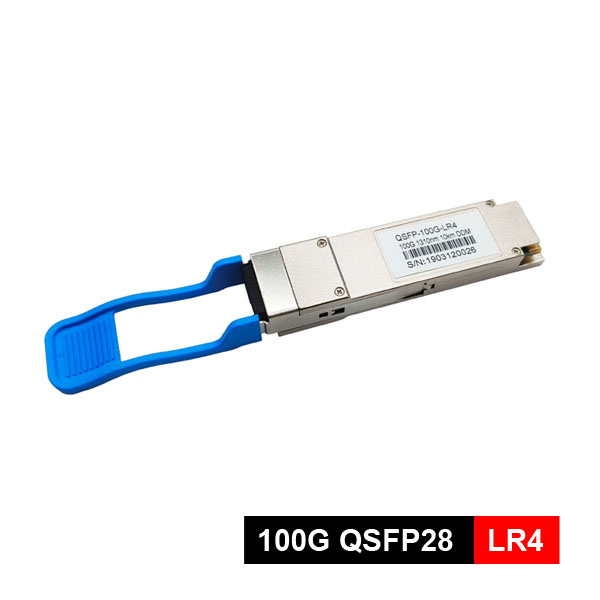
100G LR4 (Traditional)
Woking principle: 100GBASE LRL4 adopt four laser channels to work in parallel, with each channel running 25G NRZ. Finally, one channel of light is synthesized through an internal multiplexer (MUX).
Advantages: The technology is extremely mature, the compatibility is the widest (almost all old 100G switches support it), and because DSP conversion is not required, the latency is extremely low.
Disadvantages: There are 4 sets of lasers and combined splitters inside 100Gbase LRL4, with complex optical structures and high component costs.
Compatibility reminder (very important)
Not compatible with each other: Although 100G LR1 LR4 are both LC interfaces and run 10km, they cannot communicate with each other. Because one is a 1-channel light and the other is a 4-channel light, and the modulation signal (PAM4 vs. NRZ) is completely mismatched.
FEC requirements:
① LR1: RS-FEC must be enabled to function properly.
② LR4: It can usually work without FEC (or optional according to IEEE standards).
How to choose between QSFP 100GBASE LR4 or LR1?
- Choose 100G LR4 Optics: Your existing network is a pure 100G environment, or you are connected to an old switch that does not support PAM4. LR4 is currently the most reliable and compatible 10km solution.
- Choose 100G LR1 Optics: You are deploying a 400G core network and need to split the 400G ports into four 100G links using Breakout cables.