Skip to content
100GBASE DR1, FR1, and LR1 all adopt 100G Single Lambda (PAM4) technology standards (1310nm wavelength). There is only one laser (TOSA) and one detector (ROSA) inside, unlike early 100G optical fiber modules such as PSM4 or CWDM4 that required four 25G lasers. The electrical interface of DR1/FR1/LR1 modules is standard 100GAUI-2 (using 2 56Gbps PAM4 electrical signal channels, totaling 112Gbps, with a payload of 100Gbps). They are physically compatible with each other and can be mixed. However, if mixed, the link performance (maximum distance) will be based on the module with poorer performance.
The specific differences DR1 vs FR1 vs LR1
In addition to transmission distance (500m/2km/10km), there are deep differences in optical components, standard definitions, power consumption, application logic, and interoperability among the three types of single wavelength (Single Lambda) optical modules: 100G DR1, FR1, and LR1.
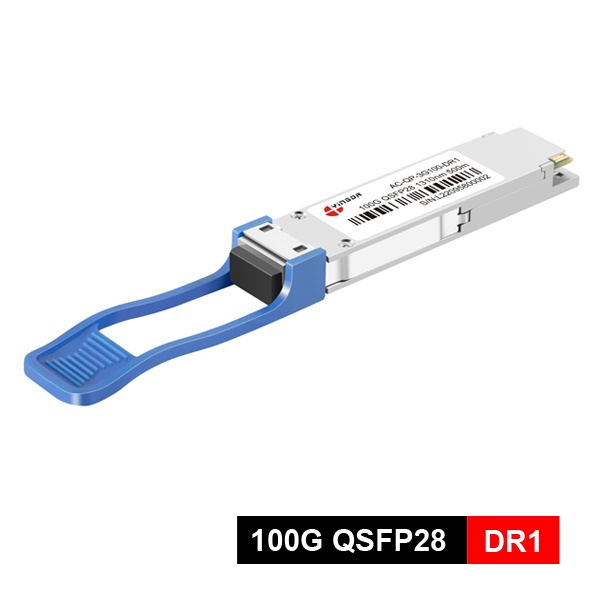
100GBASE DR1
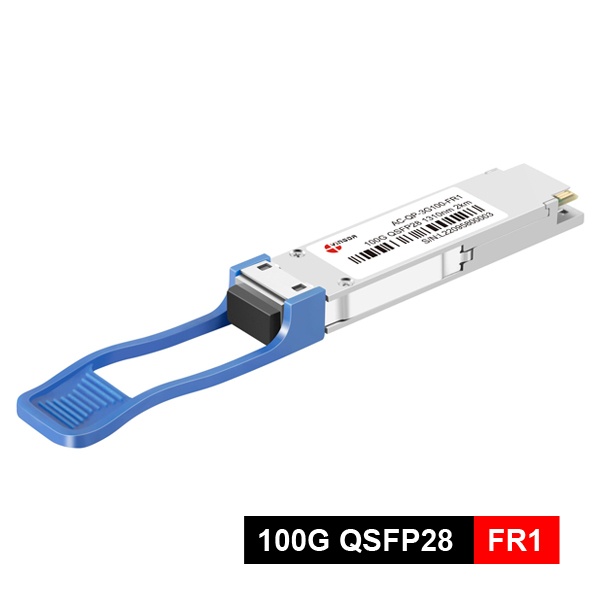
100GBASE FR1
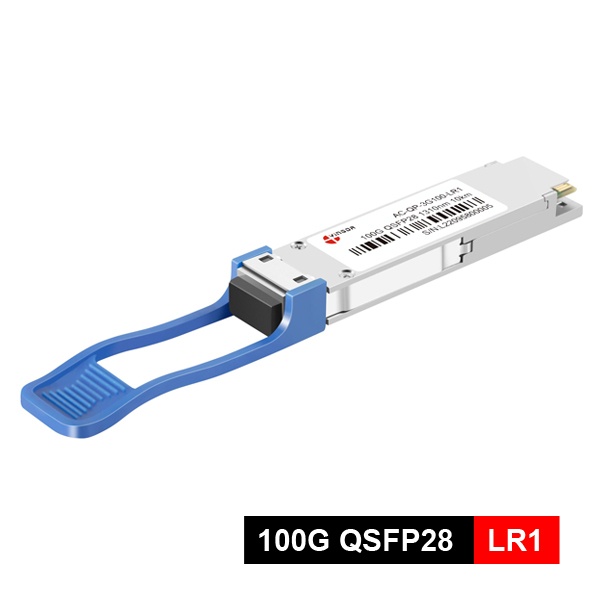
100GBASE LR1
1. Different transmission distances:
- 100GBASE DR1: Max. Transmission distance is 500 m
- 100GBASE FR1: Max. Transmission distance is 2 km
- 100GBASE LR1: Max. Transmission distance is 10 km
2. Laser type and cost
Due to different transmission distances, they have different requirements for the emission power of the laser:
- 100GBASE DR1: Low cost silicon photonics technology or DML (direct modulation laser) is commonly used. Due to its extremely short distance, it has the lowest requirements for dispersion and attenuation, no need high optical power, so the component cost is the lowest.
- 100GBASE FR1: Located in the middle zone, DML or slightly better performing EML (electroabsorption modulated laser) is usually used. It requires a more stable emission frequency than DR1 to ensure signal quality after 2 km of transmission.
- 100GBASE LR1: High performance EML (Electro Absorption Modulation) lasers must be used. In order to ensure that the signal remains clear after 10 km of transmission, the laser technology of LR1 is the most complex, the luminous power is also the strongest, and the cost is the highest.
3. Focus on standard protocols
- DR1/FR1: The core standard is defined by the 100G Lambda MSA (Multi Source Protocol) organization. The original intention of their design is to cooperate with the 400G DR4/FR4 module for 1 to 4 Breakout, mainly serving the internal of ultra large scale data centers and providing them with a highly cost-effective interconnection solution.
- LR1: In addition to complying with the MSA protocol, it also follows the IEEE 802.3cu standard. LR1 is more commonly seen as a low-cost alternative to traditional 100G LR4 (4-channel 25G) for single link transmission in industrial parks or metropolitan area networks.
4. Power consumption difference
- DR1/FR1: Power consumption is usually low (about 3.5W-4W). Due to the fact that lasers do not require strong driving, the driving current is small, so the heat dissipation pressure is low.
- LR1: Slightly higher power consumption (usually between 4W-4.5W or higher). In order to ensure long-distance signals, high-performance lasers and more complex DSP (digital signal processing) compensation logic require more power consumption.
5. Interoperability risk (pay attention to optical power)
Although they are all PAM4 modulations, they cannot be randomly mixed due to differences in optical power:
- Overload risk: The transmission power of LR1 is extremely strong. If you directly dock LR1 with DR1 within a short distance (such as 100 m), it is highly likely to cause damage or burnout to the receiver of DR1 due to excessive optical power. This asymmetric connection requires the use of 5dB -10dB optical attenuators.
- Backward compatibility: In theory, you can connect the link of FR1 with LR1 module (with more than enough distance).
Comparison Table
| Item | 100G DR1(short distance) | 100G FR1(medium distance) | 100G LR1(long distance) |
| Max. distance | 500 m | 2 km | 10 km |
| Typical laser | Silicon Photonics / DML | DML / EML | EML (high-end) |
| reception sensitivity | Poor (-4.0 dBm to -5.9 dBm) | Medium (-4.5 dBm to -6.4 dBm) | Best (-6.1 dBm to -7.7 dBm) |
| link budget | Minimum (about 3.0 dB) | Moderate (about 4.0 dB) | Maximum (approximately 6.3 dB) |
| power consumption | Approximately 3.5W to 4.5W | Approximately 3.5W to 4.5W | Approximately 3.5W to 4.5W |
| working wavelength | 1311nm (single wavelength) | 1311nm (single wavelength) | 1311nm (single wavelength) |
| interface type | Duplex LC | Duplex LC | Duplex LC |
| 400G interconnection | Standard configuration for 400G DR4 breakout | Corresponding to 400G FR4 | Corresponding to 400G LR4 (6km/10km) |
| Main applications | Cabinet room/spine leaf architecture | Between buildings in the park | Metropolitan Area Network/Long Distance Backbone |
NOTES: The power consumption and reception sensitivity parameters of some actual products may vary slightly due to differences in manufacturers and packaging. The data in the table above are typical values.
Application Difference of 100G DR1/FR1/LR1 modules
The application scenarios of these three modules are mainly determined by their coverage range and network architecture:
1. 100G DR1 (500 m) – Internal interconnection of the computer room
This is the most commonly used single wave module in the computer room.
Application scenario: Interconnection of switches within the same data center (Leaf to Spine layer).
- 400G breakout into 4x100G: The most typical usage is to connect 4 servers or 100G switches through MPO to 4LC breakout cable in conjunction with a 400G DR4 CISCO compatible transceiver.
- Replace DAC attach cable: When the distance between cabinets exceeds 7 meters (DAC limit) but is less than 500 m, use DR1 to replace expensive or bulky cables.
2. 100G FR1 (2 kilometers) – Interconnection between buildings in the park
This is the most economical option within the park.
Application scenario: Connection between different buildings or data halls in the data center park.
- Medium distance backbone: suitable for vertical cabling across floors or buildings.
- High cost-effectiveness: Its price is much lower than LR1, but a distance of 2 km is enough to cover more than 90% of the needs of enterprise parks.
3. 100G LR1 (10 kilometers) – City level/Backbone Network Connection
This is a long-distance plan that spans across regions.
Application scenario: Interconnection of two data centers (DCI) across urban areas, or operator’s metropolitan area network.
- Single wavelength scaling: Compared to traditional LR4 (four wavelength), LR1 architecture is simpler. It is currently the main force in the evolution of 100G metropolitan area networks towards single wavelength.
- 5G backhaul: used for long-distance transmission from base station aggregation points to the core network.
How to choose?
After understanding their differences, the choice becomes very clear, Yingda suggestions are as below:
- Within a distance of 500 meters, in scenarios such as between cabinets, short distances, and 400G splitting, pursuing cost-effectiveness, choose DR1. It is designed specifically for short distance interconnection between cabinets or within the same floor, with the best cost, such as wiring within the same computer room..
- Distance between 500 meters and 2 kilometers like across buildings, if you budget is no limited, and want to leave some space, choose FR1. This is the distance that DR1 cannot cover, FR1 is the standard choice within this range, such as between two buildings on campus.
- Distance between 2 km and 10 km like cross city, long-distance transmission, operator level, choose LR1. It is the only standard module that can meet this distance requirement.
- Special case – short distance but poor link quality: Although the distance is only a few hundred meters, if there are too many fiber fusion points, aging joints, or poor fiber quality, it is recommended to “reduce dimensions and strike” and choose LR1. Utilize its better receiving sensitivity to overcome high link losses and ensure stability.