Skip to content
In the selection of 200G laser transceivers, QSFP56 and QSFP-DD represent two completely different technological routes: one is the PAM4 upgrade faction that pursues bandwidth density, and the other is the multi-channel NRZ faction that pursues low power consumption and compatibility.
What are PAM4 and NRZ?
In high-speed data transmission, NRZ (Non Return to Zero) and PAM4 (Four Stage Pulse Amplitude Modulation) are the two most fundamental signal encoding techniques. Simply put, NRZ is like a switch with only “on” and “off”, while PAM4 is like a dimmer with four brightness levels. If we compare fiber optics to highways, NRZ makes cars drive faster and faster (but with limits); PAM4, on the other hand, converted a single decker truck into a double decker bus while maintaining the same speed, thus doubling its transportation capacity.
NRZ (Non-Return-to-Zero)
NRZ is a binary signal that uses two voltage levels to represent 0 and 1. Transmit 1 bit per symbol cycle. Excellent signal-to-noise ratio (SNR), mainly used in 1G/10G/25G/100G networks, with low system complexity.
- Advantages: There are only two levels, and the distance between the levels (noise tolerance) is large, making it less susceptible to interference. The circuit implementation and testing are very mature and cost-effective. No need for complex digital signal processing (DSP) or strong error correction (FEC).
- Disadvantage: As the speed increases (such as exceeding 25Gbps), the loss requirements for the transmission medium (fiber optic or copper cable) are extremely high, and the physical improvement space encounters bottlenecks.
PAM4 (Pulse Amplitude Modulation 4-level)
PAM4 uses four voltage levels (00, 01, 10, 11). Transmit 2 bits per symbol cycle. The signal-to-noise ratio is poor, with a loss of about 9.5dB, so it is mainly used in 50G/200G/400G/800G networks,
- Advantages: At the same baud rate (signal change frequency), the data transmission rate is twice that of NRZ. This makes high-speed transmission of 200G/400G possible. Due to the fact that high bandwidth can be achieved without the need for extremely high frequencies, it alleviates the pressure on the physical performance of the transmission channel.
- Disadvantage: Due to the reduced level spacing (only 1/3 of NRZ), the signal is more susceptible to interference, resulting in an increase in bit error rate (BER). It is usually necessary to integrate DSP chips for signal recovery and compensation, and it must be used in conjunction with FEC (Forward Error Correction).
Let’s use a table to compare them:
| Modulation type | NRZ (Non-Return-to-Zero) | PAM4 (4-Level Pulse Amplitude Modulation) |
| Number of levels | 2 pcs (0, 1) | 4 pcs (00, 01, 10, 11) |
| Single symbol bit count | 1 bit | 2 bits |
| Bandwidth efficiency | lower | High (doubling bandwidth at the same frequency) |
| Signal to Noise Ratio (SNR) | excellent | Poor (loss of approximately 9.5-10 dB) |
| Bit Error Rate (BER) | extremely low | Higher (must be combined with FEC error correction) |
| Hardware complexity | Simple and low-cost | Complex (requiring DSP and high-precision ADC/DAC) |
| power consumption | low | High (due to the need for complex signal processing) |
| Main applications | 1G/10G/25G/100G Ethernet | 200G/400G/800G Ethernet, PCIe 6.0 |
Why is the industry shifting towards PAM4?
When the network speed increases to 50Gbps per channel and above, if NRZ is continued to be used for acceleration, the signal frequency (baud rate) must be doubled, which will cause extremely severe signal loss in copper cables and PCBs. However, PAM4 can double the throughput without increasing the physical channel frequency. This allows us to continue using existing fiber optic and partial cable infrastructure to achieve speeds of 400G or even 800G.
Due to PAM4 dividing the same voltage space into four parts, the spacing (eye height) between each level is only one-third of NRZ, making it highly sensitive to noise. To address the issue of PAM4 being prone to errors, the 200G/400G laser transceivers must incorporate high-performance DSP (Digital Signal Processing) and FEC (Forward Error Correction) technologies.
Comparison of Power Consumption and Delay
Due to the modulation difference between 200G QSFP56 and QSFP-DD, their power consumption and latency are different.
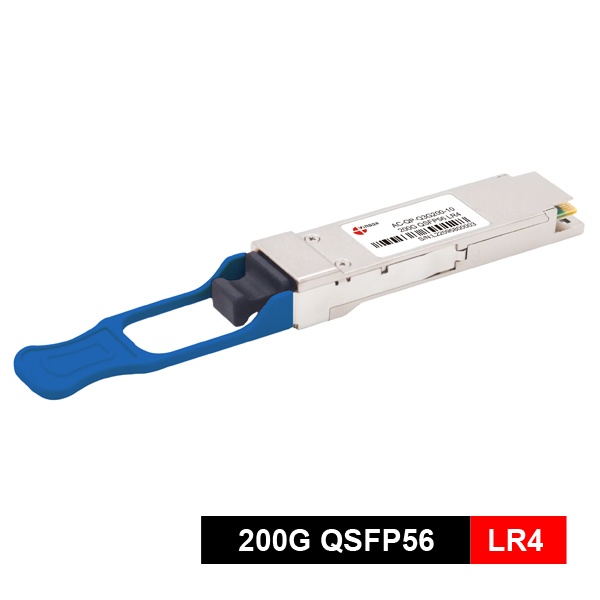
- 200G QSFP56 uses complex density conversion and 4x100G PAM4 modulation method, requiring the configuration of DSP chip for signal reassembly, mainly used for Ethernet and cloud data centers.
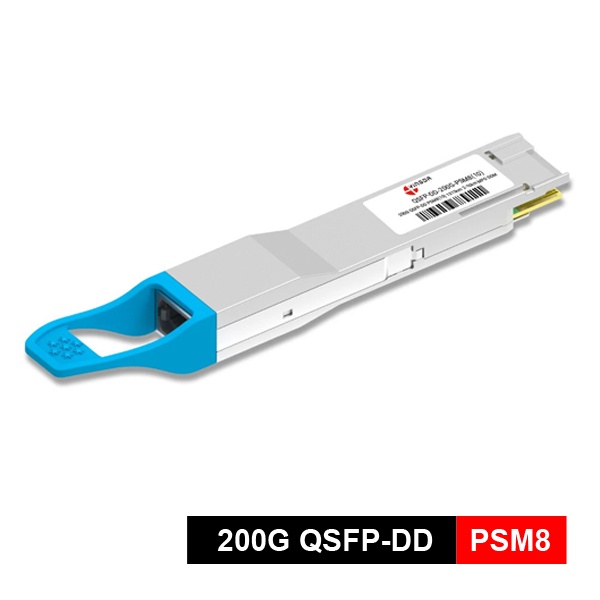
- The 200G QSFP-DD uses channel count for performance and adopts the 8x25NRZ standard. It only requires CDR signal amplification and does not require DSP chips. It is commonly used in AI computing nodes, high-performance storage (HPC) and other scenarios.
1. Power Consumption
The difference in power consumption for 200G QSFP-DD and QSSFP56 is mainly due to the working pressure and number of channels of the internal signal processing chip (DSP).
| Package type | 200G QSFP56 | 200G QSFP-DD |
| typical power consumption | 5.5W – 7.5W | 3.5W – 5.0W |
| Core reasons | Using 4x50G PAM4, it is necessary to have a high-performance DSP built-in for complex level analysis, as DSP is a major power consumer. | Adopting 8x25G NRZ, the modulation method is simple, usually requiring only a simple CDR (clock data recovery) chip, significantly reducing power consumption. |
| Thermal density | Higher. Fewer pins carry higher power, resulting in greater heat dissipation pressure. | Lower. Although there are many pins, the heat generation per unit area is relatively small, and the packaging design optimizes thermal conductivity. |
From the previous table, we conclude that at a speed of 200G, QSFP-DD (8x25G NRZ) saves about 30% -40% of electricity compared to QSFP56. During large-scale deployment, this can significantly reduce the PUE value of data centers.
2. Latency
Latency is the most critical indicator in high-performance computing (HPC) and high-frequency trading (HFT) scenarios.
| Package type | 200G QSFP56 (PAM4) | 200G QSFP-DD (NRZ) |
| processing delay | Higher (usually at the 100ns level) | Extremely low (usually in the 1ns range) |
| FEC requirements | Forward Error Correction (FEC) must be enabled. PAM4 has a low signal-to-noise ratio and cannot communicate normally without FEC. | Optional activation. The quality of NRZ signal is stable, and FEC can be turned off to reduce delay at short distances (such as DAC). |
| The additional delay caused by FEC | Enabling KP4 FEC will increase the fixed delay by approximately 100ns to 150ns. | If FEC is turned off, the delay is almost zero; Even with basic FEC enabled, the latency is much lower than PAM4. |
From the previous table, we can see that the delay performance of QSFP-DD (NRZ) is much better than QSFP56. For AI training clusters that are extremely sensitive to speed, the NRZ scheme is a more ideal choice.
How to choose PAM4 and NRZ for your laser transceiver?
Please choose QSFP-DD (8x25G NRZ) laser transceiver for the following situations:
- You are building an InfiniBand network or AI computing cluster (such as using NVIDIA HDR technology).
- You are extremely sensitive to latency and cannot tolerate the microsecond level cumulative delay caused by FEC.
- You need lower power consumption to reduce the heat dissipation expenses in the data center.
Please choose QSFP56 (4x50G PAM4)laser transceiver for the following situations:
- Your switch only has QSFP traditional ports (single row gold fingers) and does not support DD encapsulation.
- You hope the wiring is simpler (fiber jumpers that come with 4-channel solutions are usually simpler).
- You mainly run general cloud services and are not sensitive to delays of tens of nanoseconds.