Skip to content
The two package types for 200G fiber optic transceivers are QSFP56 and QSFP-DD, both of which support hot pluggable. They achieve 200G transmission through different technical approaches (4x50G PAM4 or 8x25G NRZ), each suitable for different data center network interconnection requirements. QSFP56 achieves 200G primarily by improving the efficiency of individual channels (50G PAM4), while QSFP-DD reaches 200G by increasing the number of channels (8 channels).

Let’s take a detailed look at their specific differences below:
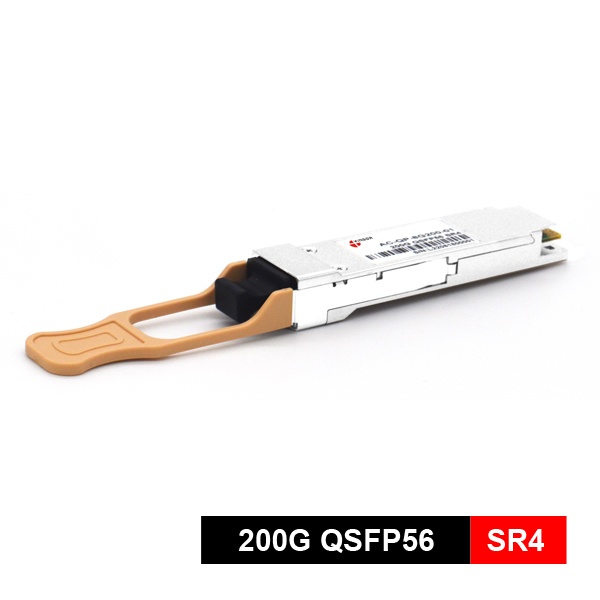
1. QSFP56 package (4x50G PAM4)
This is an upgraded version of 40G QSFP+ and 100G QSFP28, designed specifically for 200Gb Ethernet.
- Features: Transmit 4 channels of 50Gb/s to 56Gb/s signals within the QSFP package.
- Main technology: Adopting PAM4 (4-level pulse amplitude modulation) modulation technology, doubling the transmission rate of each channel from 25G to 50G.
- Application scenario: Widely used for high-speed, high-density interconnection within data centers.
- Popular part no.: QSFP 200G SR4 S (short distance multi-mode), QSFP 200G FR4 S (single mode 2km), 200G QSFP56 LR4 (single mode long distance 10km).
2. QSFP-DD package (8x25G NRZ or 8x50G PAM4)
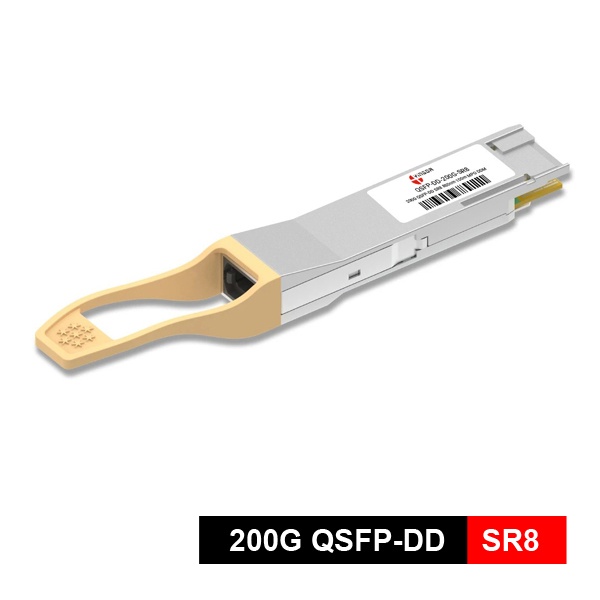
DD “stands for Double Density, and its interface has two rows of gold fingers. High port density, 1U panel can support more ports, compatible with existing QSFP28, QSFP56, QSFP+ modules, greatly facilitating smooth network upgrades.
- Features: Quad Small Form Factor Pluggable Double Density (QSFP-DD).
- Main technology: Typically, 8 channels are used, each with 25G NRZ (economical) or 50G PAM4 to achieve a total bandwidth of 200G.
- Low power consumption and low latency: NRZ modulation is simpler than PAM4, with power consumption reduced by 2-3W and extremely low latency.
- Application scenarios: Widely used in DCI ToR to spine switches, short-range rack connections, as well as ultra large scale cloud computing networks, high-performance computing networks, and 5G bearer networks.
- Popular part no.: 200G SR8, 200G PSM8, 200G LR8.
Conclusion
Based on different modulation techniques and channel designs, Yingda summarizes two general differences as shown in the table below:
| Pack type | QSFP56 | QSFP-DD |
| Full name | Quad Small Form-factor Pluggable 56 | Quad Small Form-factor Pluggable Double Density |
| Mumber of channels | 4 Lane | 8 Lane |
| Single channel rate | 50 Gbps | 25 Gbps |
| Modulation technique | PAM4 (four level pulse amplitude modulation) | NRZ (Non Return to Zero Modulation) |
| Main advantages | High bandwidth density, saving fiber optic costs | Lower power consumption, smaller latency, and stronger compatibility |
| Compatibility | Backward compatibility with QSFP+ and QSFP28 | Backward compatibility with QSFP+, QSFP28, QSFP56 |
Supplementary packaging: SFP-DD vs OSFP
Although SFP-DD and OSFP are not as common as the QSFP-DD and QSFP56, they may also be mentioned in specific scenarios:
- SFP-DD: A compact double density package primarily designed to support high-speed connections of 50G/100G, but it is less commonly used as a standalone fiber optic transceiver in the 200G ecosystem.
- OSFP: Although typically associated with 400G, it also has applications in some next-generation 200G (such as 200G per lane technology) or InfiniBand networks (such as NDR 200G).