Skip to content
In 200G network deployment, the 200G QSFP56 to 2x100G QSFP28 Breakout scheme (i.e. splitting 1x200G into 2x100G) is a very practical architecture, mainly used for interconnecting Spine-Leaf switches or connecting switches to server network cards.
The following is a detailed introduction of solutions for different packaging and scenarios:
Option 1: Direct Cable Breakout Scheme (DAC/AOC)
This is the lowest cost and lowest power consumption solution within the cabinet (1-3 meters) or between cabinets (3-30 meters).
Physical composition: One end is a 200G QSFP photonic transceiver, and the other end is divided into two 100G SFP photonic transceivers.
Common models:
- 200G QSFP56 to 2x 100G QSFP28: it is the most mainstream. By dividing 4 x 50G PAM4 channels into two groups (each group 2x50G).
- 200G QSFP-DD to 2x 100G QSFP28: Utilize 8 x 25G NRZ channels, with every 4 channels forming a 100G.
Applicable scenarios:
- DAC breakout cable (SFP copper cable): distance<3m, used for connecting the top of cabinet switch (ToR) to the server below.
- AOC breakout cable (active optical fiber): Distance of 3m to 30m, used for interconnecting switches between cabinets in the same row.

Option 2: Fiber optic breakout scheme (based on MPO interface)
When the distance exceeds 30 meters (usually within 100 meters), photonic transceivers need to be used in conjunction with branch jumpers.
Hardware configuration:
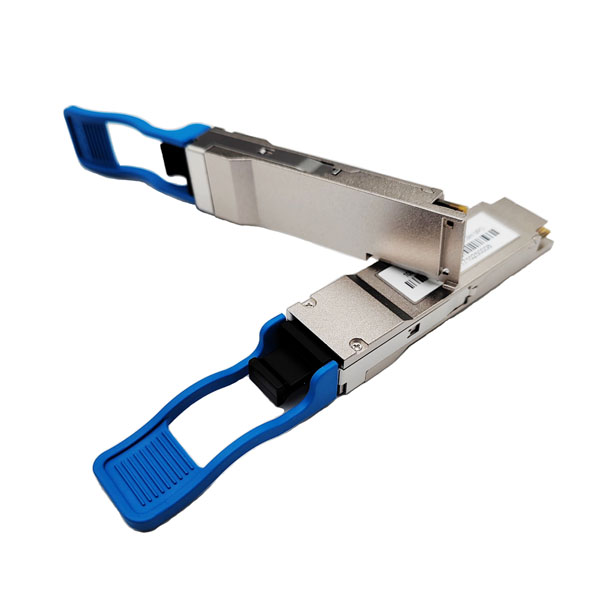
- 200G photonic transceiver: must be a parallel transmission model, such as 200G SR4 (QSFP56).
- 100G photonic transceiver: 2 x 100G SR2 (note: not standard SR4, as it needs to match 50G PAM4 rate).
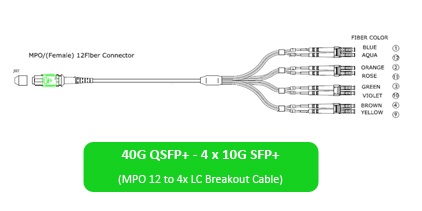
- MPO/MTP Breakout cable: MPO 12 to 2x MPO 12 breakout cable.
Working principle:
There are four 50G channels inside the 200G SR4 module, and branch jumpers direct channels 1 and 2 to the first 100G module, and channels 3 and 4 to the second.
Applicable scenarios: Short distance high bandwidth connections in data center machine rooms.

Option 3: High density interface breakout scheme (CS/SN interface)
This is an advanced solution for QSFP-DD packaging, which utilizes smaller optical interfaces to achieve direct branching at the physical level.
Feature: The optical port of the photonic transceiver is no longer a single LC or MPO, but two independent CS or SN interfaces.
Advantages:
- No need for breakout cable: Connect directly using two standard single-mode/multi-mode patch cables.
- Easy maintenance: The link is clear, and a 200G port looks like two independent 100G ports physically.
Typical model: 200G QSFP-DD 2x 100G PSM4 transceiver
Three solutions comparison
| Solution Type | Transmission medium | Typical distance | Cost | Complexity | Recommended scenarios |
| DAC breakout cable | copper cable | < 3m | extremely low | minimalist | ToR switch inside the cabinet to the server |
| AOC breakout cable | Fiber optic (non removable) | 3m – 30m | low | simple and convenient | Interconnection between cabinets in the same row |
| SR4+MTP breakout cable | Multimode optical fiber (OM4) | < 100m | middle | tall | Cross machine room connection, requiring 100G module matching |
| PSM4+CS/SN interface patch cords | Single mode/multi-mode | < 500m | tall | middle | High density wiring, pursuing ease of maintenance |
Selection precautions
1. Rate matching: The 100G signal from the 200G QSFP56 brreakout is usually 50G PAM4. The 100G device at the receiving end must be able to recognize this signal (such as 100G DR or 100G FR), and traditional 100G SR4 (4x25G NRZ) may not be directly compatible.
2. Breakout mode: You must enter the switch backend and manually set the 200G port command to split or breakout mode (e.g. interface breakout 1/1 map 100g-2x).
3. Encapsulation compatibility: Confirm whether the switch is QSFP56 or QSFP-DD, which determines which branch cable’s gold finger end you buy.