Skip to content
PAM4, PSM4, CWDM4, LWDM4 are the most core specialized terms in the optical communication industry. The first step we need to take is to categorize them:
- PAM4 is a modulation method for electrical/optical signals (solving the problem of how signals are encoded).
- PSM4, CWDM4, and LWDM4 are three different “optical path architectures/transmission solutions” pf optical modules (solving the problem of how light runs in optical fibers).
Their core differences and essential characteristics are as follows:
Modulation method: PAM4 (4-stage pulse amplitude modulation)
It is not in parallel with the other three concepts. PAM4 is a technical method that can be applied in PSM4, LWDM4, or CWDM4 transceivers.
- Essence: Traditional NRZ signals only have two levels, “0” and “1”. PAM4 has four levels: 0, 1, 2, and 3.
- Effect: It can transmit 2 bits of data in the same clock cycle, doubling the signal transmission rate directly. It is the underlying cornerstone of 200G, 400G, 800G, and modern single lambda 100G transceivers (such as 100G DR1/FR1/LR1).
Three Brothers of Optical Architecture: PSM4 vs CWDM4 vs LWDM4
These three are in a parallel relationship, representing different combinations of “laser wavelength” and “number of fibers used” within the fiber optic module.
Solution A: PSM4 (Parallel Single Mode 4-channel) – Cost Reduction through “Stacked Fiber”
- Core feature: Internally using 4 lasers with identical wavelengths (usually 1310nm).
- Fiber optic usage: It does not perform wavelength multiplexing, but instead uses a specially designed MPO pigtail (containing multiple independent fiber cores inside) to allow 4 signals to run in parallel in 4 independent fibers.
- Advantages and disadvantages: The fiber optic module does not have a MUX/DEMUX inside, resulting in a single wavelength and extremely low module cost. But because it consumes 8 core fiber optic cables (4 transmitter and 4 receiver), the cost of fiber optic cabling is extremely high, so it is only suitable for short distance data center interconnection within 500 meters.
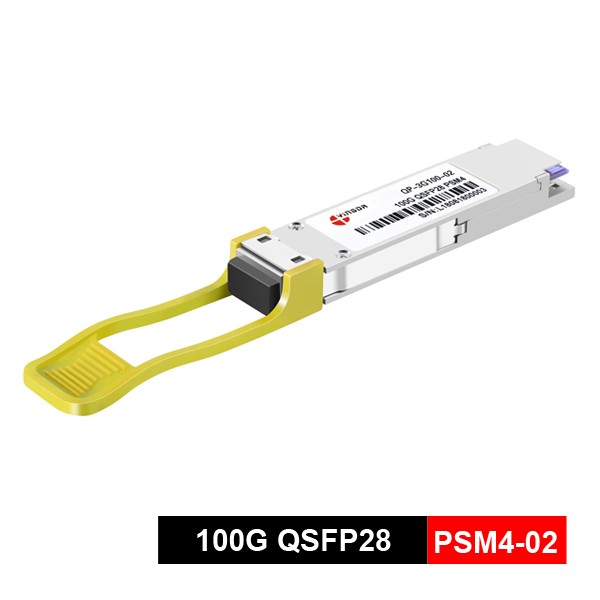

Solution B: CWDM4 (coarse wavelength division multiplexing 4-channel) – cost reduction through “no cooling”
- Core feature: Internally using 4 different wavelengths with very wide wavelength intervals (20nm): 1271, 1291, 1311, 1331 nm.
- Fiber optic usage: Four wavelengths are twisted into one beam of light through an internal MUX (multiplexer), and only one single mode fiber (two fibers in both directions) is needed for transmission.
- Advantages and disadvantages: Due to the large wavelength spacing, the laser does not require TEC cooling chips (allowing temperature drift), and the module cost and power consumption are very balanced. It is the absolute king of 2km interconnection in data centers (such as 100G CWDM4 transceivers).
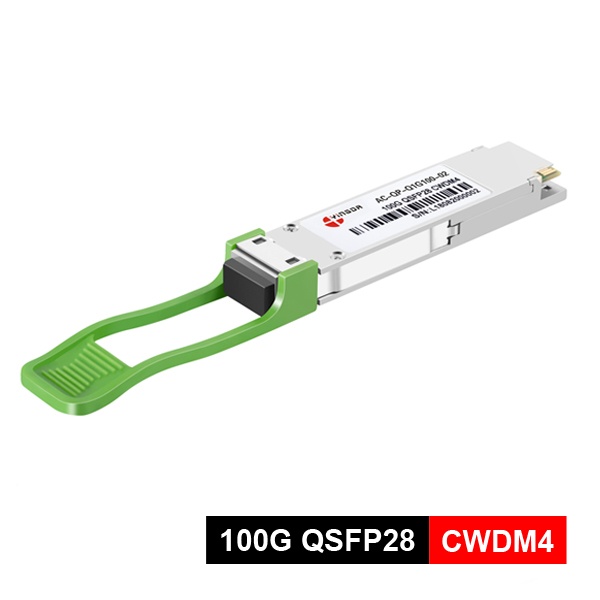
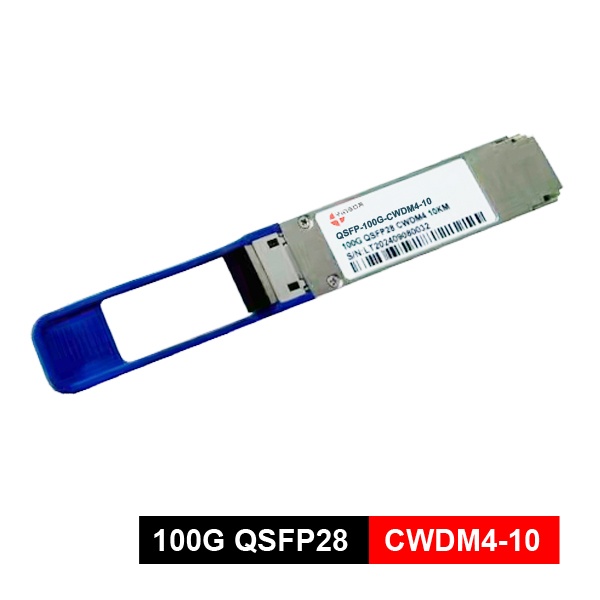
Solution C: LWDM4 (fine/LAN wavelength division multiplexing 4-channel) – running long distances with “high precision”
- Core feature: Internally uses 4 different wavelengths, but the wavelength spacing is very narrow (about 4.5nm). It is also the LAN-WDM Golden 4 wave (1295.56, 1300.05, 1304.58, 1310.92 nm).
- Fiber optic usage: Using the same MUX multiplexing technology, only 1 single-mode fiber (2 fibers bidirectional transmission) is needed for transmission.
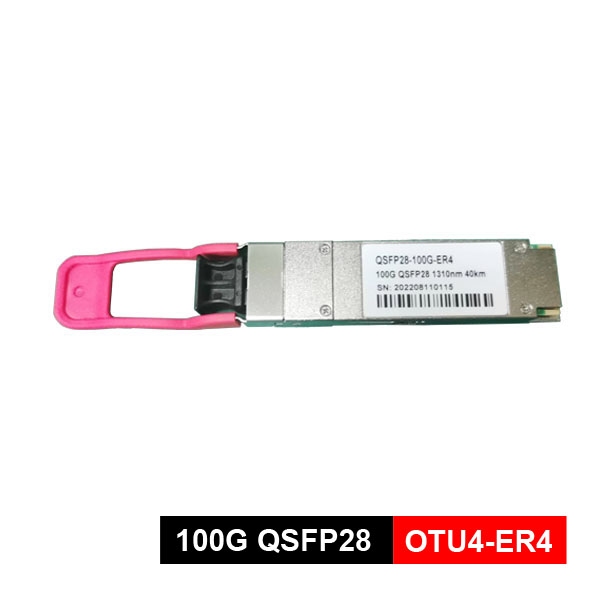
- Advantages and disadvantages: Because these four wavelengths are tightly squeezed in the “zero dispersion region” of SMF fiber, the signal will not deform even after traveling several kilometers or even tens of kilometers in the fiber (with extremely low dispersion). But the cost is that the laser must be equipped with TEC cooling for precise temperature control and wave locking. The fiber optic module cost is high and the power consumption is high, specifically designed for long-distance carrier grade networks ranging from 10 km (QSFP 100G LR4 C )to 40 km (QSFP28 ER4 100G).
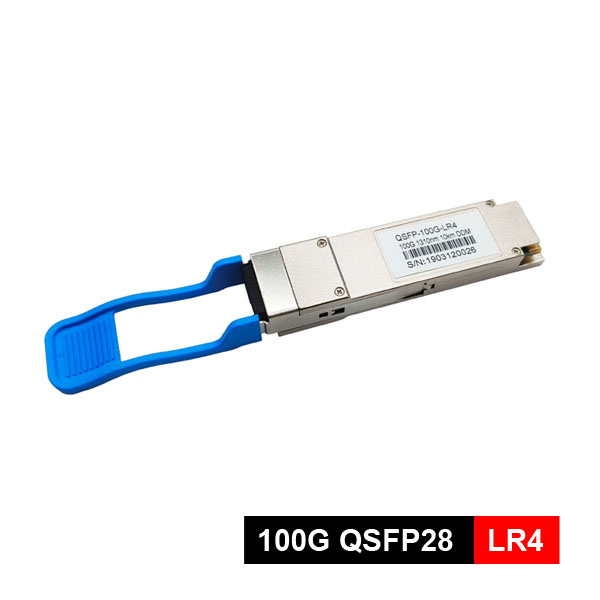
| Optical Architecture Type | PSM4 | CWDM4 | LWDM4(LAN-WDM) |
| Number of wavelengths | 1 (all 4 channels are 1310nm) | 4 (1271-1331nm) | 4 (1295-1310.92nm) |
| Wavelength interval | None (same wavelength) | 20 nm (extremely wide) | 4.5 nm (extremely narrow) |
| Number of external optical fibers | 8 Fiber MPO interface | Duplex LC interface | Duplex LC interface |
| Is TEC cooling included | No (no cooling) | No (no cooling) | Yes (strict refrigeration is required) |
| Bottom level modulation | NRZ or PAM4 can be used | NRZ or PAM4 can be used | NRZ or PAM4 can be used |
| Typical transmission distance | 500 m | 2 km | 10km-40km |
| Typical application examples | 100G PSM4 / 400G DR4 | 100G CWDM4 / 400G FR4 | 100G LR4 / 100G ER4 / 400G LR8 |
Conclusion
✅PPAM4 is a method of “packaging” signals, and among the four concepts, it is the only modulation mode.
- If you want fiber optic to be cheap, run far, and have stable performance, choose LWDM4.
- If you want cheap modules, moderate distance, and don’t want cooling, choose CWDM4.
- If you have short distance connectivity, fiber optic tubing, and pursue ultimate low power consumption, choose PSM4.