Skip to content
As we all know that, there are two SFP connector types, LC and SC. There is no difference in the performance, transmission rate, 10 kilometer distance, and optoelectronic parameters of the internal laser, the core difference between SC and LC interfaces lies in their physical structure and the application scenarios determined by it.
SFP LC connector is currently the mainstream choice for new network construction, while SFP SC connector is more commonly used in specific reuse or industrial environments.
SFP Fiber Connector LC vs SC
SFP LC Connector
- Size: LC is a micro interface with a size only about half that of SC.
- Advantages: On the narrow panel of SFP modules, the LC interface is very compact. This makes the module pull tab easier to operate and the insertion and removal smoother.
- Popularity: It is currently the absolute mainstream and most standard single core interface for SFP modules.
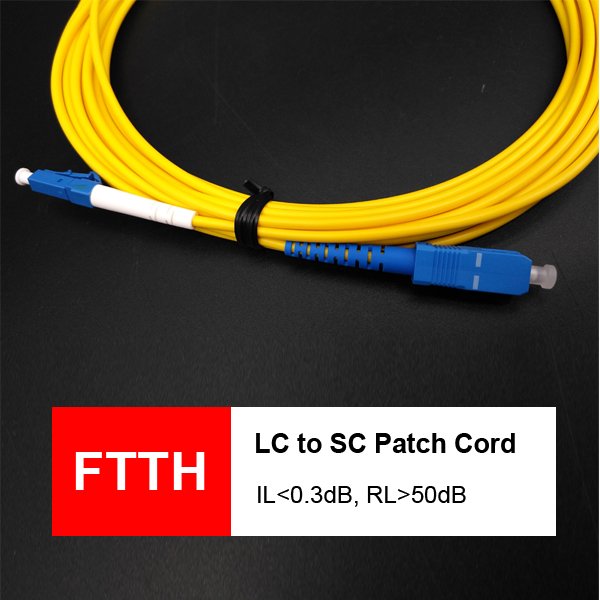
- Compatible fiber optic patch cord type: The SFP LC module must be paired with single mode patch cord LC LC simplex or LC to SC patch cord single mode simplex (The module end must be LC UPC blue connector, not APC).

SFP SC connector
- Size: SC is a standard square head with a larger volume.
- Disadvantage: Due to the large size of the SC interface, forcibly installing it on SFP modules can appear extremely crowded. The plastic pull tab of the module is usually designed to be very thin or uses a special structure, making it easy for fingers to get stuck during insertion and removal. It is rarely used in high-density switches.
- Compatible fiber optic patch cord type: It must be paired with simplex SC to SC single mode fiber cable (the SFP SC module optical interface must be SC UPC blue connector).

| SFP Fiber Connector | SFP SC Connector | SFP LC Connector |
| Structural dimensions | Larger, using 2.5mm ceramic inserts and a square push-pull structure. | Smaller, using 1.25mm ceramic inserts, with a volume only half that of SC. |
| Connection method | Push pull locking, simple and intuitive operation, there will be a snap feeling when inserting, but the risk of loosening is slightly higher after long-term use. | Snap on locking, stable connection, clear confirmation, similar to RJ45 Ethernet interface. |
| Port density | Lower. Due to its large size, the number of ports that can be deployed on the switch panel is limited. | Very high. In the same space, LC port density is twice that of SC, making it very suitable for high-density environments such as core switches and data centers. |
| Durability | It usually supports about 1000 insertions and removals, making it more sturdy and durable. | Usually supports about 500 insertions and removals, which is sufficient for the vast majority of indoor scenarios. |
| Main application scenarios | Commonly seen in traditional network upgrades, FTTx fiber to the home, industrial control, and other environments that do not have strict space requirements or require frequent on-site operations. | It is the de facto standard for mainstream high-speed networks such as data centers, enterprise campus networks, and metropolitan area networks today, and also the default interface for the vast majority of new switch devices. |
How to choose?
Firstly, it needs to be clarified that there is no difference in transmission performance between SC and LC interfaces at a speed of 1.25G. As long as the fiber is matched, they can stably support a transmission distance of 10 km. So the key is to look at the interface type on the network device.
Type 1: Scenario for Selecting SFP LC Connector
- Currently, over 95% of newly built networks will choose LC interfaces. Please choose SFP LC modules directly for easier maintenance and purchasing fiber patch cables in the future.
- Mainstream switches: Standard enterprise level switches such as Cisco, Huawei, H3C, etc. are recommended to use LC without occupying adjacent port space.
Type 2: Scenario for selecting SFP SC Connector (mainly for “backward compatibility”)
- Old project renovation: The existing fiber optic distribution frame (ODF) in the computer room or the fiber optic panels on the walls have already been equipped with a large number of SC to SC single mode fiber cable. In order to save the trouble of replacing patch cord connection, buying SFP SC modules directly is the most convenient.
- Docking fiber optic transceiver: Many traditional gigabit single fiber transceivers (Media Converter) on the market come standard with an SC port. In order to enable the module on the switch side to directly interface with the converter, the SFP SC module is selected on the switch side to achieve unified patch cord cables at both ends.
Type 3: Hybrid Connection
- If the switch is an LC interface, but the wall mount box or fiber optic patch panel is with SC interface, there is no need to replace the module;
- Or, the A-side switch uses LC SFP transceiver, while the B-side switch uses SC SFP transceiver.
In these cases, simply purchase a SM patch cord with one end LC and the other end SC (that is simplex LC to SC patch cord single mode), and pair the wavelengths of both ends of the BIDI module correctly (Tx1310/Rx1550 to Tx1550/Rx1310), and the network can be perfectly opened.