Skip to content
The SFP-1.25G-CWDM-XX-120km CWDM SFP module only use the back wavelengths (usually referring to the 8 wavelengths from 1470 nm to 1610 nm) in practical applications, and does not use the front wavelengths from 1270 nm to 1450 nm, mainly because the front wavelengths has extremely high attenuation and severe dispersion in conventional single-mode fibers (G.652), which cannot meet the signal transmission requirements for ultra long distances of 120 km.
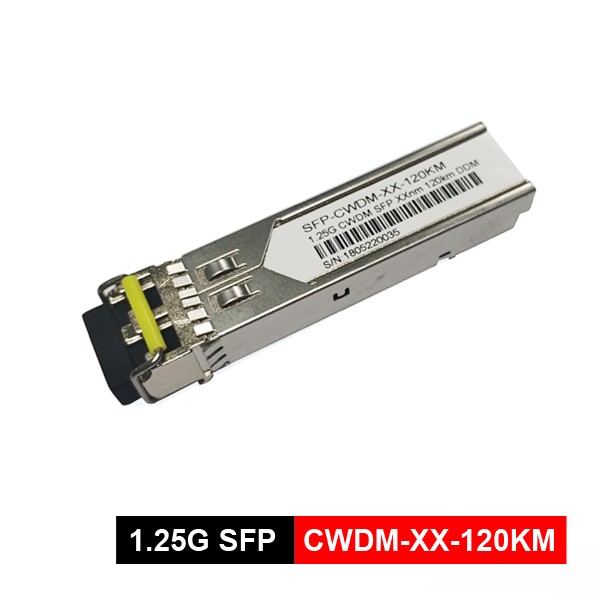
The specific reasons can be divided into the following three dimensions:
Difference in Fiber Attenuation Loss (fatal factor)
The signal attenuation rate (dB/km) of single mode fiber (such as commonly used G.652 fiber) varies greatly at different wavelengths:
| Item | Range | Remark | CWDM SFP module Yingda can provide |
| Front wavelength | 1270nm-1450nm | It is in the E-band and O-band. The typical attenuation value near 1310nm is about 0.35 dB/km or even higher. Optical fibers have significant absorption and scattering losses for these wavelengths (especially around 1383nm where they encounter the “water peak” region of traditional fibers, with the highest attenuation). If the front wavelength is used, the attenuation of the optical signal after 120 km is too large, and the power budget of the receiving end cannot meet the requirements at all. | SFP-1.25G-CWDM-xx-10km; SFP-1.25G-CWDM-xx-20km; SFP-1.25G-CWDM-xx-40km |
| Back wavelength | 1470nm-1610nm | It is located in the low loss window of the fiber (near the C-band and L-band), especially in the 1550nm band, where the fiber loss is minimal (typical value <0.25dB/km). The back wavelength ensures that the energy of the optical signal remains above the receiving threshold even after long-distance transmission. | SFP-1.25G-CWDM-xx-80km SFP-1.25G-CWDM-xx-120km |
120 KM Mathematical Calculation
Without considering fiber fusion and patch cord losses, only the transmission attenuation of the fiber itself:
- Using 1550nm (back wavelength): 120km x 0.20dB/km=24dB loss.
- Using 1310nm (front wavelength): 120km x 0.35dB/km=42dB loss.
The typical power budget for 1.25G 120km CWDM SFP module is usually around 32dB. The 42dB optical attenuation far exceeds the receiving limit of the module (APD receivers may not be able to demodulate due to weak signals), so the front wavelength cannot physically support a transmission of 120 km.
Water Peak Effect
There is a high attenuation peak (commonly known as the “water peak”) near 1383nm in old optical fibers or ordinary single mode fibers due to the absorption of hydroxide ions (OH -).
- The wavelengths of 1370nm, 1390nm, 1410nm, etc. in the front wavelength range just are within the water peak loss range, and the attenuation will increase dramatically to the point where it cannot be used.
- Although modern “full band fibers” (such as G.652. D) eliminate water peaks, it cannot be guaranteed that all old fibers on the entire link will support full band in long-distance backbone or metropolitan area networks spanning 120 km.
Dispersion and Device Cost Balance
In commonly used G.652 fibers, the zero dispersion wavelength is usually located around 1310nm, while the dispersion value around 1550nm is relatively large.
- However, due to the extremely high power requirements of the 120km ultra long distance, the CWDM SFP module must use high-performance DFB lasers and high-sensitivity APD (avalanche photodiode) receivers. The chips and Passive CWDM devices in the industrial chain have the most mature, stable, and large-scale production processes for the low attenuation region of 1470-1610nm.
- If we force the development of ultra-high luminous power chips that support 120km in the 1270nm range, the process cost will be extremely expensive and there will be no cost-effectiveness in business.
Conclusion
The industry usually divides CWDM into two segments: the front wavelength range (1270-1450nm) and the back wave (1470-1610nm).
- The front wave is generally used for medium to short distance links between 20km and 40km;
- The back wavelength range with extremely low fiber loss, it is the standard choice for building ultra long distance metropolitan area networks and trunk transmission from 80km to 120km.
| Wavelength range | 1270nm – 1450nm | 1470nm – 1610nm |
| fiber attenuation | High (≥0.35dB/km) | Extremely low (approximately 0.2dB/km) |
| Water peak influence | Severe restriction by water peak near 1383nm | no impact |
| Feasibility of 120km | Not feasible (light attenuation far exceeds power budget) | Feasible (loss within 32dB budget) |
| Common application distance | 10km – 40km | 40km – 120km+ |
If you are planning a CWDM network solution, Yingda recommended to prioritize the allocation of long-distance links to the back wavelengths (such as 1550nm/1570nm/1590nm/1610nm) to ensure sufficient optical power margin.