Skip to content
The rapid evolution of artificial intelligence (AI) clusters, high-performance computing (HPC), and cloud hyperscale infrastructures is pushing modern data centers to their physical limits. Driven by heavy compute platforms like the NVIDIA Quantum-2 InfiniBand platform, the demand for massive bandwidth and ultra-low latency has transitioned the industry standard from 10G/40G straight into the 400G and 800G era.
In these high-density networking environments, legacy LC duplex fiber patch cords are no longer viable. They consume too much cable tray space, restrict airflow, and significantly complicate infrastructure management. To unlock the full potential of next-generation fiber transceivers (such as 400G QSFP-DD SR4/DR4 or 800G OSFP SR8/DR8), high-density pre-terminated MTP/MPO trunk cables have become the mandatory architecture.
However, data center network architects and procurement managers face a critical infrastructure decision that directly impacts enterprise budget and scalability: Should you deploy a Base-12 or a Base-8 MTP/MPO cabling system? Choosing the wrong framework can lead to significant hidden costs and hardware stranded assets during future bandwidth migration.

1.Technical Breakdown: What is Base-8 vs. Base-12 MTP/MPO Architecture?
To make an informed B2B procurement decision, it is vital to understand the structural differences between these two high-density systems at the physical layer.
What is a Base-12 Cabling System?
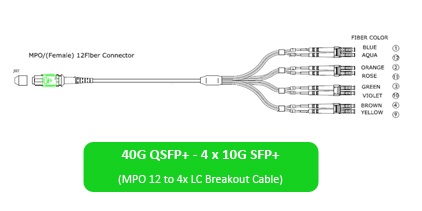
The Base-12 system is built around a multi-fiber connector multiplier of 12. It utilizes 12-fiber, 24-fiber, or 36-fiber increments. For more than a decade, Base-12 was the golden standard for backbone cabling because it perfectly matched 2-fiber (Duplex) LC laser applications via MTP-to-LC cassettes. One 12-fiber MPO trunk cable effortlessly breaks out into 6 duplex LC lines (10G/25G).
What is a Base-8 Cabling System?
The Base-8 system utilizes a multi-fiber connector based on increments of 8, employing 8-fiber, 16-fiber, or 24-fiber links. While it seemed less intuitive during the duplex LC era, Base-8 has emerged as the definitive champion for modern parallel optics. Nearly all mainstream high-speed fiber transceivers (40G SR4, 100G SR4, 400G SR4/DR4, and 800G SR8) utilize 8 physical fibers—4 to transmit and 4 to receive.
The Ultimate Comparison Matrix for 400G/800G Upgrade
| Technical Parameter | Base-12 MTP/MPO System | Base-8 MTP/MPO System |
| Connector Standard | 12-Fiber / 24-Fiber MPO | 8-Fiber / 16-Fiber MPO |
| Native Transceiver Support | 40G/100G/400G (SR4/DR4) requires conversion | Direct matching (No conversion modules required) |
| Fiber Core Utilization Rate | 66.6% Only (4 cores wasted per port) | 100% Fully Utilized (0 cores wasted) |
| Cabling Backbone Density | High density, but high complexity | Ultra-high density, mathematically cleaner |
| Future 800G/1.6T Migration | Requires expensive transformation | Seamless plug-and-play scaling |
⚠️B2B Technical Advisory: Are you currently designing a network topology or reviewing a telecom tender bill of materials? Don’t let layout misalignment stall your project. [Download Our Full MTP/MPO Cabling Architecture Whitepaper (PDF)] or reach out directly to our engineering team for a free structural review.
2.B2B Economic Math: Which System Saves More TCO?
When enterprise buyers calculate Total Cost of Ownership (TCO), they frequently look only at the upfront factory price list of the patch panels, cassettes, and trunks. However, the true B2B cost calculation lies in long-term asset utilization and pathway efficiency.
The Stranded Fiber Cost in Base-12
When you connect a native 8-fiber parallel transceiver (like a 100G SR4 or 400G QSFP28/QSFP-DD) to a standard Base-12 MTP trunk cable, 4 out of the 12 fiber cores remain dark and unused.
- The Waste: For every 3 transceiver ports you deploy, you are paying for 36 fiber cores but only utilizing 24. 12 fiber cores are permanently stranded in your optical path.
- The Financial Impact: In a medium-to-large compute data center deploying 1,000 links, a Base-12 architecture leaves 4,000 fiber cores completely wasted. You are effectively paying a 33.3% hidden tax on bulk fiber materials, cable trays, installation labor, and rack space.
The Lean Efficiency of Base-8
In contrast, a Base-8 MTP/MPO trunk cable offers an exact 1:1 mapping with modern multi-gigabit transceivers. 8 fibers out of the trunk go straight into the 8 optical pins of the module. There is zero fiber core wastage.
For large-scale infrastructure purchasing agents, Base-8 requires significantly less material volume to achieve the same data throughput. This drastically reduces backbone pathway weight, optimizes cable management space, improves cooling airflow in the server racks, and slashes overall TCO.

⚠️ Wholesale Pricing Request: Are you an international system integrator, wholesale distributor, or tender contractor looking for highly competitive factory-direct pricing? Secure your margins with our bulk manufacturing rates.
Click Here to Request Our Factory-Direct MTP/MPO Trunk Cable Price List.
3.Premium Manufacturing Quality: Why Low Insertion Loss and 3D Test Matter
High-density multi-fiber connectivity is notoriously sensitive. In a single-mode or multi-mode MPO connector, up to 12 or 24 fiber cores are crammed into a tiny ferrule. At data rates of 400Gbps and 800Gbps, even a micro-scratch, a speck of airborne dust, or a sub-micron misalignment in the fiber geometry will cause severe Insertion Loss (IL) and Return Loss (RL) spikes. This triggers dropped data packets, signal latency, and catastrophic network downtime for AI training models.
This is precisely why international buyers must look past generic, low-grade suppliers and partner with an authorized, high-precision manufacturer.
How We Lock In Enterprise-Grade Transmission Quality:
- Premium Core Materials: At YD Fiber Optic, we manufacture our trunk cables utilizing original Corning ClearCurve® bend-insensitive fiber glass and high-precision US Conec MTP® connectors to minimize micro-bending attenuation.
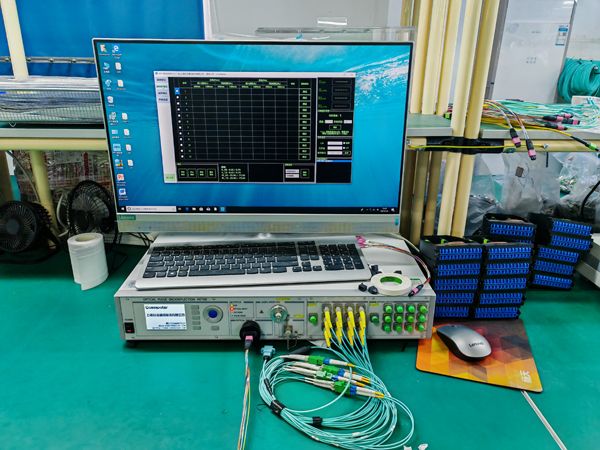
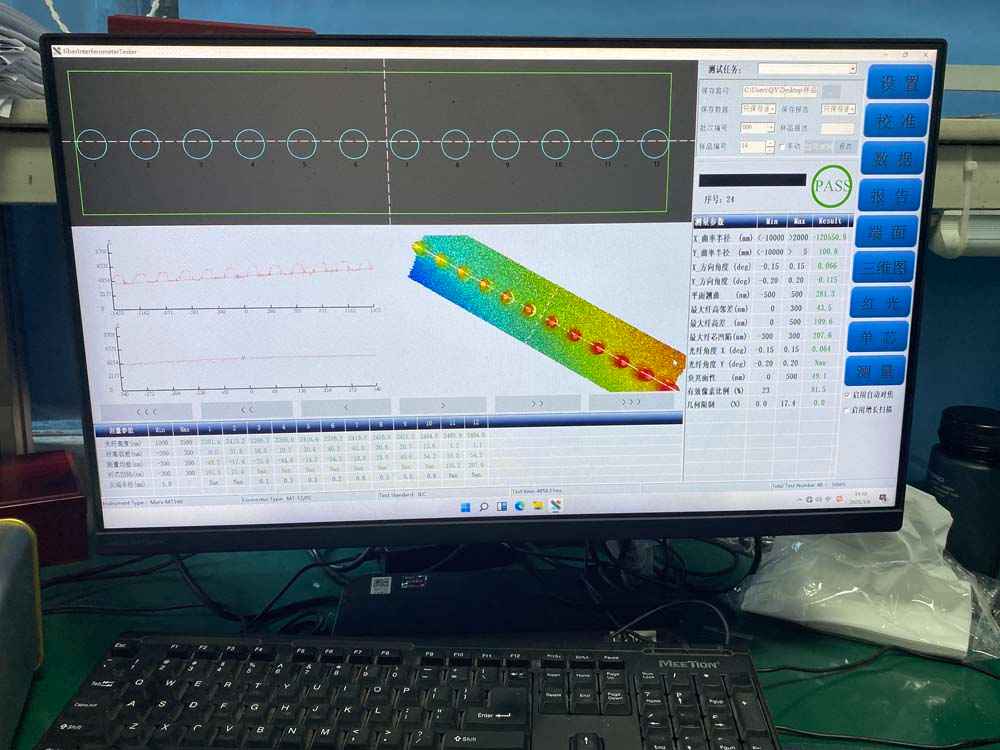
- 100% 3D Interferometer Testing: We do not rely on random batch checks. Every single MTP/MPO trunk cable assembly undergoes rigorous 3D interferometer geometric testing to verify fiber height, apex offset, and radius of curvature match international Telcordia standards.
- Ultra-Low Loss (ULL) Standards: Our premium manufacturing line consistently yields an ultra-low insertion loss of <0.35dB for multi-mode and <0.25dB for single-mode connectors, ensuring robust power budget margins for your optics.
- Ruggedized Pulling Eye Configurations: For long backbone installations across structural raceways, our cables are shipped with heavy-duty, factory-installed pulling eyes to protect the delicate pre-terminated multi-fiber connectors from tensile tension and crushing stress during pulls.
Our state-of-the-art optical polishing lines and 100% 3D verification reports accompany every shipped batch. We send digital test data sheets directly to your quality assurance managers.
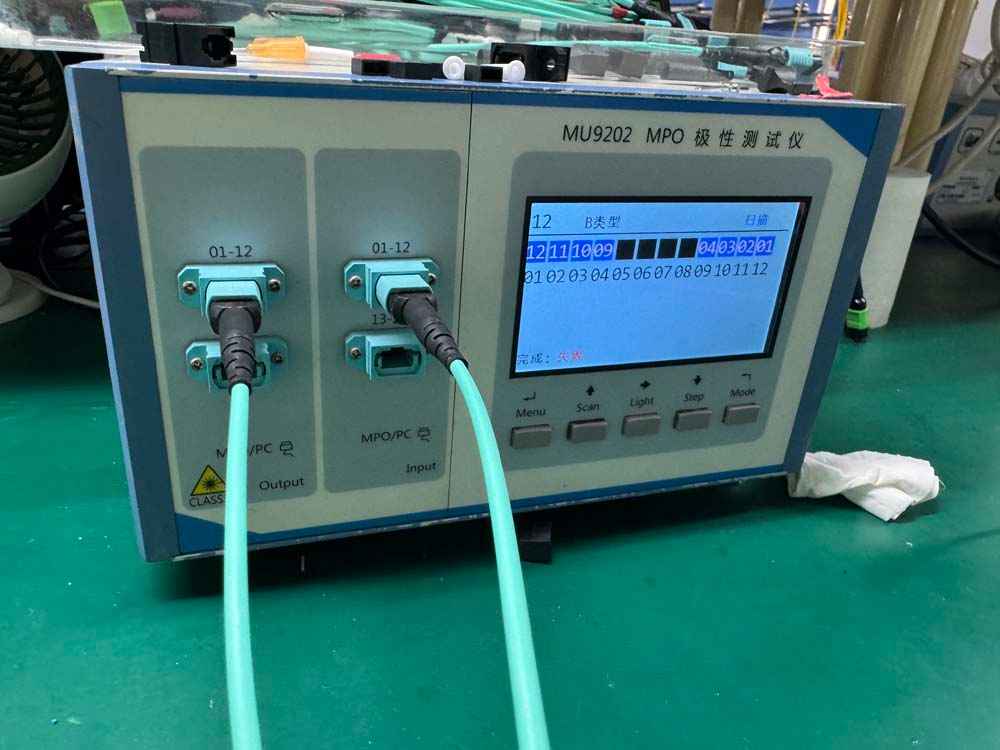
⚠️Request an Engineering Sample: Want to verify our Ultra-Low Loss performance firsthand before placing a commercial contract? We stand behind our automated production lines. Submit a Free Sample Request for Our Pre-Terminated MPO Cables or schedule a real-time virtual video inspection of our production plant.
4. Conclusion: The Definitive Infrastructure Checklist for International Buyers
Navigating a full-scale structural migration requires selecting the right framework for your specific lifecycle goals:
- Choose Base-12 MTP/MPO Systems if you are maintaining a legacy 10G/25G infrastructure that relies heavily on standard duplex LC distribution frames, and you do not anticipate an immediate leap into high-scale parallel AI architecture.
- Choose Base-8 MTP/MPO Systems if you are actively building out or bidding for a greenfield AI data center, machine learning compute cluster, or high-density telecom network infrastructure utilizing 100G/400G/800G optical links. Base-8 will guard you against stranded investment capital and maximize fiber asset utilization.
Accelerate Your Sourcing Process within 24 Hours
Managing tight project deployment deadlines? We streamline your international procurement workflow.

Drop us an email with your BOM (Bill of Materials) list, cable jacket requirements (LSZH, OFNR, or Plenum OFNP), and required fiber counts (8, 12, 16, or 24 Cores). Our dedicated technical account engineering team will formulate a comprehensive, cost-optimized system architecture layout and quotation within 24 hours.
Official Sourcing Email: sales@ydfiberoptic.com
Direct WhatsApp channel: +86 18688982406