The 10G CWDM SFP+ transceiver is a high-speed optical communication component specifically designed for 10 Gigabit Ethernet and metropolitan area network access layers. It employs coarse wavelength division multiplexing (CWDM) technology, enabling the simultaneous transmission of multiple optical signals on a single single mode fiber using different wavelengths (complying with the ITU-T G.694.2 standard, 1270nm-1610nm), thereby significantly conserving fiber resources. It features SFP+ hot-pluggable packaging, low power consumption, transmission distances typically ranging from 10km to 80km, and is suitable for high-capacity network expansion.
Technical Parameters:
- Interface type: Duplex LC optical port
- Rate: up to 11.3Gbps
- Wavelength: 1270nm to 1610nm, with a wavelength spacing of 20nm
- Encapsulation: SFP+
- Laser: DFB laser
Features
- High-efficiency utilization of optical fibers: CWDM technology defines 18 wavelengths within the range of 1270nm to 1610nm, enabling multi-channel data transmission on a single fiber pair and expanding network bandwidth without laying new fiber.
- Low cost and low power consumption: Compared to high-density DWDM technology, CWDM lasers require no cooling, resulting in lower device costs and reduced power consumption.
- Applicable Scenarios: Primarily used for 10G Ethernet access and transmission in data centers, metropolitan area networks, and campus networks.
- Transmission distance: Supports various distance requirements such as 10km, 20km, 40km, and 80km, suitable for medium to short-distance transmission within metropolitan area networks.
- Application Composition: 10G CWDM SFP+ transceivers need to be used in conjunction with CWDM MUX/DEMUX to composite or decompose signals of different wavelengths.
SFP+ CWDM Transceiver Wavelength
SFP+ CWDM has a total of 18 standard wavelength channels, with a center wavelength spacing of 20nm between each channel. Although the standard defines 18 wavelengths, there will be some emphasis in practical applications.
| Band classification | Wavelength (nm) |
| Front Band | 1270, 1290, 1310, 1330, 1350, 1370, 1390, 1410, 1430, 1450 |
| Back Band | 1470, 1490, 1510, 1530, 1550, 1570, 1590, 1610 |
The most commonly used wavelength range (Rear band: 1470nm-1610nm)
These 8 wavelengths are the “main force” of 10G CWDM SFP systems and currently the largest shipped model on the market. Due to the low loss of optical fibers around 1550nm, this wavelength group is typically used for medium to long distance transmission (such as 40km, 80km).
Core wavelengths: 1470, 1490, 1510, 1530, 1550, 1570, 1590, 1610 nm.
Reason for popularity:
- Low loss: These wavelengths are located in the low loss window of optical fibers (especially around 1550nm), supporting long-distance transmission, typically up to 40km, 80km, or even higher.
- Mature industrial chain: The passive Mux/Demux that supports this type of module is the most popular and has a high level of technological maturity.
- 8 channel standard: Most typical CWDM network expansions start with these 8 channels as the standard.
Common wavelengths in specific scenarios (Front band: 1270nm-1330nm)
In the early days, due to the presence of a “water peak” (extremely high loss) near 1383nm, it was not recommended to use 1370nm-1410nm channels for some old optical fibers. With the popularity of full wave optical fibers (G.652. D), these wavelengths are now also commonly used for short-range expansion. Although not as widely used as the later frequency band, it is also frequently used in specific fields.
Common wavelengths: 1270, 1290, 1310, 1330 nm.
Typical applications:
- Short distance transmission (10-20km): Due to the small dispersion around 1310nm, these wavelengths are commonly used for short-range interconnection within data centers or enterprise campuses.
- 4G/5G fronthaul: In base station construction, modules in the range of 1270nm-1330nm are often used to save fiber resources.
How to Choose 10G CWDM Single-mode Optical Module?
| Model | Scenes | Wavelength range | Transmission Distance (Reach) | Remark |
| SFP-10G-CWDM-XX-40km | 8-way full load expansion | 1470nm – 1610nm | 40km | The best compatibility and the most mature market. This is because the CWDM system itself has insertion loss, and a 40km power budget can more securely cover most links within the metropolitan area network. |
| SFP-10G-CWDM-XX-80km | Ultra long distance interconnection | 1550nm / 1570nm | 80km | The lowest loss and most stable performance. Used for long-distance links across regions, with the highest unit price and relatively small quantity. |
| SFP-10G-CWDM-XX-10km or SFP-10G-CWDM-XX-20km | Mobile prequel (CPRI) | 1270nm – 1370nm | 10km / 20km | Mainly used for access within the park, adjacent data centers or enterprises, with extremely low cost. It is common on the side of operator base stations. |
Important reminder:
① Color identification: SFP+ CWDM modules usually distinguish wavelengths by the color coded on the pull tab, for example, 1470nm is usually gray and 1550nm is yellow.
② Combiner matching: The wavelength of the 10G CWDM SFP+ transceiver you purchased must correspond one-to-one with the port wavelength on the CWDM wavelength division multiplexer (Mux), otherwise communication cannot be achieved.
③ Brand compatibility: Large brands such as Cisco or HPE have significant price differences in their CWDM optical transceiver, and choosing cost-effective compatible modules is currently the practice of most enterprises.
| Wavelength | 1470 nm | 1490 nm | 1510 nm | 1530 nm | 1550 nm | 1570 nm | 1590 nm | 1610 nm |
| Clasp Color | Grey | Violet | Blue | Green | Yellow | Orange | Red | Brown |
Conclusion
If you are conducting regular network expansion, recommended to prioritize the 1470nm-1610nm group. Among them, CWDM SFP10G 1470 and CWDM SFP10G 1550 are usually considered the two most classic starting wavelengths, and 40KM and 80KM optical transceivers have the highest demand.
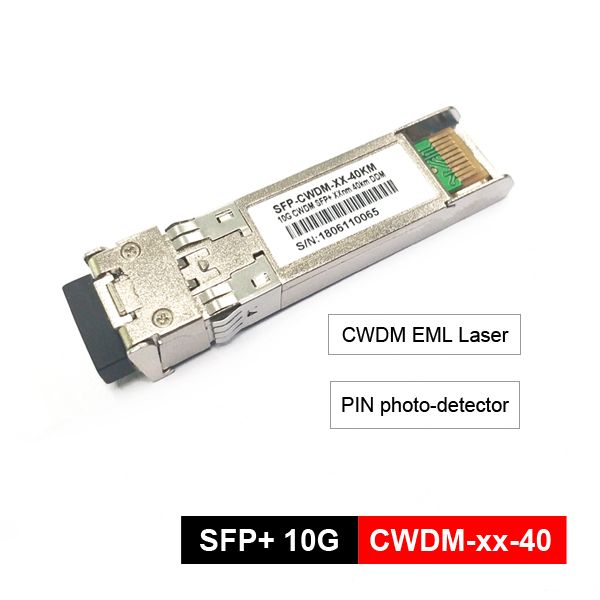
Balancing performance and cost, it is the most commonly used specification for metropolitan area network access.
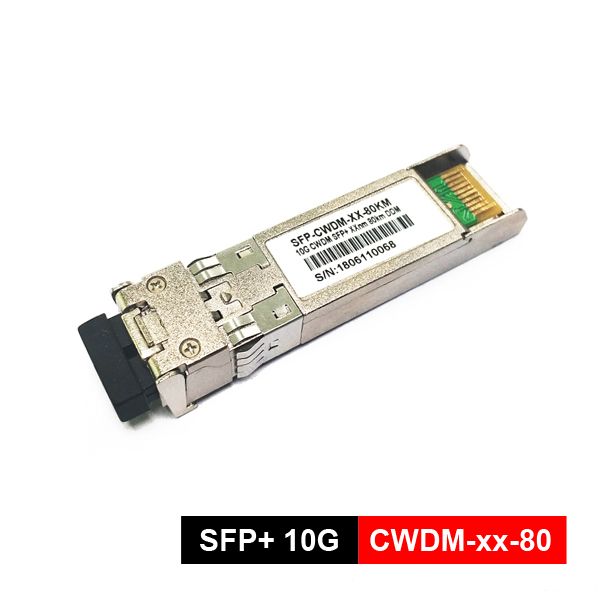
Used for longer distance convergence layers or cross campus connections.