Skip to content
10G CWDM 40km SFP+ transceiver (part number: SFP-10G-CWDM-xx-40km) is a 10GBASE CWDM single mode color light module that uses coarse wavelength division multiplexing (CWDM) technology and has a transmission distance of 40 km. Among them, “XX” represents the specific working wavelength (such as 47 representing 1470 nm, 55 representing 1550 nm, etc.).
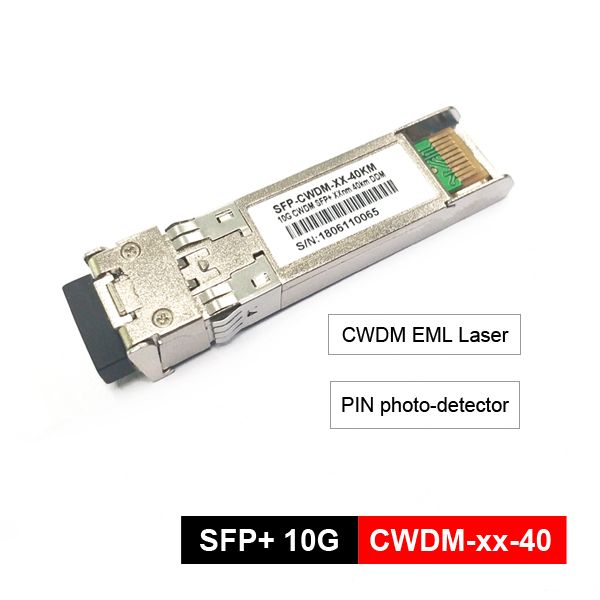
The following are the core parameters, technical characteristics, and mainstream brand compatibility solutions of the optical module:
Technical Parameters
- Encapsulation type: SFP+ (Small Form factor Pluggable Plus).
- Transmission rate: Supports a maximum of 10.3125 Gbps to 11.1 Gbps (compatible with 10G Ethernet, CPRI, OTN OTU2, etc.).
- Center wavelength (XX): Typically provides 18 bands between 1270nm and 1610nm, with commonly used long-distance channels ranging from 1470nm to 1610nm (channel spacing of 20nm).
- Fiber type: Single mode fiber (SMF, 9/125 µ m).
- Transmission distance: Standard 40KM.
- Optical port type: Duplex LC interface.
- Laser type: DFB (distributed feedback) or EML (electroabsorption modulation) lasers are usually used.
- Receiver type: PIN photodetector.
- Typical optical power range (refer to standard data sheets such as ProLabs):
- Transmitter Power: -1 dBm to +4 dBm or 0 dBm to +5 dBm.
- Rx Sensitivity: Below -15 dBm to -16 dBm.
- Saturated received optical power (overload): 0 dBm.
- Digital Diagnostic Monitoring (DOM/DM): Supports real-time monitoring of voltage, temperature, bias current, transmit optical power, and receive optical power.
Naming Conventions for 10G CWDM SFP+ Transceiver
Major mainstream network equipment manufacturers have corresponding high compatibility 10G CWDM SFP+ transceiver modules, such as CWDM 40km 1470 nm SFP optical module, Cisco 10G CWDM SFP model number is CWDM-SFP10G-1470-40 (1470 for wavelength, 40 for40km transmission distance), Yingda’s model number is SFP-10G-CWDM-47-40km (47 representing 1470 nm). Yingda widely supports customized mainstream switch codes such as Cisco, Huawei, Juniper.,etc.
| SFP | – | 10G | – | CWDM | – | 47 | – | 40KM |
| Package type | Transmission rate | Core technology | Central wavelength | Transmission distance | ||||
| SFP+ | 10Gbps | CWDM | 27=1270nm 29=1290nm 31=1310nm … 47=1470nm … 61=1610nm | 10km 20km 40km 80km |
Application Scenarios
1. Network capacity doubling: When used in conjunction with CWDM (Mux/Demux) in metropolitan area networks, up to 18 completely isolated 10G signals can be transmitted simultaneously in the same pair of single-mode fibers, completely solving the problem of fiber resource scarcity.
2. Long distance interconnection: used for medium to long distance backbone power transmission in large enterprise parks, data center interconnection (DCI), and metropolitan area access networks (MAN).
Device Scheme for 10G CWDM SFP+40KM module
The internal device scheme of SFP-10G-CWDM-XX-40KM varies significantly depending on the wavelength, while CWDM has a wavelength range of 1270-1610nm and 18 channels spaced 20nm apart. In practical applications, it is mainly divided into two band ranges.
- 1470nm-1610nm (back band): These are the most commonly used 8 channels. This band is around 1550nm wavelength with lower fiber loss, which is more conducive to long-distance transmission, such as 40km and 80km. For a distance of 40km, it’s a bit overused.
- 1270nm-1450nm (front band): In the early days, due to the presence of a “water peak” (extremely high loss) near 1383nm, it was not recommended to use the 1370nm-1410nm channel for some old optical fibers. With the popularity of full wave optical fibers (G.652. D), these wavelengths are now also commonly used for short-range expansion. In this band, especially in the 1270-1370nm range, the fiber attenuation and dispersion are relatively large. The inherent low chirp and low dispersion cost characteristics of DFB lasers can make up for the shortcomings of this band. Many 40km modules labeled as “DFB+PIN” are specifically designed for wavelengths such as 1290nm and 1330nm. For higher requirements, a DFB laser combined with a high-sensitivity APD detector is needed to ensure stable transmission at 40 kilometers.
How to choose a device solution?
The key to determining the feasibility of a solution lies in the power budget of the link. In order to achieve a transmission distance of 40km, the power budget of the optical module usually needs to reach around 14dB to 16dB. The two currently mature solutions are DFB+PIN (APD) or EML+PIN.
- Link budget: How far the SFP+ transceivers can transmit depends on whether the remaining optical power margin can resist fiber attenuation after subtracting the receiving sensitivity from the transmitting power.
- Common rule: DFB is used for short wavelengths, and EML is used for long wavelengths.
Comparison of Two Schemes
| Solution | EML+PIN scheme (increasing emitted light power) | DFB+APD scheme (improves receiving sensitivity) |
| Emitting end laser | EML (Electro Absorption Modulation Laser): High dispersion tolerance, low jitter, excellent signal quality, very suitable for high dispersion long wavelength bands of 1470nm~1610nm. | DFB (Distributed Feedback Laser): Direct modulation, with a high dispersion penalty at 40km transmission in high wavelength bands (such as 1550nm and above). |
| Receiver detector | PIN photodiode: simple structure, low cost, high stability, but low sensitivity (usually around -15dBm to -16dBm). | APD (Avalanche Photodiode): With internal amplification gain and extremely high sensitivity (up to -24dBm), it can strongly capture weak signals. |
| Implementation of optical power budget | Relying on the high optical power emitted by EML (such as+1~+5dBm) to compensate for the sensitivity disadvantage of the PIN receiving end. | By relying on the lower transmission power of DFB and the extremely high receiving sensitivity of APD, high budget can be achieved. |
Compared with the DFB+PIN scheme, EML+PIN is a more common and mature standard choice for SFP CWDM 40km SFP+ transceivers with long wavelengths (1470nm+). Its transmission power and link budget are generally higher, and its performance is better.
Procurement precautions:
1. Working temperature: The working temperature is available in commercial grade (0℃~70℃) and industrial grade (-40℃~85 ℃).
2. Compatibility: When purchasing, it is also necessary to confirm the compatibility of the device brand. The optical modules provided by Yingda can be widely compatible with the XXX brand.
3. Link budget: When purchasing, it is recommended to directly check the data sheet of the specific model to confirm whether the marked transmission (Tx) type is DFB or EML, the reception (Rx) type is PIN or APD, and whether the nominal link budget can meet your actual line attenuation requirements.
4. Power consumption and heat dissipation: EML lasers usually integrate TEC (thermoelectric cooler) internally to stabilize the wavelength, and their power consumption and heat generation will be higher than conventional DFB modules. When designing the whole machine, attention should be paid to the heat dissipation of SFP+ports.
5. Redundancy margin: The receiving sensitivity of PIN (about -16dBm) is relatively narrow. If there are many fiber fusion points, ODF jumper frames, or CWDM multiplexer/demultiplexer (Mux/Demux) insertion losses in your actual link, the 14-16dB power budget may be tight.