Skip to content
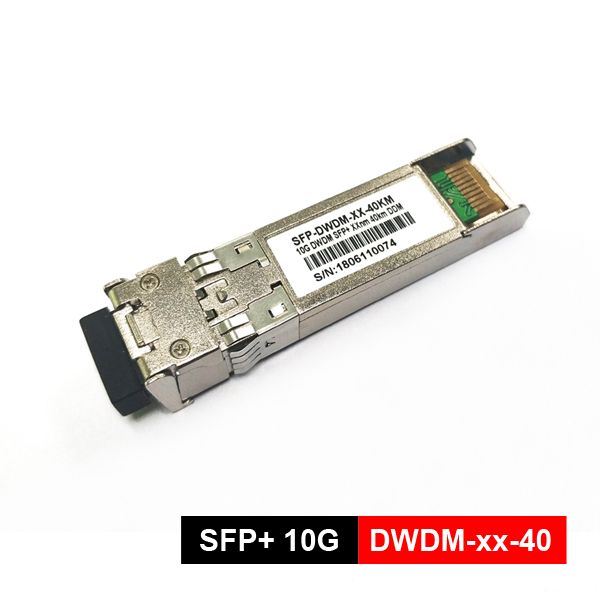
In the 10GBASE DWDM SFP+ field, the most widely used specification is 10G DWDM 80km (ZR) of C-Band, especially the Tunable version which is becoming absolutely mainstream.
The Most Commonly Used Specification Ranking
Type 1. 10G DWDM Tunable – Current Preferred
- Reason for popularity: DWDM has over 40 or 80 channels. Previously, using a “fixed wavelength” module required stocking dozens of products, but now a single adjustable module can cover all channels (C17-C61).
- Advantages: Greatly simplifies inventory management and post maintenance, although the unit price is slightly higher, the overall cost (stocking, labor) is the lowest.
- Transmission Distance: Basically, the specifications are 80km.
Type 2. Fixed wavelength C17-C61 (100GHz interval)
- Reason for popularity: If tunable modules are not used, these channels located in the middle of the C-band (1528-1563nm) are most commonly used. Because this band has the lowest fiber loss and can be perfectly used with EDFA (optical amplifier).
- Transmission Distance: 80km (ZR) is the most standard DWDM specification.
Type 3. DWDM SFP10G 80km (ZR)
- Reason for popularity: DWDM is rarely used for short distances (BiDi SFP+ transceiver or CWDM SFP+ transceivers are usually used for short distances). Since choosing DWDM SFP+ is usually for long-distance or through complex combiners, a power budget of 80km is the most reliable choice.
| Feature | Most commonly used specifications | Why? |
| Band | C-Band | Lowest loss, supports optical amplifier expansion. |
| Channel spacing | 100GHz (0.8nm) | The most cost-effective and technologically mature. |
| Distance (Reach) | 80km (ZR) | DWDM is designed specifically for long-distance and high loss scenarios. |
| Product Type | Tunable | Unified stocking to avoid business interruption caused by purchasing the wrong wavelength. |
Key Considerations During Deployment
- Dispersion compensation (DCM): When the 10G signal exceeds 80km, it is severely affected by dispersion. If your link is close to or exceeds 80km, in addition to amplifiers, it is usually necessary to install dispersion compensators.
- Power consumption and heat dissipation: DWDM SFP+ transceivers (especially tunable modules) consume much more power than ordinary 10GE LR modules. When fully plugging in the switch, be sure to confirm whether the power supply and heat dissipation of the switch can support it.
- Paired matching: Although DWDM SFP+ does not need to distinguish the transmission and reception wavelengths like BiDi SFP+, it is necessary to ensure that the wavelength of the module is completely consistent with the port wavelength on the combiner (Mux/Demux).
Selection Suggestion
- If you are operating a large network, buy Tunable DWDM SFP+ transceiver directly;
- If you are only expanding one or two links point-to-point and have a limited budget, you can buy a fixed wavelength of 10G DWDM 80km.
Yingda can provide the above-mentioned DWDM SFP+ transceivers. If you have corresponding requirements, please contact us for a quotation.