Skip to content
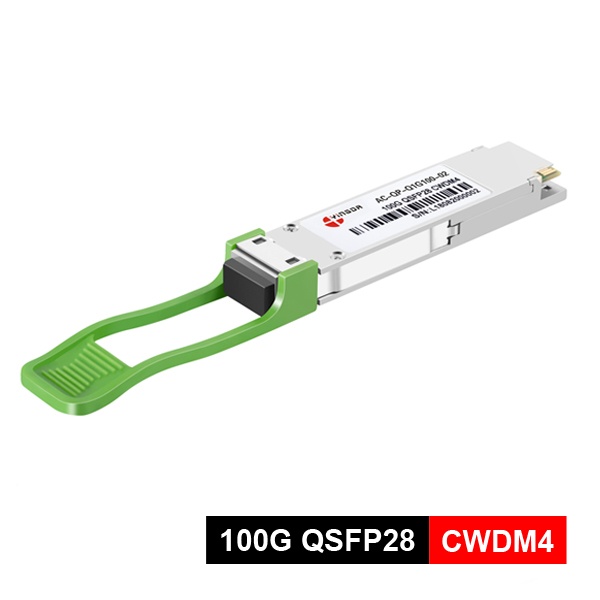
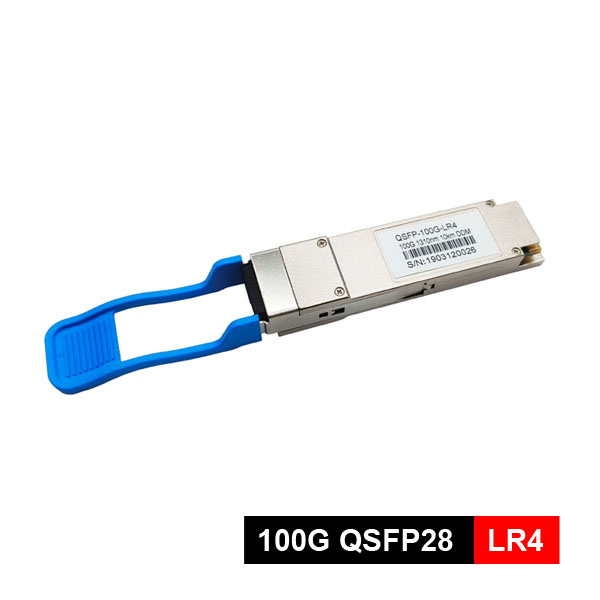
100G-CWDM4-QSFP 2km and QSFP 100G LR4 are the two most commonly used single-mode 100G hot pluggable transceivers in data centers and telecommunications networks. All of them achieve long-distance transmission by multiplexing four 25.78Gbps electrical signals into one 100G optical signal through a pair of single-mode fibers.
Common Characteristics
Although the models are different, they are all referred to as single-mode optical modules, which have many core commonalities in terms of underlying architecture, interface standards, and application levels:
- Same packaging and external dimensions: QSFP28 four channel micro pluggable packaging is used, with identical appearance, length, width, thickness, and gold finger pin definitions, which can be directly inserted into any standard QSFP28 switch port.
- Same overall transmission rate: The internal physical architecture consists of four independent electrical signal channels, each with a transmission rate of 25.78 Gbps (using NRZ modulation signal). The overall speed is 103.1 Gbps=4 * 25NRZ.
- Same fiber optic medium and interface: Both use standard duplex LC interface, running on 9/125 µ m single-mode fiber and unable to use multi-mode fiber. One transmitter and one receiver are achieved through a duplex patch cord.
- Similar working principle: Internally integrated are optical multiplexers (Mux) and demultiplexing devices (Demux). At the transmitting end, four different wavelength optical signals are combined into one fiber for transmission, and at the receiving end, the four optical signals are separated and restored, greatly saving backbone fiber resources.
- The same DDM/DOM functionality: both have built-in Digital Diagnostic Monitoring functionality. Network administrators can view the working temperature, working voltage, bias current, received optical power (Rx), and transmitted optical power (Tx) of modules in real-time through the switch command line, facilitating troubleshooting.
Comparison Between 100G CWDM4 and LR4
The main difference between 100G CWDM4 and LR4 lies in transmission distance and cost.
- 10G CWDM4 QSFP is suitable for medium distance (single-mode fiber) within 2km, using CWDM technology, lower cost, the mainstream choice for data center interconnection;
- QSFP 100G LR4 is suitable for 10km long distances and uses fine wavelength division multiplexing (LAN WDM). The laser cost is higher, making it suitable for metropolitan area network interconnection.
| Model | 100G QSFP28 CWDM4 | 100G QSFP28 LR4 |
| meet the standard | CWDM4 MSA Industry Alliance Standard | IEEE 802.3ba international standard 10GBASE-LR4 |
| Maximum transmission distance | 2km | 10km |
| Technology type | CWDM | LAN-WDM |
| Center wavelength | 1271, 1291, 1311, 1331 nm | 1295.56, 1300.05, 1304.58, 1309.14 nm |
| Channel spacing | 20 nm (large spacing, low device requirements) | 4.5 nm (extremely narrow spacing, high device requirements) |
| Laser type | Direct Modulation Laser (DML) | Electroabsorption modulated laser (EML) |
| Temperature Control Requirements (TEC) | No temperature control required, low cost | Must be equipped with TEC temperature control, high power consumption and high cost |
| Forward Error Correction (FEC) | System host FEC must be enabled | No need or dependence on FEC (depending on specific standards) |
| Fiber optic connector | Duplex LC | Duplex LC |
| Relative price | Low (highly cost-effective) | Higher (more expensive) |
| Application scenarios | Internal interconnection of data centers and campus network | Interconnection between metropolitan area networks and long-distance data centers |
| Power consumption | lower | higher |
Key Differences Analysis
- Transmission distance and application scenarios: CWDM4 mainly compensates for the high cost of LR4 in short distance applications. Its transmission distance is within 2km, fully covering the commonly used medium distance connection requirements in data centers. LR4 meets the longer transmission requirements of up to 10km.
- Technical difficulty: CWDM4 adopts four CWDM wavelengths with large center wavelength spacing, with a wide spacing of 20nm, allowing the laser wavelength to naturally drift with temperature, making the technical difficulty relatively low. LR4 adopts LAN WDM with a spacing of only 4.5nm. In order to prevent single-mode fiber dispersion and maintain high-precision frequency, it is necessary to have a built-in cooling laser EML (TEC temperature control) to heat or cool the laser in real time, which is technically difficult and consumes high power
- FEC (Forward Error Correction): It is usually recommended to enable FEC function on the switch for 100G CWDM4 to achieve error free transmission.
- Laser cost: CWDM4 uses a simpler DML laser structure, eliminating the need for expensive TEC (temperature control) components, resulting in lower chip and packaging costs. In order to counteract signal attenuation in 10km transmission, LR4 must use a more complex EML laser, which consists of a DML core and an external electroabsorbent modulator. The process is difficult and the cost is expensive. So its hardware cost and material complexity have significantly increased.
- Error correction mechanism: The physical link budget of CWDM4 is relatively low, and the network switch side needs to force the Host FEC (Forward Error Correction) to ensure full speed transmission of 2km.
How to Make Choices in Real Applications?
Select the scenario of 100G CWDM4 QSFP:
- The computer rooms of large Internet data centers (IDC) are interconnected internally and across buildings.
- The actual laying distance of the link is less than 2 km.
- The budget is extremely cost sensitive, hope to replace the expensive QSFP LR4 100G module in the most economical way possible.
Select the scenario of 100G LR4 QSFP28:
- Enterprise park network backbone links, metropolitan area network (MAN) access, or long-distance interconnection across data centers (DCI).
- The actual laying distance of the link exceeds 2 kilometers but is less than 10 kilometers.
- Financial and high-performance computing industries have extremely high requirements for latency and error correction compatibility, and do not want scenarios where the system forces FEC to cause additional latency.
KIND NOTE: Due to the completely different wavelength spectrum and multiplexing technology between the CWDM4 module and LR4 module, it is absolutely impossible to directly connect to the network.