Skip to content
10GBASE-SR/SW is a 10 Gigabit SFP+ module technology based on the IEEE 802.3ae standard, specifically designed for short-distance data transmission. It typically utilizing the hot-pluggable SFP+ form factor, and represent one of the most widely used methods for short-range connectivity. 10GBASE SR SFP+ primary design objective is to enable users to meet the cabling requirements of high-density data centers and campus networks by multimode fiber.
The Meaning of 10GBASE-SR/SW: Many modern “SFP-10G-SR” modules are, in practice, compatible with both the 10GBASE-SR and 10GBASE-SW standards. Furthermore, they typically support multi-rate operation, allowing them to automatically adapt to varying data rate requirements (ranging from approximately 9.95 Gbps to 11.3 Gbps).
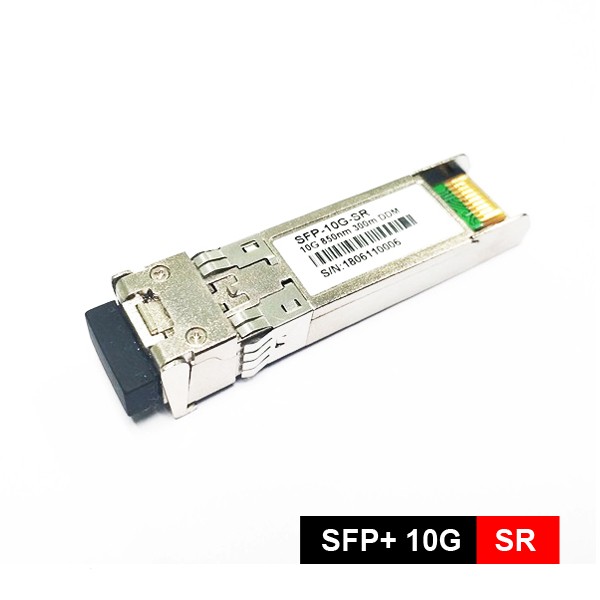
Common Features of 10GBASE SR SW
| Wavelength | 850nm wavelength (short wave) |
| Light Source | VCSEL (Vertical Cavity Surface Emitting Laser). |
| Distance | 300m over OM3 multimode fiber; 400m over OM4 multimode fiber |
| Interface Type | Duplex LC |
| Features | Hot-pluggable, Digital Diagnostics Monitoring (DDM) supported |
10GBASE SR SW Applications
SFP+ transceiver 10GBSE SR SW, featuring a duplex LC interface, is primarily installed in switches, routers, and Network Interface Cards (NICs) to facilitate interconnections between servers and switches within server rooms.
- Data Centers: Connections between switches, and between servers and switches.
- Enterprise Wiring Closets: Backbone cabling within buildings.
- Storage Networks: Used in short-distance SANs requiring 10 Gigabit speeds.
Difference:10GBASE SR vs SW
The fundamental difference between 10GBASE-SR and 10GBASE-SW lies in the distinct “Physical Layer Sublayers (PHY)” they employ, which consequently dictates the specific transmission network environments to which they are adapted. 10GBASE-SR SFP+ modules are utilized in standard Ethernet networks (LANs), whereas 10GBASE-SW SFP+ modules are designed specifically for legacy optical fiber networks (SONET/SDH).
10GBASE-SR (Short Range) – LAN PHY
- Applications: Primarily used for short-distance interconnections within Local Area Networks (LANs), enterprise networks, and data center server rooms.
- Features: Offering the lowest cost and lowest power consumption, it is currently the most widely used type of SFP Module 10GB in data centers.
10GBASE-SW (Short Range – WAN PHY)
- Applications: Primarily used in Wide Area Networks (WAN) or Metropolitan Area Networks (MAN), and compatible with SONET/SDH transmission equipment.
- Features: Similar to the physical characteristics of 10GBASE-SR, but features a different frame format; it is specifically designed for interfacing within WAN environments.
| Technology | 10GBASE-SR | 10GBASE-SW |
| Full Name | Short Reach (LAN) | Short Reach (WAN) |
| PHY Type | LAN PHY (64B/66B) | WAN PHY (64B/66B + Encapsulation) |
| Application Scenario | Enterprise Intranet / Data Center (LAN) | WAN/MAN (WAN/SDH) |
| Protocol Standard | IEEE 802.3ae (Ethernet) | SONET/SDH (OC-192) Compatible |
| Data Rate | 10.3125 Gbps | 9.953 Gbps |
| Encoding Scheme | 64b/66b Encoding | 64B/66B + WIS (WAN Interface Sublayer) |
In current high-speed networks, 10GBASE-SR is the most widely used mainstream specification, whereas SW is utilized only in specialized WAN access scenarios.
Key Technical Points
Transmission Rate Differences:
- SR transmits raw 10GbE signals directly over the optical fiber.
- SW utilizes the WIS (WAN Interface Sublayer) to encapsulate Ethernet data within SONET/SDH frames; to ensure compatibility with legacy carrier networks, its transmission rate is slightly lower than that of standard Ethernet.
Compatibility:
- Both utilize 850nm Vertical Cavity Surface Emitting Lasers (VCSELs).
- At the physical layer (fiber and interface), they are similar; however, due to differences in their Data Link Layer protocols, they are not directly interoperable.
Conclusion
In modern data centers and enterprise networks, 10GBASE-SR is the absolute mainstream standard. 10GBASE-SW has become extremely rare, existing primarily in specialized scenarios requiring direct connectivity to legacy telecommunications carrier SDH equipment.
If you encounter a product with a model designation such as SFP-10G-SR-X, it typically signifies that the device not only complies with the mainstream 10GBASE-SR Ethernet standard but also supports 10GBASE-SW and potentially even OTU2/OTU2e (Optical Transport Unit) rates. Such modules are suitable for a variety of optical transmission links, offering enhanced compatibility; they are typically multi-rate modules produced by major manufacturers such as Cisco.