Skip to content
QSFP-40G-SR-BD (also known as QSFP BiDi, Bidirectional) is a short distance multi-mode fiber optic transmission 40GBASE SR BIDI transceiver. Its biggest feature is the use of dual fiber bidirectional (BiDi) technology, which does not require the replacement of existing duplex wiring. Only a pair of standard LC duplex fibers are needed to achieve 40G transmission (20Gbps per fiber), making it the best solution for smooth upgrading from 10G networks to 40G.
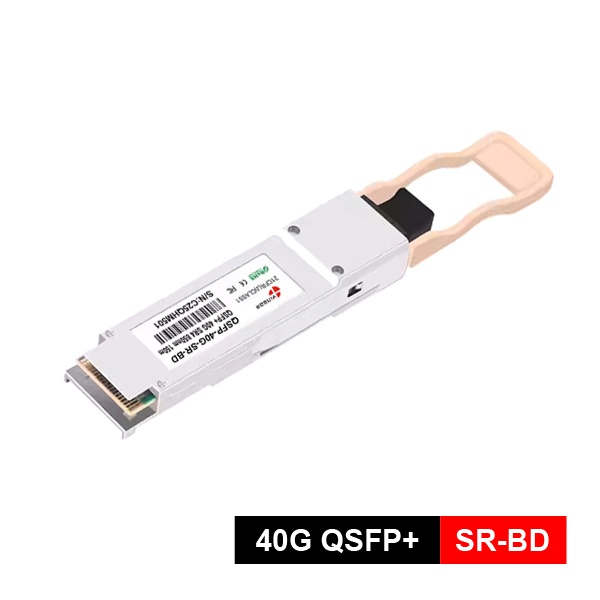
Technical Parameters
| Model | QSFP-40G-SR-BD |
| boxed type | QSFP+ |
| interface type | Duplex LC |
| Fiber optic type | MMF |
| transmission distance | OM3:100m / OM4:150m |
| operating wavelength | 850nm and 900nm |
| channel architecture | 2 x 20G BiDi (bidirectional channel) |
| power consumption | < 3.5W |
| electrical interface | XLPPI(4 x 10.3125Gbps NRZ) |
| protocol standard | 40G Ethernet QSFP+ MSA |
| Operating Temperature | 0℃ to 70℃ (commercial grade) |
| power supply voltage | 3.3V |
Core Advantages
- Bidirectional technology: Using bidirectional technology to transmit signals of different wavelengths on the same optical fiber, reducing wiring costs.
- High compatibility: Widely used in 40G QSFP+ switch systems, typically supporting DDM/DOM digital diagnostic functions.
- Application scenario: Short distance connection of data center access layer and backbone network.
- Features: Only use LC Duplex patch cords to realize 40G transmission instead of MPO/MTP 12 fiber connectors.
Working Principle
Why does it only require 2-core optical fiber to transmit 40G?
Ordinary 40G QSFP BIDI optical modules require 8 core fibers for parallel transmission, while QSFP-40G-SR-BD only use 2 cores fiber for 40G bidirectional transmission, which is achieved through three-step processing:
Step 1: Combine 4 x 10G electrical signals into 2 x 20G electrical signals
- Host side input: 4 × 10G NRZ electrical signal
- Internal Gearbox processing: 4:2 multiplexing, combining 4 x 10G channels into 2 x 20G channels
Step 2: Convert 2 channels of 20G electrical signals into 2 channels of optical signals with different wavelengths
- Channel 1 (opposite end A): TX 850nm/RX 900nm (unidirectional)
- Channel 2 (opposite end B): TX 900nm/RX 850nm (unidirectional)
Step 3: Simultaneously send and receive on one fiber optic cable (bidirectional)
- A single optical fiber carries two optical signals of different wavelengths (850nm and 900nm)
- Simultaneous sending and receiving – this is the origin of the name “BiDi (Bidirectional)”
- Two LC interfaces independently complete bidirectional 20G transmission, and two channels are aggregated into a total bandwidth of 40G.
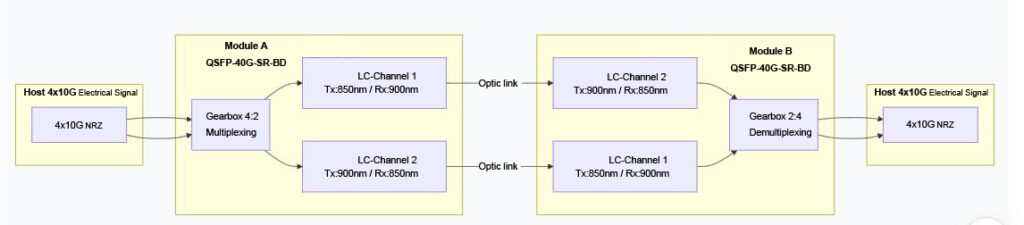
Key note: BiDi transceivers must be used in pairs because the transmitting/receiving wavelengths at both ends must match (sending at 850nm requires receiving at 850nm).
Comparison: QSFP-40G-SR-BD vs QSFP-40G-SR4
40G SR4 uses 8 core optical fibers for parallel transmission (4 send and 4 receive), while40GBASE SR BIDI uses 2 core optical fibers for bidirectional transmission (each LC port sends and receives simultaneously, with different wavelengths used to distinguish directions). It is precisely this technological difference that enables BiDi to fully reuse existing 10G cabling systems. The specific details are shown in the table below:
| Model | 40G SR-BD (BiDi) | 40G SR4 |
| interface type | Duplex LC | MPO-12 |
| Required number of fiber cores | 2-core | 8-core |
| Transmission distance | 100m(OM3)/150m(OM4) | 100m(OM3)/150m(OM4) |
| Power consumption | < 3.5W | < 1.5W |
| Upgrade from 10G to 40G | ✅ Reuse existing LC wiring without the need for modification | ❌ MPO cable needs to be re laid |
| 4 x 10G breakout capability | ❌ not supported | ✅ Support (MPO to 4LC breakout cables) |
| Single core transmission capacity | 20G bidirectional (2 x 10G transmitter + 2 x 10G receiver) | 10G unidirectional |
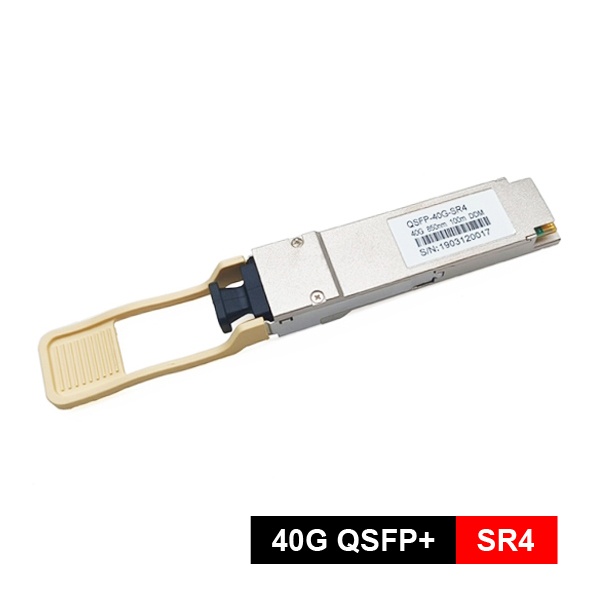
How to choose 40GABSE SR BiDi or 40GBASE SR4?
The cabling system in data centers is often one of the largest fixed asset investments. 40GBASE SR BiDi allows operators to protect existing investments without the need for duplicate cabling, and quickly achieve 40G upgrades using existing 10G cabling infrastructure.
| Scene | Recommend Solution | Reason |
| New data center and high-density switch deployment, pursuing the lowest power consumption | SR4 | Power consumption: SR BiDi<3.5W, SR4 <1.5W, SR4 is about 60% lower than BIDI, with better heat dissipation |
| Requires 4x10G branch capability | SR4 | The two wavelengths of BiDi cannot be split into four independent 10G signals |
| Fiber optic resources are scarce and need to be maximally utilized | SR BiDi | 2core/port vs SR4 8core/port |
| TOR Leaf interconnection within the data center (≤ 150m) | SR BiDi | 2-core fiber optic is sufficient, with flexible wiring |
| New network construction and pursuit of long-term 100G upgrade | SR BiDi (or consider 100G BIDI ecosystem) | Can be extended to 100G BIDI scheme, continuing to reuse LC wiring |
| 10G to 40G upgrade scenario | SR BiDi | Simply replace the optical modules at both ends, fully reuse, no need for modification, plug and play, saving 50%+modification costs |
Cost Description: The price of QSFP 40G SRBD module is about 30% lower than that of single-mode solutions such as 40GBASE LR4, and the power consumption of BiDi VCSEL laser is only 43% of that of 40GBASE LR4-S EML laser, which is more friendly to heat dissipation and high-density deployment.
The Evolution of BiDi Technology
The design concept of 40GBASE SR BiDi has laid a solid foundation for subsequent upgrades:
- 40G ↔ 100G BIDI compatibility: Cisco and other manufacturers have launched dual rate BIDI modules, and 40GBASE SR BiDi can coexist with 100G BiDi on the same LC duplex cabling system
- SWDM4 BIDI Extension: Some manufacturers offer a 4-wavelength (850/880/910/940nm) SWDM4 BIDI version, which can extend the transmission distance to 300-400 m (requires matching use, not compatible with standard BiDi)
This means investing in a 40G BiDi cabling system, which can continue to be used for 100G BiDi in the future without the need for further fiber infrastructure upgrades.
Conclusion
QSFP-40G-SR-BD is an optical module designed specifically for smooth upgrades from 10G to 40G. It uses a unique dual fiber bidirectional technology that enables 40G transmission with only 2 core LC fibers. It can directly reuse existing 10G cabling systems without the need to modify fiber infrastructure to quickly complete upgrades. Although the power consumption is slightly higher than SR4 (3.5W vs 1.5W), its core value of “protecting existing investments” has significant overall cost advantages for data centers with existing 10G networks.
| Positioning | Preferred upgrade scenario from 10G to 40G, short distance multi-mode transmission |
| Core technology | 2 x 20G BiDi (850nm/900nm bidirectional), LC interface |
| Interface advantages | Duplex LC, 2-core fiber optic, fully compatible with 10G cabling |
| Transmission distance | 100m(OM3)/150m(OM4), meet the internal interconnection needs of most data centers |
| Power consumption | <3.5W |
| Selection principle | Upgrade the scenario to BiDi and create new facilities to balance power consumption/flexibility/fiber resources as needed |
| Evolution Path | Can be extended up to 100G BIDI to protect long-term investments |