Skip to content
The QSFP 4x10G SR breakout solution (i.e., the 40G QSFP+ to 4×10G SFP+ port splitting solution) is a core method for data center upgrades and high-density networking. The 40Gbase SR4 QSFP+ optical module integrates four independent 10Gbps signal channels internally, splitting one port into four 10G ports via physical media, effectively tripling the 10G access capacity of a single switch board.
Based on cabling distance, cost, and existing hardware conditions, there are three mature branch solutions for 40G SR4:
QSFP module + Breakout Cable Solution
— suitable for flexible cabling of 7m to 150m
This is the most commonly used and highly flexible solution for cross-cabinet or medium-to-short distance interconnection within data centers.
Hardware Configuration:
- 1 x 40Gbase SR4 QSFP+ module (inserted into a 40G switch port).
- 4 x SFP 10Gb SR modules (insert into 10G switch or server ports).
- 1 × MPO to 4xLC fiber breakout cable (one end with 8/12-fiber MPO/MTP connector, the other end branching into 4 x DLC connectors).
Transmission distance: Up to 100 meters with OM3 fiber and up to 150 meters with OM4 fiber.
Applicable scenario: The core/aggregation switch (40G) connects downstream to multiple servers or access switches (10G) located in different cabinets.

AOC/DAC Branch Cable Solution
— (suitable for short distances within 0.5-7-meter cabinets)
This solution does not require the purchase of independent 40GBASE SR4 QSFP modules, but directly uses finished integrated cables with SFP connectors, which are highly cost-effective and plug and play.
40G QSFP+ to 4 x 10G SFP+ DAC
— high-speed branch copper cable:
- DAC Cable: One end is a 40G QSFP+ connector, and the other end is four 10G SFP+ connectors, with a copper wire architecture inside.
- Transmission distance: usually limited to 1 m to 7 m.
- Advantages: Extremely low power consumption, lowest cost, very suitable for direct connection between TOR (top of cabinet) switches and servers in the same cabinet.
40G QSFP+ to 4 x 10G SFP+ AOC
— active branch fiber optic cable:
- The two ends of AOC cable have the same connectors, but the middle medium is optical fiber, which is lighter in weight and has stronger resistance to electromagnetic interference.
- Transmission distance: generally around 7 to 20 meters.
- Advantages: Compared to DAC wiring, it is more convenient and suitable for high-density interconnection between adjacent cabinets.
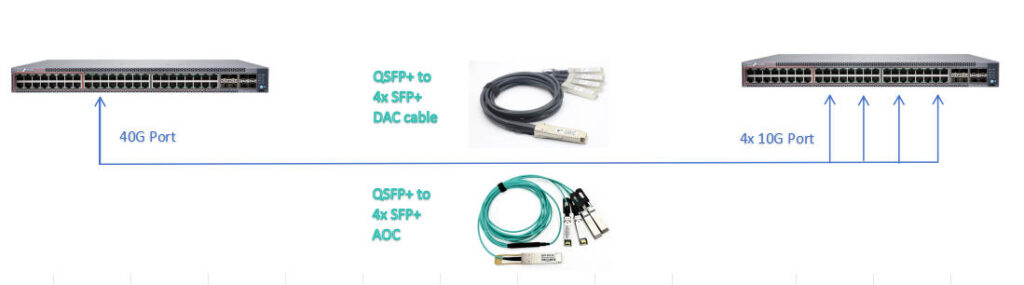
High Density Fiber Optic Distribution Box Solution
— MTP to LC cassette, suitable for structured centralized cabling
When the data center room is large in scale and requires standardized, cross regional structured cabling, it is usually transferred through intermediate distribution frames.
- Advantages: Convenient maintenance and label management, avoiding clutter caused by pulling long-distance branch jumpers in the computer room; Support smooth upgrade of ports in the later stage.

Important Considerations for Implementing Branch Schemes
- Switches must support port splitting (Breakout command): Not all 40G ports on switches support physical splitting. Before deployment, the port splitting command (such as the “interface breakout” command for Cisco/Huawei devices) must be typed in the switch backend to logically map one 40G port into four 10G ports.
- Avoid optical power overload at the receiving end: If the transmission power of the standard 40GBASE SR4 QSFP+ is too high, it may cause overload alarms at some traditional SFP 10GB SR receiving ends. When selecting optical modules, it is recommended to prioritize those with optimized transmission power for Breakout applications.
- Cable core matching: The 40GBASE SR4 QSFP+ uses 8 fibers for signal transmission (4 transmitter and 4 receiver), so the MPO end of the fiber breakout cable must use 8 fibers or 12 fibers (with 4 cores in the middle vacant) multimode connectors.