Skip to content
The QSFP28 100G DR1 is a mid-range module single mode designed for 100G Ethernet interconnection within 500 m of data centers, utilizing single wavelength 100G PAM4 modulation technology. Unlike traditional 100G SR4 (multimode, 100 m) and 100G LR4 (4 wavelengths, 10 km) , which adopt a 4 x 25G NRZ multi-channel architecture, 100G DR1 transceiver aggregates four 25G channels into one 100G channel and achieves 100G transmission through two optical fibers at one wavelength 1310nm, greatly simplifying the design of optical transceivers. The general differences between the three are shown in Table 1-100G SR4, LR4, and DR1
| Item | 100G SR4 | 100G LR4 | 100G DR1 |
| core technology | 4×25G NRZ + VCSEL | 4×25G NRZ + WDM | 1×100G PAM4 |
| Number of optical fibers | 8 cores(MPO-12) | 2 cores(Duplex LC) | 2 cores(Duplex LC) |
| transmission distance | 70-100m(MMF) | 10 km(SMF) | 500 m(SMF) |
| power consumption | <2W | <4W | <4W |
| Application scenarios | Short distance within the data center | Long distance park/urban area | 500 meter interconnection of data center |
From the table above, we can see that 100G DR1 transceiver fills the 500 m gap between SR4 (100 m) and LR4 (10 km), and is a cost-effective single-mode solution for data center machine room interconnection. Its typical power consumption is less than 4W, and some optimized products can reach less than 3.5W. Compared with the 100Ge LR4 (10 km) scheme, its power consumption is comparable, but the distance is shorter.
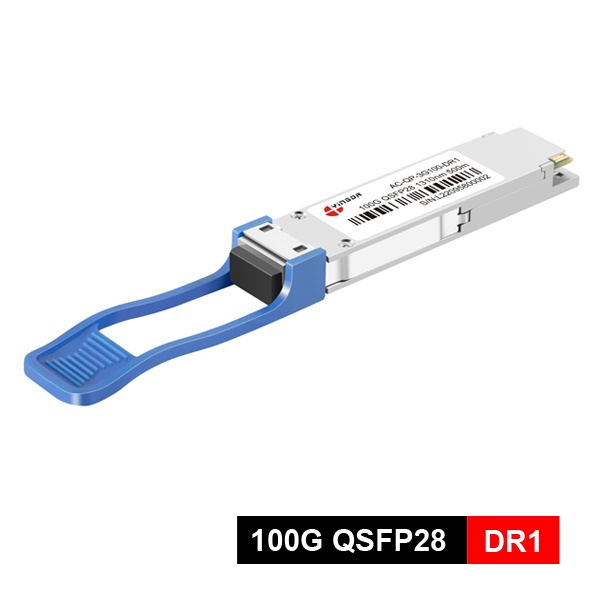
QSFP28 100G DR1 Core specification parameters
| parameter item | Specification | Additional notes |
| boxed type | QSFP28 | Hot pluggable, commonly used for 100G network devices |
| transmission rate | 106.25Gbps | Adopting PAM4 modulation format, 1 x 53.125GBd PAM4, with an effective data rate of 100G |
| electrical interface | CAUI-4 (4x 25.78 Gbps NRZ) | Used for connecting switch ASIC |
| Optical interface type | Duplex LC | |
| Fiber optic type | Single mode fiber (SMF, G.652) | |
| transmission distance | 500 meters | KP-FEC error correction must be enabled during actual deployment |
| working wavelength | 1310nm (single wavelength) | Single channel transmission |
| emitter type | EML (Electro Absorption Modulation Laser) or Silicon Optical Scheme | Silicon photonics technology is becoming a popular choice for low power consumption and high integration |
| Receiver type | PIN photodiode | |
| power consumption | <4W | Typical 3.5W ~ 4W |
| Operating Temperature | Commercial grade 0 ℃ to 70 ℃ | Commercial grade, suitable for data center environments |
| protocol standard | IEEE 802.3cu 100GBASE-DR1, 100G Lambda MSA |
Below, we will provide a detailed explanation of the most important parameters of 100G DR1:
Key 1: Single wavelength 100G PAM4
- Adopting PAM4 (4-stage pulse amplitude modulation) technology, with a single channel symbol rate of 53.125GBd
- Compared to the 4 × 25G NRZ scheme, the number of optical components is reduced by 75%, resulting in lower costs
Key 2: 100G DR1 FEC requirements
- 500 m transmission requires KP-FEC (Forward Error Correction) to ensure bit error rate performance
- FEC can correct bit errors in transmission and is a key technology in the single wavelength 100G scheme
Key 3: Technical route selection
There are mainly two types of EML/silicon optical solutions on the market, and their differences are roughly as follows:
- EML solution: Traditional technology is mature and stable in performance, using a cooled EML laser, which is currently the mainstream.
- Silicon optical solution: In recent years, it has emerged to integrate optical devices with electronic chips, which has lower power consumption and is easy to mass produce, with controllable costs. It is particularly suitable for large-scale data centers such as AI/ML clusters.
100G DR1 Technology Architecture
The core of 100G DR1 is the Gearbox DSP chip inside the module, which completes the rate conversion between the electrical interface and the optical interface, simply put: 4 x 25G NRZ ↔ 1 x 100G PAM4
Sender (TX):
- Electrical interface input: 4-channel 25.78Gbps NRZ signal (CAUI-4)
- DSP processing: Convert 4 channels of 25G NRZ to 1 channel of 53.125GBd PAM4 signal
- Optical output: Drive 1310nm EML laser and output 100G PAM4 optical signal
Receiver (RX):
- Optical input: PIN detector receives 1310nm PAM4 optical signal
- DSP processing: Recover and convert PAM4 signal into 4-channel 25G NRZ signal
- Electrical interface output: CAUI-4 outputs to the host device

QSFP28 100G DR1 Application Scenarios
1. 500m Interconnection within the data center (core applications)
100G DR1 is an ideal solution for data center machine room interconnection:
- Spine Leaf architecture: 100G high-speed channel between different cabinets
- Typical distance: 100-500 meters, covering most of the internal interconnection needs of data centers
- Fiber advantages: Single mode fiber, 2 cores are sufficient, no need for multimode MPO wiring

2. Breakout application of 400G DR4
100G DR1 is used in conjunction with 400G DR4 to achieve 1 split and 4 branches:
- 400G DR4 module: 4 × 100G parallel, MPO-12 interface
- Branch scheme: 400G DR4+MPO-12 to 4 x LC duplex patch cord → 4 sets of 100G DR1 devices
- Value: One 400G port can serve four 100G devices, with flexible expansion

3. Smooth evolution of data centers towards 400G
During the upgrade from 100G to 400G, QSFP28-DR1 can serve as a transitional solution:
- The existing 100G network adopts DR1 (single-mode, 500 meters)
- When upgrading, it can be directly replaced with 400G DR4 (belonging to the same single wave 100G ecosystem)
- Fiber optic infrastructure reuse, no need to rewire
4. AI/GPU cluster interconnection
- The silicon optical version of 100G DR1 is suitable for AI data centers due to its low power consumption and high-density characteristics
- Support GPU server interconnection in AI training clusters
- Silicon photonics solution provides cost advantage for large-scale deployment
Comparison between DR1 and other 100G single-mode schemes
| Item | 100G DR1 | 100G LR4 | 100G PSM4 |
| Technical Architecture | 1x100G PAM4 | 4x25G NRZ + WDM | 4 x 25G NRZ parallel |
| Interface type | Duplex LC | Duplex LC | MPO-12 |
| Number of optical fibers | 2-core | 2-core | 8-core |
| Transmission distance | 500 m | 10 km | 500m / 2km |
| Number of wavelengths | 1 (1310nm) | 4 (LAN-WDM) | 1 (1310nm) |
| Power consumption | <4W | <4W | <4W |
| Cost | lower | higher | moderate |
| Applicable scenarios | 500m interconnection of data center | Park/urban area 10 km | Parallel cabling data center |
Selection suggestion:
- Within 500 meters, cost priority → DR1 (single wavelength, LC interface)
- 500m -10km → LR4 (only option)
- Existing MPO parallel cabling infrastructure → PSM4
Conclusion
The 100G QSFP28 DR1 transceiver is the cost-effective choice for 500 m single-mode interconnection Using 1 × 100G PAM4 single wavelength technology, 500 m transmission is achieved on single-mode fiber through duplex LC interface, with a power consumption of less than 4W, filling the gap between SR4 (100 m) and LR4 (10 km). It is an ideal solution for 100G interconnection within data centers. According to our actual engineering needs, Yingda suggests that the following situations can choose 100G DR1 transceiver to achieve a balance between cost and benefit.
| Scenario requirements | Recommended Solution | Reason |
| Data center machine room interconnection (≤ 500 meters) | 100G DR1 | Single mode duplex LC, 2-core fiber, power consumption<4W, high cost-effectiveness |
| 400G to 100G branch application | 100G DR1 + 400G DR4 | Belonging to the same single wave 100G ecosystem, with flexible branching |
| There is already duplex LC single-mode wiring | 100G DR1 | Seamless compatibility with existing infrastructure |
| Pursuing lower power consumption | Low power version DR1 (<3.5W) | Some manufacturers provide optimized versions |
| Large scale AI cluster deployment | Silicon Light Edition 100G DR1 | Cost controllable and highly integrated |