Skip to content
Optical fiber transceiver 100GBE SR4 QSFP28 and 100G SRBD are address to solve the short distance (about 100 meters) 100G interconnection inside the data center, but their requirements for fiber optic cabling are completely different.
The following are the core differences between 100GBE SR4 QSFP28 and 100G SRBD:

Technical architecture comparison
| Item | 100G SR4 | 100G SR-BiDi (Bidirectional) |
| fiber optic interface | MPO-12 (Alignment:Type B) | LC Duplex |
| Number of optical fibers | 8 cores (4 send, 4 receive) | 2 cores (1 send, 1 receive) |
| working principle | 4-channel 25G NRZ parallel transmission | 2-channel 50G PAM4 bidirectional wavelength division multiplexing |
| wavelength | 850nm (All channels are the same) | 850nm & 900nm (Dual wavelength) |
| fiber type | Multimode fiber OM3/OM4/OM5) | Multimode fiber OM3/OM4/OM5) |
Analysis of core difference
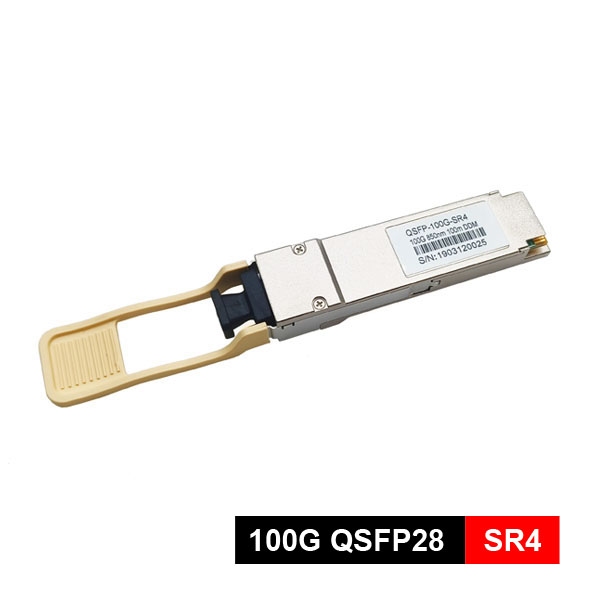
QSFP 100G SR4 Standard:
Disadvantage: MPO fiber jumpers must be used. If your computer room originally only had LC patch cords, you need to rewire them.
Principle: SR4 100G is the most standard 100G short-range solution. Using MPO interface, there are 4 lasers working simultaneously inside, each running 25G.
Advantages: The widest compatibility, supported by almost all brands of switches; The module price is currently the cheapest among the 100G series.
QSFP 100G SR BiDi (Bidirectional):
Disadvantage: The QSFP 100G SR BIDI module price is more expensive than SR4, but it has the best support for OM5 fiber (limited distance for OM3/OM4).
Principle: It uses “bidirectional” technology to simultaneously transmit and receive (using two wavelengths of 850nm and 900nm) in a multimode fiber.
Advantage: The biggest selling point is “fiber reuse”. It can be directly plugged into the existing 10G/40G dual core LC multimode fiber, and can be upgraded to 100G without changing the wiring.
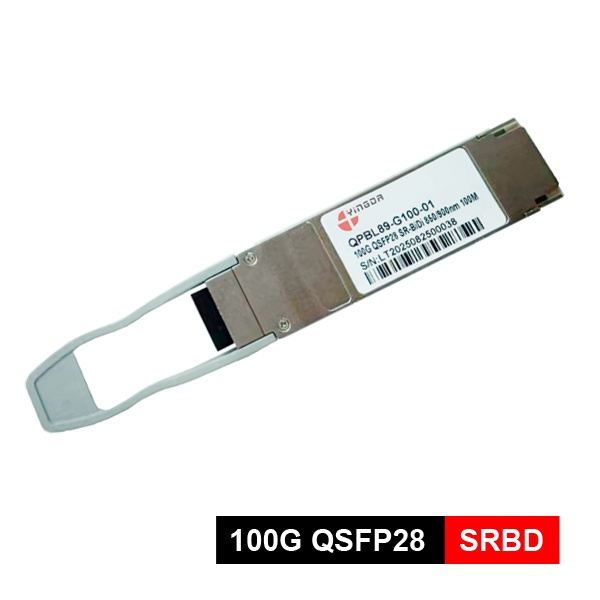
Comparison of usage scenarios
Scenario A: Building a new high-density data center
- Recommended: Transceiver 100Gbe SR4 QSFP28
- Reason: Newly built computer rooms usually have MTP to MTP fiber cable (100G MTP cable) laid uniformly. The 100G SR4 module has the lowest cost and the MPO interface is convenient for future direct upgrades to 400G SR8 or DR4.
Scenario B: Renovation of the old computer room (upgrading from 10G to 100G)
- Recommended: QSFP 100G SR BIDI
- Reason: If your computer room is filled with LC duplex multimode patch cords and you don’t want to install new 100G MTP cable, 100G SRDB is the only “lossless upgrade” solution. Just replace the transceivers modules at both ends without moving patch cords.
Scenario C: Need for ‘1 to 4 Breakout‘
- Recommended: 100G SR4
- Reason: SR4 can split one 100G port into four 25G ports by a QSFP 100G SR4 S cable, that is MPO to 4xLC fiber breakout cable. SR BiDi does not support this splitting operation.

Conclusion
From the above analysis, it can be inferred that although both 100G SR4 and SRBD are multimode transceiver, their architectures, working principles, and application scenarios have significant differences. Therefore, we can choose the most optimal solution based on the existing wiring environment, project cost budget, and actual situation.
- Pursuing the lowest transceiver price and requiring 1 to 4 breakout: choose SR4 (with MPO cable).
- Pursuing zero wiring changes and upgrading old data centers: Choose SR BiDi (with LC cable).