Skip to content
In a 400G network, the choice of cabling method primarily depends on the transmission distance, optical module packaging form (such as QSFP-DD, OSFP), and existing infrastructure. Common wiring schemes include the following five types.
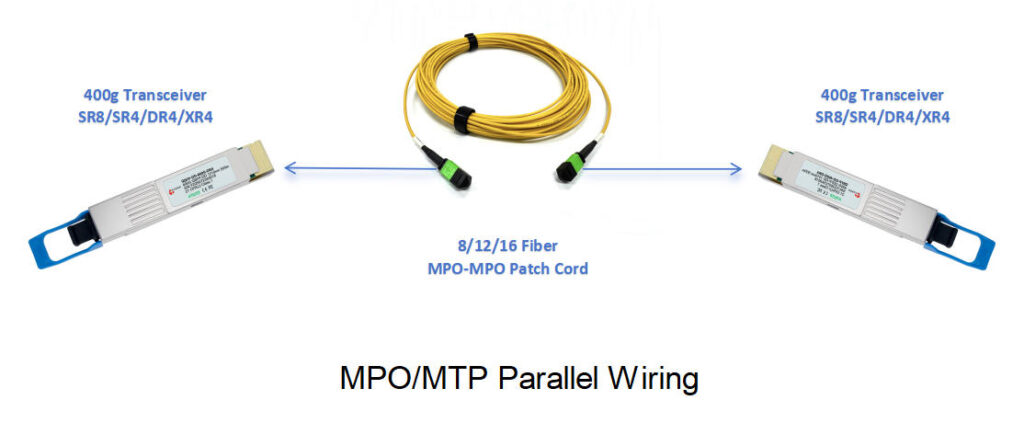
1. Parallel fiber optic cabling (MTP/MPO)
This is the most mainstream short distance (within 500 meters) cabling method for 400G networks, mainly used for standards such as SR8, DR4, XDR4, etc.
- 8 Core MTP/MPO solution: Due to the fact that parallel 400G SR4 transceivers typically operate on 8 fibers, using an 8 fiber MPO connector can achieve the highest fiber utilization and simplest port mapping.
- 12 Core/16 Core MPO/MTP solution: Some early or specific standard SR8 modules may use MPO 16 fiber, but in modern data centers, 12 core or 24 core backbone cables are often used for compatibility, connected to 8-core ports through branch adapters.
2. Duplex LC wiring
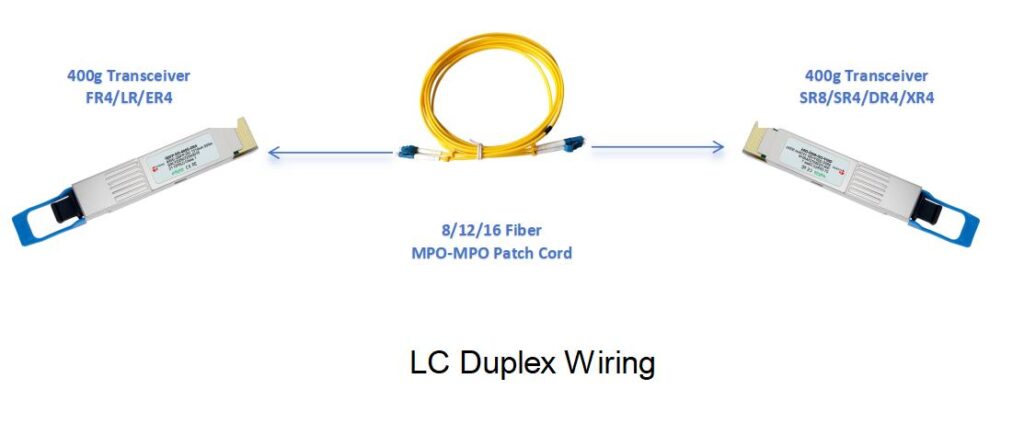
LC duplex wring are mainly used for long-distance transmission 2km to 10km and above, such as 400G-FR4, 400G-LR4, 400g-ER4, etc. Such optical transceivers all use wavelength division multiplexing (WDM) technology: By transmitting signals of four different wavelengths in parallel on a pair of optical fibers, traditional single-mode duplex LC patch cable can reduce the fiber counts.
3. Direct connection cable and active fiber optic cable (DAC/AOC)
AOC and DAC cable are suitable for extremely short distance connections within cabinets or between adjacent cabinets (usually less than 7-10 meters).
- DAC (Directly Attached Copper Cable): Passive DAC cable has the lowest cost and power consumption, but the transmission distance is usually limited to within 3 meters, suitable for ToR switch to server connections.
- AOC (Active Optical Cable): AOC fibre cable are composed of optical fibers and optical modules fixed at both ends, it is lighter and thinner than DAC, with a transmission distance of up to 10-30 meters, commonly used for interconnection between cabinets.

4. Fanout / Breakout Cable
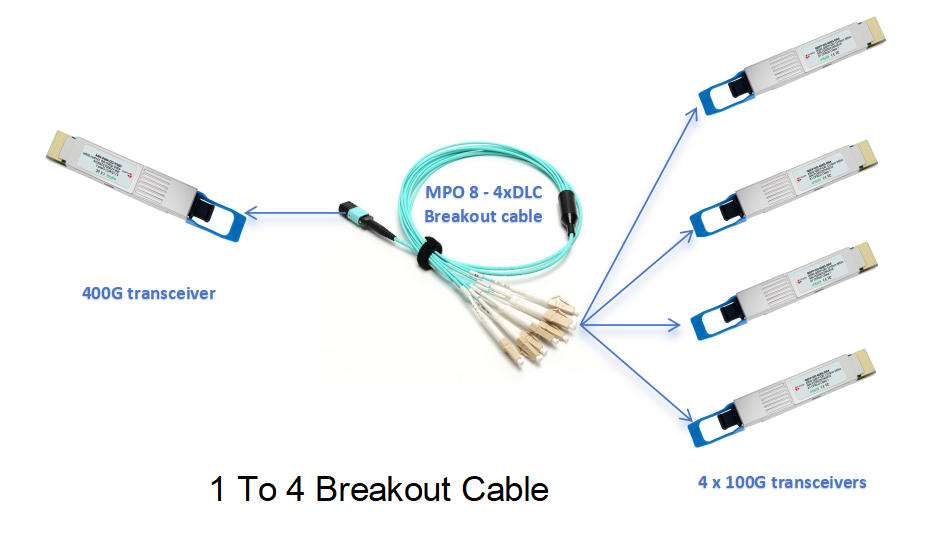
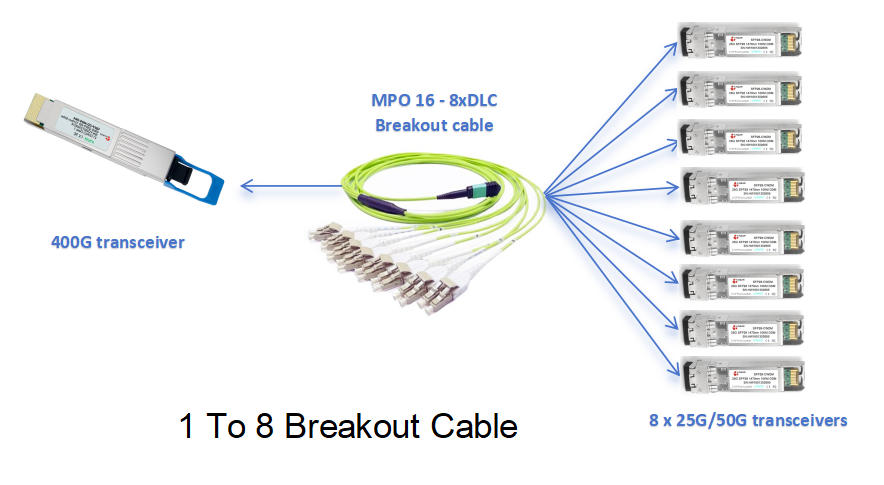
Branch cable is mainly used to achieve the transition from 400G core ports to 100G, 50G, or 25G access ports.
- 1 To 4 breakout cable: For example, connect a 400G (QSFP-DD) port to 4x100G ports through MPO to 4LC breakout cable.
- 1 To 8 breakout cable: By using DAC or AOC breakout cable directly or by special 16 cores MPO conversion cables with 400G SR8 modules, the 400G port is decomposed into 8x 50G or 8x25G ports, improving port density and flexibility.
5. Structured Cabling
In large-scale data centers, structured cabling is commonly employed:
MDA/HDA Design: Managed via cross-connection points within the Main Distribution Area (MDA) and Horizontal Distribution Area (HDA), this design supports flexible patching between ports of varying speeds (e.g., mapping 400G to 10G, 25G, or 100G), thereby maximizing infrastructure reusability.
Explore more:
16 Fibers MTP MPO Patch Cord and Its Application
Where are 8 Fiber MPO to 4LC Duplex Patch Cords Typically Used?
What product can be used for breaking out 400G DR4 to 100G DR1?
How to split a 400G link into 8x25G?
How do you connect 400G devices to an existing 100G cabling system?