Skip to content
Achieve a 400G to 8x25G splitting, which involves dividing a single 400G port into eight independent 25G ports, primarily relying on switches with branching capabilities and specific parallel optical modules and high-density MPO/MTP breakout cable. It should be noted that this does not refer to directly outputting eight 25G electrical signals from a single 400G module, but rather achieving the split through the technical architecture of parallel optical modules and physical fiber optic division.
The 400G interface is physically based on 8 lanes of 50G PAM4 signals, which use PAM4 modulation, while 25G devices typically employ NRZ modulation. Therefore, simple passive cables (DAC) cannot be used, and signal conversion must be achieved through products equipped with a “Gearbox” chip. Ensure the selected cable is labeled as supporting “PAM4 to NRZ” or comes with a built-in Gearbox. Additionally, FEC is mandatory for 400G but optional for 25G. In mixed connections, it is essential to manually configure the FEC modes of both switches to match; otherwise, the link will fail to establish.
Core Product Solutions
Solution 1: AEC Breakout Cable (Active Electrical Cable)
- Product: 400G QSFP-DD to 8x 25G SFP28 AEC.
- Working principle: The Gearbox chip is integrated inside the cable to convert the 8x 50G PAM4 electrical signal on the 400G side into the NRZ signal required for the 25G end.
- Features: Low power consumption compared to optical modules, supporting cross generation (PAM4 to NRZ) conversion.
Solution 2:Active optical modules(Gearbox conversion)+ MPO/MTP breakout cable
- Product: 400G SR8 breakout supporting 8x25G mode + MPO-16 to 8x LC breakout cable + 25G SFP Module.
- Key point: The 400G port on the switch side needs to have “channelized” capability, which can slow down a single 50G PAM4 and run it in 25G NRZ mode.
Solution 3:Cascade switch
- Product: 1 aggregation switch with 400G upstream port and multiple 25G downstream ports (such as Cisco Nexus 9300).
- Features: If the direct wiring is too complex or the distance is too far, usually a 400G cable is first connected to the intermediate switch, and then a 25G port is branched out from the switch.
Below are the specific implementation steps for the Solution 2.
| Item | Key requirements | Remark |
| Switch platform | Must support 8x25G branch mode | Switch chips (such as Broadcom Tomahawk series) and operating systems need to explicitly support 8-way splitting of 400G ports. You need to enter a specific port on a switch that supports this mode (such as Arista, Cisco, NVIDIA, etc.) and enter the command related to interface breakout. |
| Optical module type | 8 transmit and 8 receive parallel modules (such as SR8 or PSM8) | There are 8 independent 25G channels inside the module, instead of 4 100G channels. |
| fiber optic connector | MPO-16/24 APC connector | 8 transceiver channels for connecting modules. |
| Branch cable | MPO-16/24 to 8x LC or 8x SFP28 interface | Split the parallel optical fibers at the module end into 8 independent duplex LC interfaces, each connected to 8 25G devices. |
Solution 2 Implementation Steps
Step 1. Switch configuration – Enable port splitting
The prerequisite for implementing this function is that both the switch hardware and software support “port splitting”.
- Hardware requirements: Switch ports must be encapsulated with QSFP-DD. QSFP-DD has 8 high-speed electrical ports (SerDes), each of which can be independently configured for speed 25Gbps.
- Software configuration: You need to log in to the switch operating system and change the working mode of the specified 400G port from the default “1x400G” to “8x25G”.
Step 2. Optical module selection
400G Transceiver Side:
Not all 400G modules support splitting into 8x25G, depending on their internal optical design. Suggest use 400G 8-channel parallel modules.
- Recommended solution: 400G PSM8 module or 400G SR8 breakout module
- Internal architecture: Adopting 8x50G PAM4 or 8x25G NRZ architecture.
- Interface: MPO-16/24 APC connectors are used to transmit 8 independent channels in parallel through 16 or 24 core optical fibers.
NOTE: Not applicable solution – FR4/LR4 module
These modules adopt a 4x100G PAM4 architecture internally, Duplex LC optical receptacle, and multiplex 4 electrical channels into 4 optical wavelengths, which only supports splitting 4x100G (400DR4 to 4x100G DR1), and cannot be split into 8x25G.
25G Transceiver Side:
Select SFP28 LR or SR module for 25G module, both details are listed in below table:
| Item | SFP28 25G SR (short distance) | SFP 25G LR (Long Range) |
| interface type | Duplex LC | Duplex LC |
| fiber type | Multimode fiber (OM3/OM4, aqua) | Single mode fiber (OS2, yellow) |
| Maximum transmission distance | 70 m (OM3) /100 m (OM4) | 10 km |
| working wavelength | 850nm (VCSEL laser) | 1310nm (DFB laser) |
| Typical application scenarios | Short distance interconnection inside the cabinet and within the same computer room | Long distance connections between buildings in the park and across data centers |
Step 3. Wiring connection – MPO/MTP Breakout Cable
The connection of physical links requires the use of specific fiber breakout cables:
- Module side: Insert MPO-16/24 connector.
- Branch box: Convert MPO to 8x LC breakout cable or dedicated MPO breakout cassette.
- Equipment/Device side: There will be 8pcs LC duplex interface at other end of other cable, which are connected to devices with 8 x 25G SFP28 ports.
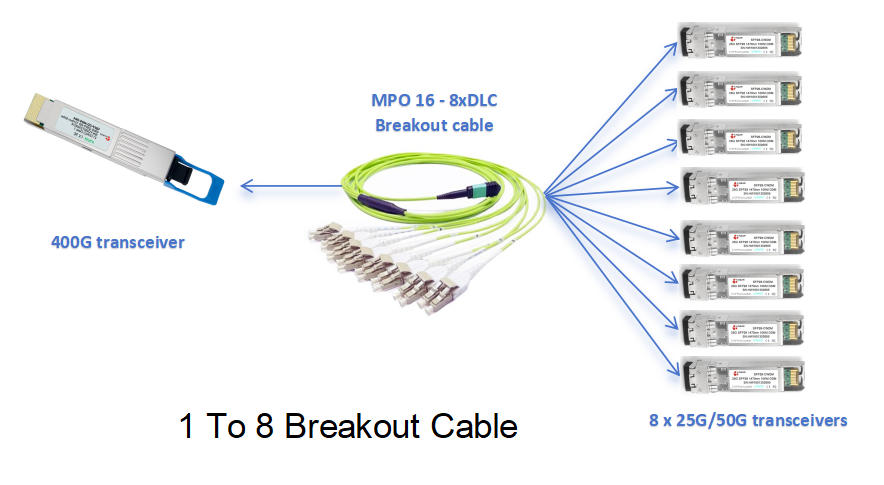
Typical scenarios and products for reference
| Application | Part no. | Implementation method |
| 400G to 8x 25G | 400G QSFP-DD SR8/PSM8 | The module is designed in 8-channel parallel and supports branching directly to 8x SFP28 25G through MPO-16 to 8x LC conversion cable. |
| 400G to 4x 100G | 400G QSFP-DD DR4/FR4 | The module is designed with 4 channels and branches to 4 100G QSFP28 ports through 12 fiber parallel to 2 fiber duplex breakout cable. |
| 200G to 8x 25G | 200G QSFP-DD PSM8 | 8x25G NRZ architecture, lower cost, can be directly branched. |
Additional note: If the existing 400G module is of SR8 or DR4 type, they usually support splitting 4 x 100G modules, but to achieve 8x25G, the module based on 8-channel parallel optical design mentioned above must be used.
Conclusion
The key to achieving a branch from 400G to 8x25G is:
- Software level: Ensure that the switch supports 8x25G port splitting.
- Hardware level: Use 8-channel parallel optical modules such as PSM8.
- Physical level: Configuration with MPO to 8x LC fiber breakout cable.