 Skip to content
40G network cabling is primarily designed for data center environments. Although considered a previous-generation technology, it remains widely deployed in many existing data centers. The current mainstream 40G interface standard is QSFP+ (Quad Small Form-factor Pluggable Plus), and the specific cabling approach adopted typically depends on the required transmission distance and available budget. Yingda has identified approximately four distinct cabling schemes, the details are as follows:
Short Distance Connections (Intra-rack / Adjacent Racks, <50 meters)
These solutions are typically employed for connections within a data center rack or between adjacent cabinets (ToR cabling); they offer the lowest cost and are easy to install. Generally, two options are available: Fiber Active Cable (AOCs) with integrated optical modules, and DAC Cable 40G (DACs) copper cables with integrated modules.
QSFP+ DAC cable 40G (High-Speed Copper Cable):
A copper cable featuring integrated QSFP+ modules at both ends. It boasts an extremely low price point, low power consumption, and offers the best overall cost-effectiveness. It is ideally suited for connecting switches to servers or storage devices (ToR). However, its transmission distance is extremely limited, typically within 1 to 7 meters and the cables themselves tend to be relatively thick and rigid.
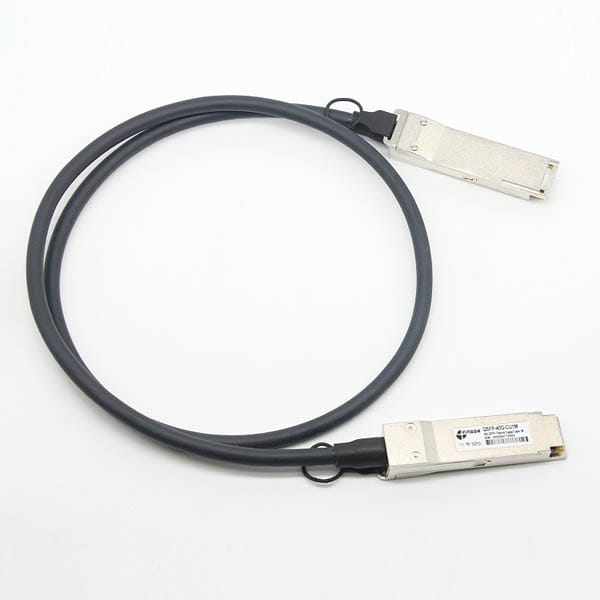

A QSFP MPO Cable featuring integrated QSFP+ modules at both ends; it is lighter and thinner than a DAC, offers strong resistance to electromagnetic interference, and supports longer transmission distances (up to 50m), making it suitable for inter-rack connections.
Medium to Long Distance Connections (Within Data Centers or Between Buildings: 100m to 40km)
When the distance exceeds 50 meters, it is standard practice to utilize discrete 40G QSFP+ modules paired with fiber patch cords for cabling. This is the most commonly adopted method for 40G networks.
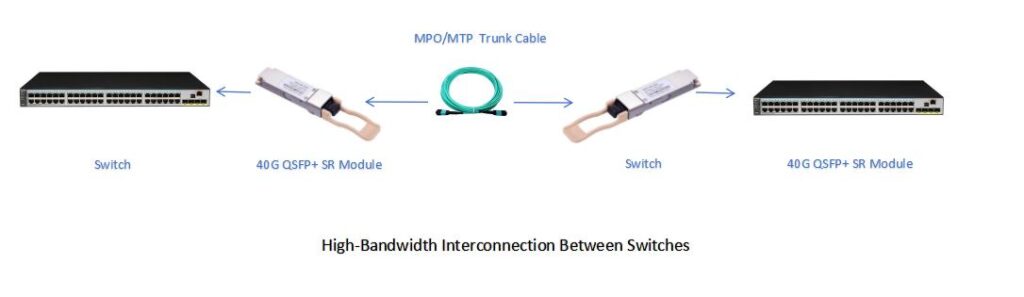
Multimode Solution: 40GBASE-SR4 Optical Module + MPO/MTP Fiber Patch Cord
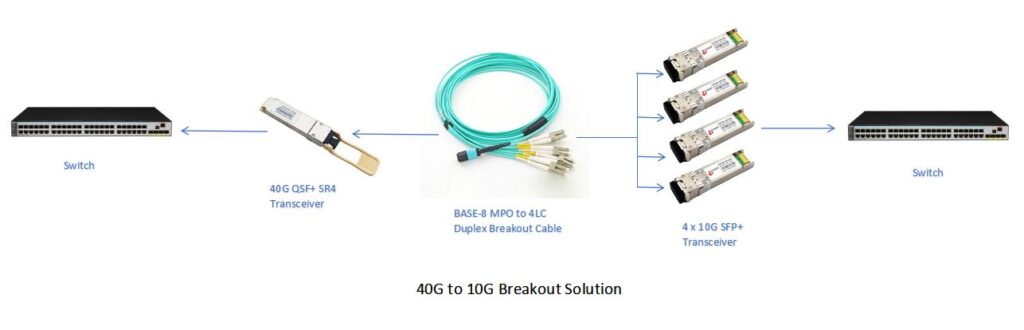
This solution employs an 8-fiber multimode cable (comprising 4 transmit channels and 4 receive channels), with each channel transmitting a 10G NRZ signal. It offers a cost-effective approach and supports “Breakout” configurations, splitting a single 40G link into four separate connections to four 10G SFP+ ports. This QSFP 40G SR4 MPO solution is well-suited for short-distance connections (100m to 150m) between equipment cabinets.
- Module: 40G QSFP+ SR4 Transceiver.
- Fiber Patch Cord: Utilizes 8-fiber or 12-fiber MPO/MTP (Base-8) trunk cables (for direct 40G-to-40G connections) or MTP breakout cables (for 40G-to-10G branched connections).
- Fiber Type: Multimode Fiber (OM3/OM4).
- Transmission Distance: OM3 supports transmission up to 100m; OM4 supports transmission up to 150m.
Single Mode Solution: 40GBASE-LR4/PSM4/ER4 Optical Modules + Duplex LC Single Mode Fiber Patch Cables
This cabling solution utilizes CWDM (Coarse Wavelength Division Multiplexing) technology to multiplex four 10G signals into a single channel, transmitting them over a pair of fibers (via a Duplex LC interface). This approach significantly conserves fiber resources and eliminates the need for MPO patch cables. It is ideally suited for long-distance connections spanning across buildings or within a campus environment, supporting transmission distances ranging from 10 km to 40 km.
- Modules: 40G QSFP+ LR4 (10 km) or ER4 (40 km) Transceivers.
- Fiber Patch Cables: Duplex LC Single Mode Patch Cables (OS2, Yellow).
- Fiber Type: OS2 Single-Mode Fiber.
- Transmission Distance: LR4 supports 10 km; ER4 supports 40 km.

MPO Structured Cabling Solution (Recommended)
In complex data center environments, the adoption of structured cabling is recommended to facilitate management and ensure a seamless upgrade path to 100G and 400G in the future.
Solution A (Direct Interconnect)
This solution utilizes 8 fiber or 12 fiber MPO/MTP trunk cables to connect MPO adapter plates on patch panels with 40G QSFP+ modules. Since 40G (SR4) connections actually utilize only 8 fibers, adopting a Base-8 MTP/MPO cabling scheme achieves 100% fiber utilization while facilitating future upgrades to 100G. This method is straightforward and allows for rapid installation.

Option B (Breakout Connection)
A 40G QSFP+ port is converted into four 10G LC duplex interfaces via an MTP to LC breakout cable or MTP to LC cassette, making it suitable for connecting to 10 Gigabit servers.
Port Splitting (40G to 10G): By utilizing a 1 to 4 QSFP+ to 4xSFP+ breakout cable, a single 40G port can be split into four 10G ports to connect to legacy devices.

40G Cabling Solution Comparison
| Solution | Interface Type | Cable type | Max.distance | Core advantage |
| SR4 | MPO-12 | Multimode (OM4) | 150m | Support 1 to 4 (Breakout) |
| BiDi | LC | Multimode (OM4) | 150m | Reusing Old 10G LC Patch Cords |
| LR4 | LC | Single mode (OS2) | 10km | The Preferred Choice for Long-Distance Single-Mode Applications |
| DAC | Integrated with QSFP+ module | Copper cable | 7m | Lowest Cost: Direct Connection Within the Cabinet |
| AOC | Integrated with QSFP+ module | Fiber optic cable | 7-50m | Lower Cost: Inter-Rack Connectivity |
Key Points:
- 40G to 10G Conversion: Only the SR4 mode supports a 1 to 4 split configuration, which is achieved using a MPO to 4xLC fiber breakout cable
- Polishing Type: QSFP 40G SR4 MPO modules typically utilize UPC (flat-face) polishing, characterized by black or beige connectors. This differs from 100G/400G single mode MPO modules, which strictly require APC (angled-face) polishing, characterized by green connectors. It is critical to avoid mixing these two types.
- Prioritize 8 Fiber MPO: The 40G SR4 transceivers standard utilizes only 8 fibers (4 for transmission and 4 for reception); therefore, an 8 fiber MTP/MPO system offers greater efficiency in fiber resource utilization.
- Cleaning MPO Connectors: Fiber optic connection points must be kept clean to prevent dust contamination from causing network outages. We offer specialized 8 fiber MPO cleaner pen and 16 fiber MTP cleaner.
Conclusion
The core connectivity methods for 40G cabling include direct connections via MPO trunk cables and hybrid cabling utilizing MPO to LC cassette modules; these approaches facilitate high density and flexible scalability. The adoption of structured cabling helps mitigate cable congestion in high-density environments while optimizing heat dissipation.
- For connections within a data center cabinet, DAC cable 40G are the preferred choice;
- For short-distance transmission across cabinets or within a server room, the use of OM4 MPO multimode fiber is recommended;
- For long-distance transmission across buildings, single mode fiber paired with LC interface QSFP+ module is mandatory.