Skip to content
In 100G/400G high-speed parallel transmission networks, it is recommended to prioritize the MTP polarity Type B (cross-type) solution. For scenarios requiring complex structured cabling via patch panels, the Type A (straight-through) backbone combined with specific patch cords is typically employed. However, the Type C (pair-reversed) solution is never recommended for direct interconnection of parallel optical modules due to its potential to disrupt the alignment of parallel channels.
To thoroughly unveil the logic behind polarity selection, we need to dissect it from the transceiver mechanism of optical modules, the fundamental differences among the three polarities, and specific application scenarios.
Why Must High-Speed Networks Prioritize Polarity?
Traditional 10G/25G networks employ duplex transmission, with one transmit (Tx) and one receive (Rx) fiber, which can be easily configured by simply crossing LC patch cables.
The 100G (e.g., 100G-SR4) and 400G (e.g., 400G-SR8/DR4) standards widely employ Parallel Optics technology:
- 100G SR4: Utilizes a 12 fiber MPO connector, with 4 fibers on the left for transmission (Tx1-Tx4), 4 fibers on the right for reception (Rx1-Rx4), and 4 fibers in the middle left unused.
- 400G DR4: Utilizes 12-fiber MPO, with 4 parallel channels at 100G per channel.
- 400G SR8: Utilizes a 16-fiber MPO connector with 8 lanes for simultaneous transmission and 8 lanes for simultaneous reception.
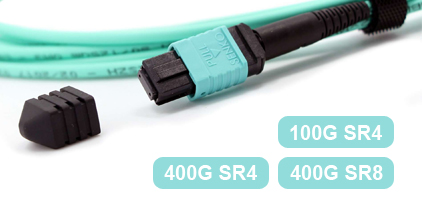
The core purpose of polarity management is to ensure that the first channel transmitter (Tx1) of device A can accurately connect to the first channel receiver (Rx1) of device B. Once the wrong polarity is selected, the optical signal will enter the empty core or the wrong channel, causing the link to fail to up.
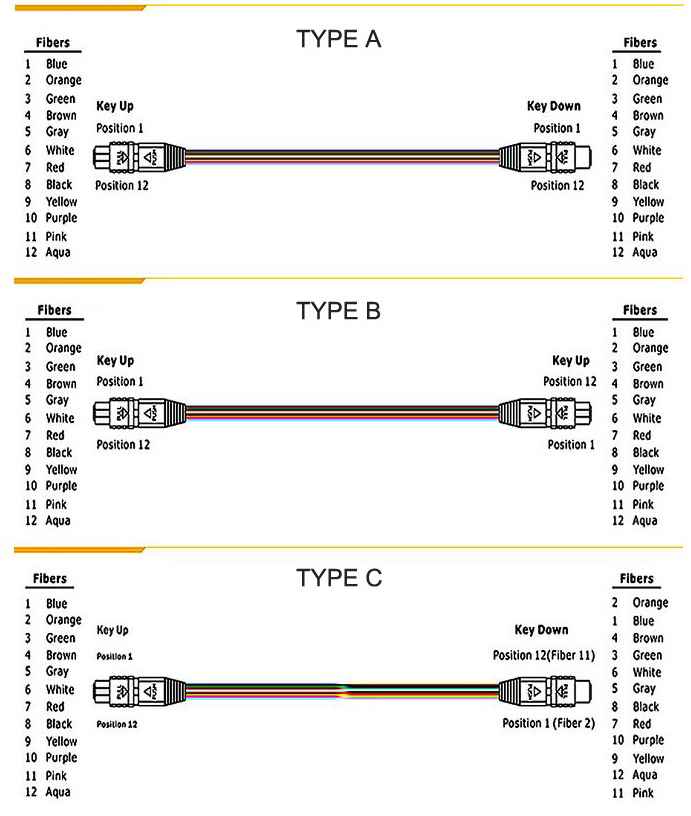
The Essential Difference Between the Three Polarities (Type A/B/C)
| MPO/MTP Polarity Types | Key Orientation | Fiber Core Mapping Relationship (taking 12 cores as an example) | Signal Characteristics |
| Type A (straight through) | Key Up and Key Down | Position 1 to Position 1, Position 12 to Position 12 | The physical location of the signal remains completely unchanged |
| Type B (cross type) | Both ends are Key Up | Position 1 to position 12, position 2 to position 11 | The entire linear array is completely reversed and flipped |
| C-type (pair-reversed) | Key Up and Key Down | 1 on 2, 2 on 1; 3 on 4, 4 on 3 | Only flip adjacent pairs of lines pairwise |
How to Choose a 100G/400G Network?
According to different wiring architectures, the selection logic is very clear:
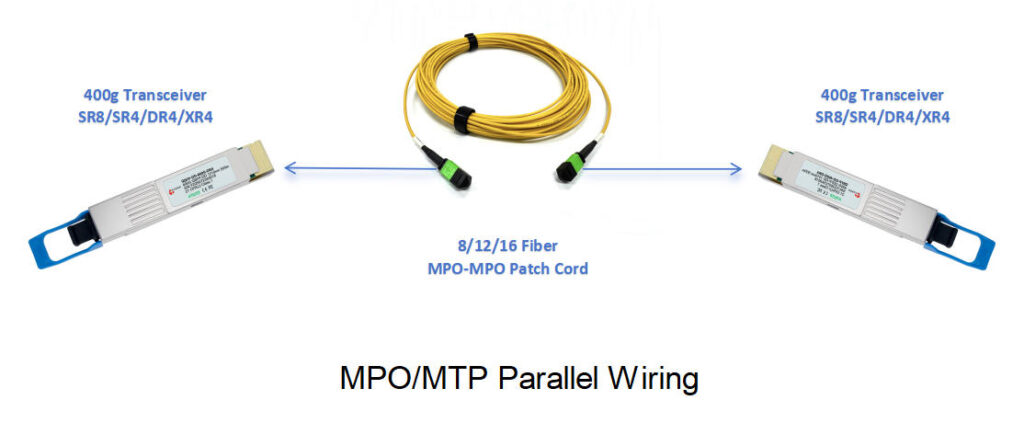
Scenario 1: Two high-speed switches are directly interconnected (most commonly)
- Select polarity: Type B MPO Jumper
- Reason for selection: The internal layout of parallel optical modules (such as QSFP28, QSFP-DD) is fixed (e.g. left transmitter and right receiver). The fully inverted characteristics of MPO crossover cable (1 to 12, 12 to 1) naturally achieve perfect cross docking between Tx and Rx arrays. Simply plug in the optical module at both ends for communication, plug and play, extremely error free.
Scenario 2: Structured cabling of data center backbone (via fiber optic patch panel)
If you are building a large data center, fiber optic cables need to pass through cable trays and enter modular patch panel cassette for management:
Solution 1 (TIA standard recommendation): Type A MPO trunk cable + Type B MPO patch cord
- Configuration: The large capacity MPO trunk cable in the middle adopts polarity Type A (straight through), and the fiber patch panel adopts Type A adapter, but the equipment patch cord at one end must use polarity Type B.
- Advantages: The trunk cable is straight through, making it easy to smoothly upgrade or change the network in the later stage (such as switching from duplex LC to parallel MPO).
Solution 2 (Simplified Polarity Type B Solution): Type B MPO trunk cable + Type B adapter
- Configuration: The trunk cable, adapters, and patch cords are all uniformly purchased in Type B.
- Advantages: The entire network component model is single, inventory management and on-site construction are extremely simplified, and it is not easy to cause polarity confusion due to workers inserting the wrong patch cables.

Scenario 3: High speed port splitting (e.g. breakout 400G to 4x 100G)
- Choose polarity: Type B MPO-MPO conversion cable or MPO 12 to 4x LC duplex breakout cable.
- Reason for selection: In scenarios where 400G (DR4) is split into 4 x 100G (FR1/LR1) or 100G (SR4) is split into 4 x 25G, MPO Type B ensures that each pair of split fibers accurately corresponds to the Tx and Rx of downstream devices.

Deployment and Suggestions for Avoiding Pitfalls
1. Male and Female Pin Matching: MPO/MTP connectors must be docked with one male (with guide pin) and one female (without pin). The high-speed optical module is entirely MTP male (with pins) inside, so the MTP patch cords directly connected to it must be female (without pins).
2. End polishing (PC vs APC): Single mode optical modules with 100G/400G (such as DR4/FR4) are required to use APC (slope) polishing for MPO interfaces due to reflection sensitivity; Multimode optical modules (such as SR4/SR8) typically uses PC/UPC (planar). When connecting a single-mode APC interface with a polarity type B structure, attention should be paid to the compatibility of the adapter’s key position. When purchasing, it should be clearly stated to the supplier whether it is used for single-mode or multi-mode.
3. Adhere to the principle of singularity: Once a data center project selects a polarity standard (such as the MTP universal polarity type B scheme), all subsequent expansions must be strictly consistent, avoiding the mixed use of A and B types, otherwise it will bring endless troubleshooting nightmares to later operations.