 Skip to content
The MPO 8 fiber to 4x LC duplex patch cord serves as an conversion cable for converting MPO backbone connections into standard LC duplex interfaces. It is primarily used in high-density data centers, enterprise server rooms for pre-terminated cabling, and scenarios involving high-speed network upgrades. Its core function is to split a single high-bandwidth parallel optical interface into four lower-bandwidth duplex interfaces, thereby enabling flexible interconnection between devices. Thanks to its pre-terminated design, it significantly reduces the installation time required for fiber optic cabling within data centers and server rooms.
Key Technical Parameters
- Fiber Type: For multimode applications, OM3/OM4 (Aqua or Magenta) is typically selected; for single-mode applications, OS2 (Yellow) is chosen.
- Wire Sequence/Polarity: Type B (Crossover) polarity is typically employed to ensure that the transmitting end (Tx) correctly corresponds to the receiving end (Rx).
- Connector End-face: For multimode applications, UPC (flat) is standard; for single-mode applications, APC (angled) is often recommended to minimize return loss.
Below, we will provide a detailed explanation of the 3 application scenarios for this MPO breakout cable:
40G/100G Network Breakout
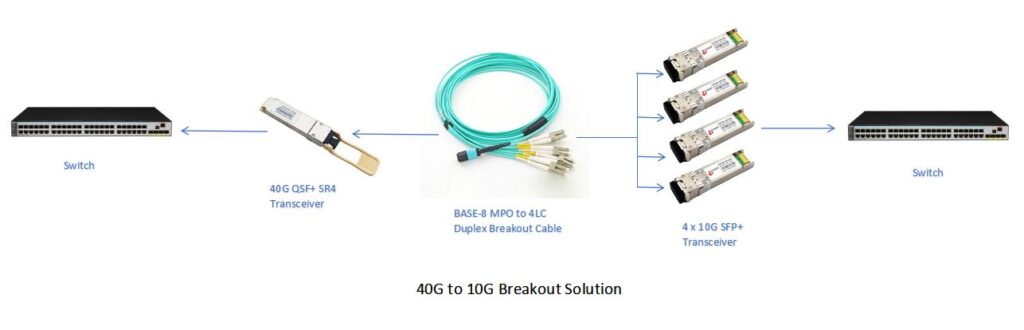
40G/100G network breakout is the most classic application for this breakout cable which split a single high-bandwidth port into four independent channels to connect multiple lower-speed devices. This approach significantly enhances the utilization efficiency of switch ports, thereby eliminating the need to purchase expensive, lower-speed line cards solely to accommodate lower-speed devices.
40G QSFP+ to 10G SFP+:
Splits a single 40G QSFP+ port on a switch into four 10G SFP+ ports.
- 100G QSFP28 to 25G SFP28:
Splits a 100G QSFP28 port into four 25G SFP28 ports.

High Density Patch Panel Management
In large scale data centers, MPO trunk cables are commonly utilized for long-distance transmission to conserve rack space.
- Port Mapping: At the cabinet end, an 8 fiber MPO to 4LC fiber breakout cable is used to connect the MPO trunk to a fiber adapter panel or MPO module, thereby splitting the connection into individual LC interfaces that plug directly into servers or storage devices.
- Reduced Congestion: A single fiber MTP cable replaces four duplex LC patch cords, significantly reducing cable accumulation behind the cabinet and improving thermal management.

Transitioning Between Backbone Cabling and Device Connections
- SR4 Module Connectivity: Since 40GBASE-SR4 and 100GBASE-SR4 optical modules utilize only 8 internal fibers (4 for transmission and 4 for reception, with the middle 4 fibers left unused), an 8 fiber MPO to 4xLC fiber breakout cable perfectly matches their physical structure, ensuring no fiber cores go to waste.
- Interconnection of Diferent Interfaces: When a core switch (featuring MPO interfaces) requires a direct connection to access-layer switches or servers (featuring LC interfaces), this type of MPO to LC cable serves as the essential physical connection medium.
Should BASE-8 MPO to 4LC breakout cables utilize single-mode or multi-mode fiber?
Whether an MPO to LC cable use single mode or multimode fiber depends on the transmission distance, the accompanying optical transceivers, and cost considerations. The following is a comparison of specific applications:
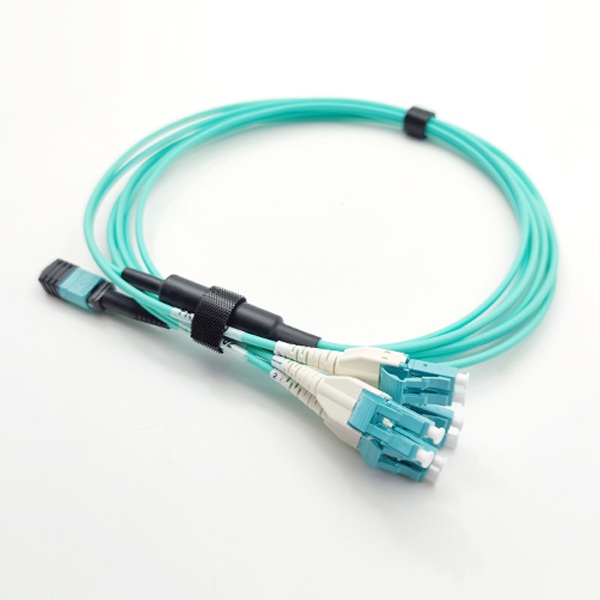
MPO Multi-mode (OM3/OM4/OM5)
MPO multi mode is the most commonly used type within data centers. Its outer jacket is typically aqua (OM3), violet (OM4), or lime green (OM5).
Transmission Distance:Typically ranges from 100 to 400 meters (depending on the fiber grade and data rate).
Advantages:The accompanying multimode fiber transceiver (such as SR4) are significantly less expensive than their single mode modules, making this a cost effective choice for high-density cabling over short to medium distances.
Typical Scenarios
- Short Distance Interconnection: Primarily used for connecting devices located within the same server room, the same rack, or adjacent racks.
- 40G QSFP+ to 4x10G SFP+: Splits a single 40G QSFP+ SR4 port into four 10G SFP+ SR ports.
- 100G QSFP28 to 4x25G SFP28: Splits a single QSFP28 100G SR4 port into four 25G SFP28 SR ports.
MPO Single Mode (OS2)
Typically, the outer jacket of MPO single mode is yellow, and the MPO connectors are predominantly green (featuring an APC angled polish) to minimize reflection loss.
Transmission Distance: 40GBASE SR4 QSFP transceiver module with MPO connector is capable of reaching distances of 2 km, 10 km, or even further.
Advantages: Single mode MPO offers virtually limitless bandwidth potential, eliminates modal dispersion, and exhibits extremely low signal attenuation, making it ideally suited for long-distance, high-performance networks.

Typical Scenarios
- Medium to long Distance Transmission: Used for connection across equipment rooms, different floors, or even separate buildings.
- 40G PSM4 Splitting: Since QSFP single mode fiber transceiver (such as the 40G QSFP+ PSM4) use MPO interfaces for 4 channel parallel transmission, single mode MPO/MTP breakout cables are required to split the signal into four individual 10G SFP+ single mode interfaces.
- Hyperscale Data Centers: In certain hyperscale data centers, single mode solutions are adopted comprehensively, often across the entire facility to standardize cabling infrastructure and accommodate future expansion requirements spanning several kilometers.
Conclusion
You must ensure that the type of MPO/MTP patch cord (single-mode or multi-mode) exactly matches the type of fiber transceivers installed in your device.
- If the fiber transceivr is SR4 transceiver, select multimode MPO breakout cable (such as 40GBASE SR4 cable);
- If it is PSM4 transceiver, select single mode MPO breakout cable (such as PSM4 40G breakout cable).
| Features | Multimode MPO | Single Mode MPO |
| Cable color | Qqua OM3,Purple OM4 | Yellow OS2 |
| Fiber Transceiver Compatible | SR4 transceiver 850nm | PSM4 transceiver 1310nm |
| Transmission Distance | < 400 m | > 2 km |
| Primary Cost | MPO Cables are slightly expensive, while fiber transceivers are inexpensive. | MPO Cables are inexpensive, while fiber transceivers are expensive. |