 Skip to content
In the 800G network, DAC (Direct Attached Cable) and AOC (Active Optical Cable) are mainly used for high-speed interconnection within data centers, and distance is the core factor determining whether to choose DAC or AOC.
- DAC is suitable for extremely short distances (1-2 meters) and low-cost scenarios within or adjacent racks;
- AOC is suitable for scenarios between racks or columns (2-100 meters) that require long-distance and lighter wiring, especially in high-density AI training clusters.
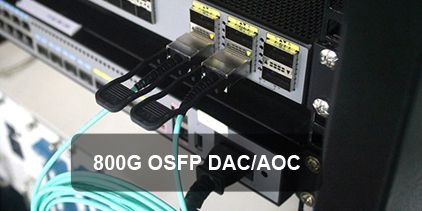
Below, Yingda will provide a more detailed explanation from several aspects, including transmission distance, power consumption budget, and applications.
Transmission distance and physical characteristics
- Due to the significant loss of 800G signals at high frequencies, the maximum distance of a pure passive 800G OSFP DAC is usually only within 2 meters. At the same time, copper cables are very thick and rigid (usually using 26AWG or 28AWG thickness), which can seriously affect ventilation and heat dissipation when arranged in large quantities in cabinets, and have strict requirements for bending radius.
- 800G AOC utilizes fiber optic transmission and can typically support distances of 2 to 30 meters or even longer. Fiber optic cables are very thin and flexible, lightweight, greatly reducing the difficulty of wiring behind the cabinet and facilitating heat dissipation and airflow.
AOC vs DAC latency and power consumption
- 800G DAC is close to zero power consumption (passive components) and does not generate additional heat, which is extremely important in the 800G era (single module 30W) and can effectively reduce the PUE of data centers. Meanwhile, due to the absence of photoelectric conversion process, DAC has extremely low latency (nanosecond level), making it the preferred choice for InfiniBand (IB) networks.
- 800G AOC typically requires a power consumption of around 2W-4W at each end to drive the internal photoelectric conversion chip (DSP/VCSEL/TIA). Due to the photoelectric conversion, the delay is slightly higher than that of DAC.
Cost comparison
- DAC cable has the lowest price. It does not contain lasers and complex electronic components, making it the most cost-effective solution for short distance connections (within the same cabinet).
- AOC cable essentially consists of two fixed optical modules and a section of optical fiber, which is much more expensive than copper cables.
Comparison of application scenarios
800G DAC (high-speed copper cable) is typically used over ultra short distances (within the rack) and with extreme concern for cost and power consumption.
- Server to switch (ToR) connection: In ultra-high density data center racks, the connection from an 800G network card (NIC) to a top rack switch (ToR) is typically within 1-3 meters.
- Switch to switch stacking: used for short distance interconnection between adjacent switches within the same rack.
- Local AI training cluster: Extreme high-speed connections within GPU/XPU servers and between servers and adjacent network card switches, requiring extremely low latency.
- Scale Up architecture: In high-performance computing architectures such as NVIDIA GB200, DAC is commonly used for local interconnection of in cabinet nodes to achieve extremely low latency.
800G AOC (active optical cable) is mainly used for short to medium distance (between racks) scenarios that require high bandwidth, low latency, and anti-interference.
- Interconnection between different racks/columns: When the connection distance is between 3 meters and 100 meters, exceeding the transmission limit of DAC, AOC is the standard solution for achieving interconnection between racks, with a maximum length of up to 100 meters.
- Backbone cabling in data centers: the connection between core switches and column head switches (EoRs), or the interconnection between different rows of racks. Fiber optic cables are thinner, lighter, and softer than copper cables, making them ideal for high-density cabling in supercomputing centers or large data centers.
- Breakout connection: Use 800G-4x200G or 800G-2x400G AOC breakout cables to connect an 800G interface to multiple 400G or 200G interfaces, balancing performance with existing device capabilities.
Comparison table
For a more intuitive comparison, Yingda have created a comparison table for each parameter, as follows:
| Item | 800G DAC cable(passive) | 800G AOC cable | Remark |
| fiber optic cable type | copper cable | optical cable | |
| transmission distance | <2 meters | 3 meters to 100 meters | DAC is mainly used for TOR switches to servers |
| power consumption | Extremely low (~0W) | Higher (2-4W per end) | High heat dissipation pressure in 800G data center |
| Weight/softness | Heavy, hard, thick, not easily bent | Light, soft, thin, easy to wire | Affects wiring convenience and heat dissipation |
| delay | extremely low | higher | The difference between milliseconds and nanoseconds |
| Anti interference (EMI) | general | extremely strong | Fiber optic cables are not affected by electromagnetic interference |
| cost | minimum | higher | AOC prices are usually several times higher than DAC prices |
| Typical Applications | GPU-Switch、ToR-Server | Switch – Switch, inter column interconnection |
Selection suggestion
- If it is a rack internal switch connected to a network card, DAC (or ACC/AEC for better performance) is preferred.
- If it is a cross rack (Row) or medium to long distance, AOC or optical module solutions must be selected.
In the 800G era, due to the fact that pure passive DACs could hardly run at 800G (2-meter distance was too short), other high speed 800G OSFP cable like ACC (Active Copper Cable) or AEC (Active Electrical Cable) optical cables emerged to fill the awkward middle distance of 2-7 meters, gradually becoming a competitive advantage for DACs. ACC/AEC incorporates linear equalization or re timing chips into copper cables, retaining some of the low-cost characteristics of copper cables while running further (3-5 meters) than ordinary DACs, while also being more energy-efficient than AOC.