 Skip to content
Since your 400G port is DR4 (single-mode parallel), in order to achieve one-to-four connections to the 100G port, you need to choose a single-mode product based on 100G Single Lambda (single wave 100G) technology.
The following are specific product solutions recommended based on different wiring distances:
Solution 1: Use 400G AOC Fiber Cable
If you need connections over distances of around 10 to 30 meters (e.g. across cabinets) and want the easiest installation, integrated 400G AOC fiber cables are recommended.

- Supports customized length and is compatible with mainstream manufacturers such as Cisco, Mellanox, MikroTik, Juniper, Dell, HP, Huawei, ZTE, H3C, Ruijie, etc.
- 400G AOC cable are available from 1 to 7 m and longer, with good heat dissipation performance.
- Prefabricated at the factory, no need to worry about fiber polarity or interface cleaning, just plug and play.
Solution 2: Use optical module + MTP breakout cables (the most flexible type)
If you need to run longer distances (up to 500 meters) or already have an existing single-mode fiber infrastructure, purchase the following combinations.

Step 1: Purchase QSFP-DD 400G SR4 Transceiver
400G DR4 optical transceiver module use single-mode MPO-12 APC interface, 4 receivers and 4 transmitters, adopts PAM4 signal modulation mode, and can transmit up to 500 meters.


Step 2: Purchase QSFP28 100G DR1 Transceiver
400G DR4 S Transceiver use single mode MPO-12 APC interface, each 12-core interface can only have 8 core optical fibers (BASE-8), and the remaining 4 core optical fibers are not used.
Note: it must be a DR1 single-wave module with DSP function that can identify PAM4 signals. It is not a 25NRZ format like traditional SR4 or LR4.
Step 3: Purchase MPO/MTP breakout cable
Because the 400G DR4 transceiver uses an APC (bevel) interface, the MPO end face must be a green APC connector, otherwise severe reflection will occur and damage the module.
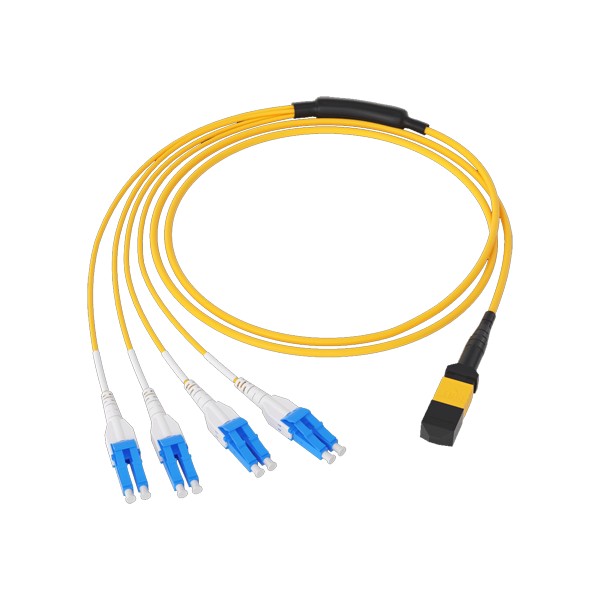
Solution 3: Short-distance DAC Breakout Cable (within 3 meters)
If you are connecting to servers in the same rack, a DAC breakout cable is the most cost-effective and lowest power option. Although the physical interface at the branch end is QSFP56, it is backward compatible with QSFP28 ports.
The picture shows the 400G DAC cable connecting the server in the same cabinet.

400G QSFP-DD to 4x 100G QSFP56 DAC Breakout Cable
- Supports customized length and is compatible with mainstream manufacturers such as Cisco, Mellanox, Mitrotek, Juniper, Dell, HP, Huawei, ZTE, H3C, Ruijie, etc.
- Provides short-distance connections within 1 to 3 meters and has good heat dissipation performance.
- Prefabricated at the factory, no need to worry about fiber polarity or interface cleaning, just plug and play.
Why in this solution, AOC can use QSFP28, but DAC must use QSFP56 interface?
400G DR4 uses PAM4 signal modulation, which is caused by different signal rate matching and physical layer electrical standards from 100G DR1.
1. Why does DAC recommend QSFP56?
In the 400G DR4/SR8 system, the single physical signal is 50G PAM4.
- Physical layer logic: 100G separated from 400G is essentially 2-way 50G PAM4.
- Interface definition: QSFP56 is a packaging standard tailored for 50G PAM4 signals. Its electrical interface design fully complies with the high-frequency requirements of 50G PAM4.
- Speciality of DAC: DAC (copper cable) is a purely physical electrical connection without photoelectric conversion. If the 400G end sends PAM4 signals, the 100G end must have an interface that can “understand” and process PAM4 electrical signals. In the standard definition, QSFP56 is the standard interface carrying 100G (2x50G PAM4).
2. Why can QSFP28 be used for AOC/optical modules?
The traditional QSFP28 runs 4x25G NRZ, but the QSFP28 DR1 here is a “special case”: inside the AOC or independent 100G DR1 optical module, there is a powerful chip called DSP (digital signal processor), which can perform signal conversion.
- Optical port end: Receives 1 channel 100G PAM4 optical signal from 400G DR4.
- Electrical port: DSP will “translate” this signal into an electrical signal that the switch can understand.
There are currently a large number of existing 100G switches on the market that only support QSFP28 ports. In order to allow these old equipment to interface with new 400G equipment, manufacturers developed Single Lambda (single wave) 100G technology and stuffed it into the QSFP28 casing. As long as there is a DSP inside the module for signal conversion, the outer shell uses QSFP28 for backward compatibility with old equipment.
3. Direct attach cable vs Active optical cable vs Transceiver
| connecting medium | Branch end interface | core reasons |
| DAC (copper cable) | QSFP56 | The copper cable does not change the signal format, and the PAM4 electrical signal at the 400G end requires the QSFP56 interface to physically carry it. |
| AOC / optical module | QSFP28 (DR1) | The DSP inside the module converts the optical signal on the 400G side into an electrical signal compatible with the 100G switch port (QSFP28). |
Selection Recommendation:
What model is your current 100G switch? I can help you check whether it supports QSFP28 or QSFP56 packaging.
- If your 100G switch is an old model (only supports QSFP28): Please be sure to purchase the QSFP28 DR1 solution (AOC or module + jumper).
- If your 100G switch is a newer model (supports QSFP56): DAC or AOC are fine, but QSFP56 usually has better signal integrity.