Many people have questions about the relationship between EPON, GPON, 10G PON, XG-PON, and NG-PON 2. Today, through this article, Yingda will provide a detailed introduction, hoping to help you.
The Early History of Broadband: EPON and GPON (2000-2004)
Let’s begin with the origin of PON. In the 1980s, with the rapid rise of computers and multimedia technology, global data communication services began to boom. Early internet services provided by telecom operators relied heavily on copper infrastructure—such as telephone lines, twisted pair cables, and coaxial cables—using technologies like ADSL (Asymmetric Digital Subscriber Line) and ISDN (Integrated Services Digital Network).
However, these traditional copper-based methods suffered from slow transmission speeds and high deployment costs. To meet the soaring demands of internet users, optical fiber emerged as the ultimate communication medium. Ever since Chinese scientist Dr. Charles Kao laid the theoretical foundation for fiber optic communication in 1966, this technology entered a fast track of evolution, with mature manufacturing and a robust industry chain shaping up by the late 1980s.
In the late 1980s, to apply fiber optics to broadband access services, manufacturers gradually introduced their own narrowband PON technology. At that time, the speed of this technology was very low, not exceeding 2Mbps. Moreover, because manufacturers were fighting on their own, there was never a unified standard and specification.
The Birth of ITU-T Standards: From APON to BPON (2000)
In 1995, seven major network operators, including BellSouth, BT, and France Telecom, jointly established the Full Service Access Network Alliance (FSAN) to unify optical access network equipment standards.
By 1997, based on FSAN’s recommendations, the ITU-T (International Telecommunication Union Telecommunication Standardization Sector) released the G.983.1 standard, known as APON (ATM PON). ATM stands for Asynchronous Transfer Mode, a transmission protocol that was a fierce competitor to the IP protocol back then.
To clear up the misconception that APON only supported ATM services, FSAN and ITU-T upgraded and renamed the specification to BPON (Broadband PON) around 2000. This marked the official entry into the broadband PON history era.
The Milestone: GPON and EPON Evolution (2003-2004)
To break through the gigabit bottleneck, FSAN initiated a new project in 2002 to standardize PON networks operating above 1Gbps. This led to a major milestone in March 2003, when ITU-T officially issued the G.984 standard, universally known as GPON (Gigabit Passive Optical Network).
While FSAN and ITU-T were leading the telecom sector, another world-renowned standardization organization was working on an alternative path: the IEEE (Institute of Electrical and Electronics Engineers). IEEE is the creator and major supporter of the Ethernet standard. After IEEE released the Gigabit Ethernet standard in 1998, it sought to develop an Ethernet-based PON standard.
In 2000, IEEE established the EFM (Ethernet for the First Mile) Working Group under the IEEE 802.3 group and officially launched related standardization work. In April 2004, the EFM working group achieved great success and officially launched the IEEE 802.3ah standard, introducing EPON (Ethernet PON) to the market. The fierce competition between GPON and EPON from 2004 onwards laid the foundation for modern fiber-to-the-home (FTTH) networks.

| Technical Standard | International Standard | Full name | Year of Launch |
| APON | ITU-T G.983.X | ATM PON | 1997 |
| BPON | ITU-T G.983.X | Broadband PON | 2001 |
| GPON | ITU-T G.984.X | Gigabit-capable PON | 2003 |
| EPON | IEEE 802.3ah | Ethernet PON | 2004 |
Over time, ATM gradually lost its position and declined in competition with IP. APON (BPON) was also abandoned by operators and withdrawn from the historical stage due to cost and efficiency issues.
Technical Comparison: EPON vs. GPON Standards
EPON and GPON are different technology systems introduced by different standard organizations. There is no upgrading, evolution, or substitution relationship between the two; they developed in parallel.
The key difference between GPON and GPON lies in the second layer (the data link layer):
- EPON: On the second layer, it replaces ATM with Ethernet.
- GPON: It adopts a newly defined encapsulation structure, GEM (GPON Encapsulation Mode), which encapsulates and maps various services such as Ethernet, TDM, and ATM.
| Item | GPON | EPON |
| Standard | ITU.T | IEEE |
| Rate | 2.488G/1.244G | 1.25G/1.25G |
| Spectral ratio | 1:64 ~1:128 | 1:16 ~1:32 |
| Load bearing | ATM, Ethernet, TDM | Ethernet |
| Bandwidth efficiency | 92% | 72% |
| QOS | Very good, including Ethernet, TDM,ATM | Good, only Ethernet |
| Light budget | Calss A/B/C | Px10/Px20 |
| Ranging | EqD Logical Isometric | RTT |
| DBA | Standard format | manufacturer customized |
| TDM support | TDM over Ethernet (PWE3, CESoEthernet) or native TDM | TDM over Ethernet (PWE3, CESoEthernet) |
| ONT Interconnection | OMCI | no |
| OAM | ITU-T G.984 (strong) | Ethernet OAM (Weak, manufacturer expansion) |
| OPEX | Low OPEX | Middle OPEX |
In short, EPON and GPON each have their own advantages and disadvantages. Simply put, GPON has a larger bandwidth, supports more users, and offers higher efficiency, but it is also more complex to implement, resulting in higher costs.
From the perspective of domestic market share, EPON was widely adopted by China Telecom at that time, while GPON was more popular among China Unicom and China Mobile.
The Era of Next-Generation PON: Evolution to 10G PON Standards
EPON and GPON are both passive optical networks operating at the 1Gbps level. However, this 1Gbps represents the shared bandwidth at the central office, meaning they can typically only provide end-users with a practical speed of around 100Mbps. As household and business bandwidth demands skyrocketed, the industry began its transition toward 10G PON technology.
The Rise of 10G-EPON Standard (IEEE 802.3av)
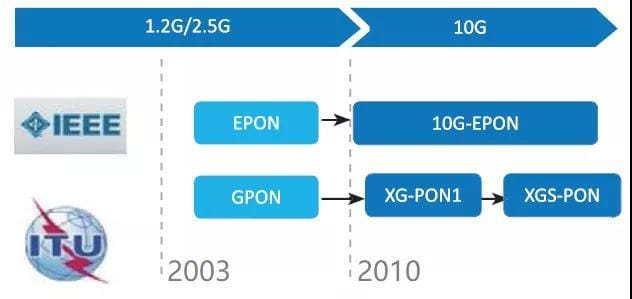
To tackle the bandwidth bottleneck, the IEEE initiated the development of a 10Gbit/s EPON system standard in 2006, which was officially ratified as the IEEE 802.3av 10G-EPON standard in 2009.
Under the 10G-EPON framework, the technology is split into two deployment modes:
- Asymmetric Mode: Features a 10 Gbps downlink rate and a 1 Gbps uplink rate.
- Symmetric Mode: Delivers a full 10 Gbps rate for both uplink and downlink traffic.
Deep Dive into NG-PON1: XG-PON and XGS-PON Evolution
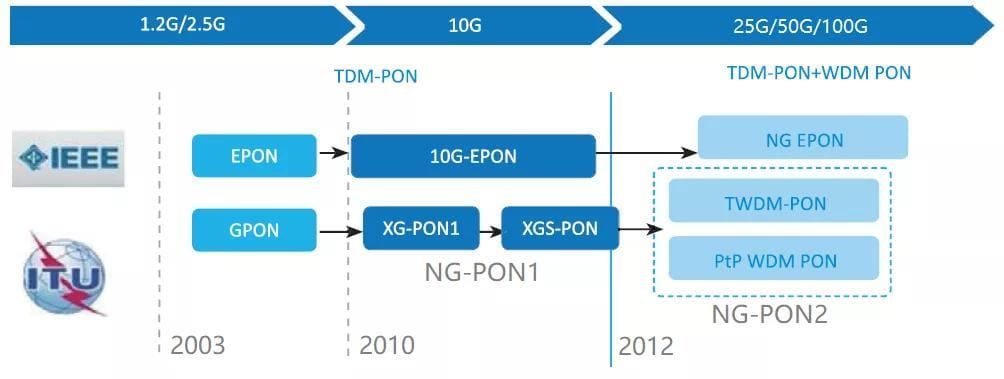
Parallel to the IEEE, the ITU-T was also advancing its flagship gigabit architecture. In 2008, the ITU-T started research on next-generation GPON networks, categorizing the evolutionary roadmap into NG-PON1 (Next-Generation PON 1, for co-existence with GPON) and NG-PON2.
The defining milestone of the NG-PON1 era was the birth of the XG-PON standard in 2010, regulated under the ITU-T G.987 series.
At the beginning, XG-PON also had two ways, one was asymmetric XG-PON1, with a downlink rate of 10 Gbps and an uplink rate of 2.5 Gbps; Another method is the symmetrical XG-PON2, with both uplink and downlink speeds of 10 Gbps.
Due to implementation complexities at the time, the symmetric XG-PON2 scheme was canceled around 2013, and XG-PON1 was directly renamed XG-PON.
| 10G PON Standards | Standard Body | Launch Year | Downstream Rate | Upstream Rate |
| 10G-EPON (Asym) | IEEE 802.3av | 2009 | 10 Gbps | 1 Gbps |
| 10G-EPON (Sym) | IEEE 802.3av | 2009 | 10 Gbps | 10 Gbps |
| XG-PON (NG-PON1) | ITU-T G.987 | 2010 | 10 Gbps | 2.5 Gbps |
| XGS-PON | ITU-T G.9807.1 | 2016 | 10 Gbps | 10 Gbps |
Later in 2015, the symmetric scheme was restarted with a new name, XGS-PON (S stands for symmetric).
In 2017, ITU officially adopted the G.9807 XGS-PON international standard.
By looking at the following picture, you should see it more clearly:
Combo PON Deployment and Network Upgrade Strategies
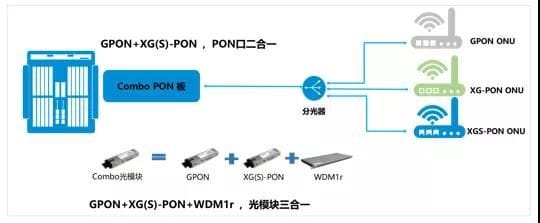
To facilitate a smooth transition from legacy GPON to 10G PON infrastructure, manufacturers introduced the Combo PON solution, which has seen heavy centralized procurement by global telecom operators.
Combo PON is a three in one optical module that integrates GPON optical module, 10G PON optical module, and WDM1r multiplexer internally. In this way, whether the user side is connected to GPON ONT or 10G PON ONT, it can work normally, which is conducive to the upgrade transition.
From a technical perspective, upgrading to 10G-PON is highly efficient because it fully leverages the existing physical architecture:
- ODN (Optical Distribution Network): Remains completely unchanged. This passive pipeline asset represents the most expensive part of FTTH deployment and lasts for decades.
- OLT Equipment (Central Office): The existing GPON/EPON chassis and platforms are preserved; operators only need to swap in high-capacity 10G interface line cards.
- ONU (User Side): User terminals are replaced gradually and cost-effectively, typically triggered when subscribers upgrade to “Gigabit Broadband” packages.
The Future of PON: Evolution to 25G, 50G, and 100G PON
For standard organizations, 10G PON is not the end of PON technology, and 25G/50G/100G PON has already been put on the agenda.
The ITU-T Roadmap: NG-PON2 and TWDM PON Standards (2015)
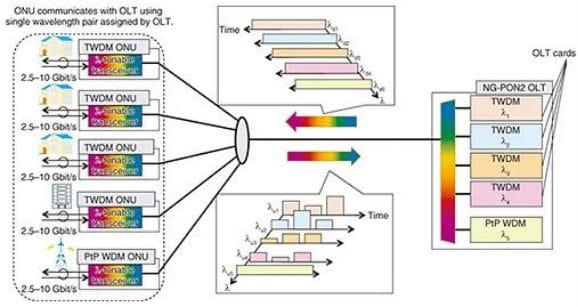
After the completion of the XG-PON standard, FSAN (Full Service Access Network) initiated research on the NG-PON2 standard (NG-PON1 is the previous 10G PON, including 10G GPON and 10G EPON). The key requirements of NG-PON 2 are mainly 40G downlink and 40G/10G uplink, achieving a transmission distance of 20km and 1:64 splitting.
During the initial architectural evaluation, the industry scrutinized several technical candidates, including high-speed TDMA-PON, TWDM PON, OFDM-PON, and WDM-PON. After careful engineering comparison, FSAN officially selected TWDM PON (Time and Wavelength Division Multiplexed PON) as the execution mechanism for NG-PON2 in April 2012. This decision led directly to the formulation of the ITU-T G.989.x series standards, which were successfully completed and published in 2015. The TWDM PON architecture operates by superimposing 4 to 8 distinct wavelengths, with each individual wavelength utilizing a 10G TDM layout.
The IEEE Alternative: 100G-EPON Evolution (IEEE 802.3ca)
In 2013, IEEE initiated research on NG-EPON and established IEEE ICCOM to analyze market demand and technical solutions for NG-EPON. By March 2015, the IEEE published a definitive white paper on NG-EPON technologies. Shortly after, in July 2015, the official development of the 100G-EPON standard was authorized under the project designation IEEE 802.3ca. This comprehensive standard was eventually ratified and officially released in August 2020, solidifying the multi-wavelength 25G/50G/100G Ethernet-based optical roadmap.
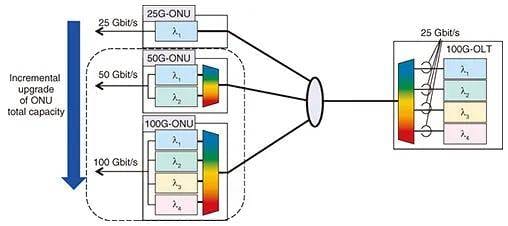
Also below picture for better understanding:
The 50G-PON Debate: Consolidating Next-Gen Infrastructure
On the basis of 10G TDM, ITU-T experts are also considering further enhancing single wave capacity, with a focus on 25G, 50G, and 100G.
- 25G Capacity: The performance jump from 10G to 25G was determined to be too incremental to justify complete system upgrades.
- 100G Capacity: Engineering 100G on a single wavelength introduced severe optical dispersion penalties and high transceiver costs.
- 50G Capacity: Consequently, a single-wavelength 50G PON emerged as the most balanced, cost-effective, and logical evolution path.
Among them, the difference between 25G and 10G is too small, while 100G is too difficult. So, 50G is generally considered a more suitable direction for evolution.
In February 2018, the optical access industry successfully finalized the foundational framework for the single-wavelength 50G TDM-PON standard under the ITU-T. This marked a vital paradigm shift, mapping out a clear technical migration path for operators looking beyond 10G deployments. However, the IEEE did not mirror the single-wavelength 50G proposal, leading to divergent technology philosophies between the two major standard bodies regarding the ultimate next-generation roadmap.
In summary, 10G PON can provide 100M~1G bandwidth per user, while 25G, 50G-PON, and 100G PON can provide 1G~10Gbps bandwidth for users. The large-scale deployment of broadband access platforms usually takes about 7-8 years to complete. From 2016 to 2018, we entered the period of large-scale deployment of 10G PON.
That is to say, it is expected that by 2025, we will usher in the large-scale deployment of 5Gbps and 10Gbps fiber optic access broadband.
Fusion of PON Schools: Market and Technology Integration
In addition to researching next-generation 10G PON and 50G-PON technologies, the industry is also closely monitoring an important issue, which is the integration of the ITU-T and IEEE technology schools.
Since the birth of EPON and GPON, the two factions have coexisted for a long time, which is actually very unfavorable for the industry.
On the one hand, it brings difficulties to the technical decision-making of operators and equipment (multiple-choice questions are difficult to solve), and on the other hand, it also increases the cost of the industrial chain (industrial chain enterprises need to invest in two lines).
For the huge optical access network market in China, the impact of the differentiation of PON technology factions is even greater, and there is also more waste of resources. So, Chinese operators and industry chains have a strong desire for PON integration and have done a lot of promotion work.
Under the active promotion of the domestic and international industry, ITU-T and IEEE have also made some positive “gestures”, including issuing joint statements, forming working groups, and establishing contact letter mechanisms. However, to truly achieve the ultimate integration, it still takes a long time at present.