Skip to content
For 200G switch interconnection, MPO, LC, and DAC interface schemes are not mutually exclusive, but each has clear applicable scenarios. The key to choosing which solution depends on the interconnection distance, whether port breakout is required, and the existing fiber infrastructure.
Yingda has compiled a core decision table that can help you quickly understand the differences among the three:
| Item | DAC (Direct Attach Copper Cable) | AOC (active optical fiber cable) | MPO fiber optic solution | LC Fiber Optic Solution |
| Core medium | Twinax DAC cable | Fiber optic cable+integrated Ethernet to fiber transceiver | Multi mode fiber (MMF)+ Ethernet to fiber transceiver | Single mode fiber (SMF)+ Ethernet to fiber transceiver |
| Interface type | QSFP56 (integrated) | QSFP56 (integrated) | MPO-12 APC | Duplex LC |
| Maximum distance | 3-5 me (passive), 7-10 m (active) | 30-100 m | 70-100 m (OM3/OM4) | ≥2 km |
| Power consumption and cost | extremely low | moderate | moderate | Higher (long-distance module) |
| Main advantages | Lowest cost, almost zero power consumption, plug and play | Distant than DAC, also plug and play, lightweight cable | Provide standard and flexible parallel connections within 100 m | Long distance transmission, dual core design saves fiber resources |
| Best Scenario | In-Rack Short Distance Interconnection | Mid distance plug and play interconnection within/across cabinets | Interconnection of backbone or TOR switches within 100 m of the data center | Cross regional (>100 m), park or DCI long-distance interconnection |
Specific selection guide
According to your specific needs, you can follow the following logic to choose:
1. Interconnection within the cabinet (≤ 3 meters)
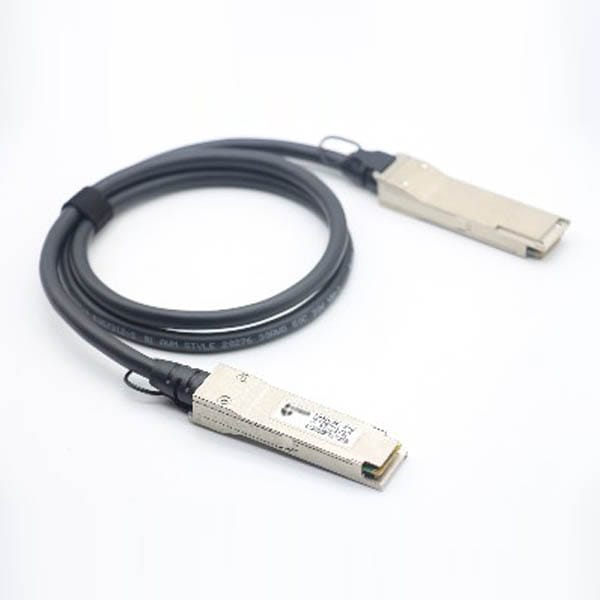
Preferred solution: 200G DAC (QSFP56) direct attach copper cable.
- Reason: This is the lowest cost, lowest power consumption (almost zero), and lowest latency solution. DAC SFP cable is the absolute mainstream choice within the same cabinet.
- Example: Connect a server network card in a cabinet to a TOR switch.
2. Cross cabinet interconnection (5-100 meters)
- Option A (plug and play): 200G AOC active optical fiber cable.
- Reason: AOC SFP is a “plug and play” fiber based DAC that provides longer distances than copper cables (usually up to 100 meters) and is fully resistant to electromagnetic interference, making deployment very convenient.

- Option B (flexible deployment): 200G SR4 Ethernet to fiber transceiver +MPO 12 fiber cable
- Reason: This is the standard solution for interconnection within 100 meters of data centers. Adopting MPO 12 connector, supporting 4-channel parallel 50G-PAM4 signal transmission. Compared to AOC SFP, this separation scheme is more flexible in wiring management and long-distance connections.

3. When port splitting is required (200G → 4x50G / 2x100G)
When your 200G switch port needs to connect multiple low-speed devices, you need to use the “breakout” function:
- Short distance splitting: Use 200G → 4 × 50G SFP56 DAC direct attach copper cable, or 200G → 2 × 100G QSFP56 AOC optical fiber cable.
- Long distance splitting: With MPO to LC breakout cable, a 200gb transceiver SR4 (MPO interface) can be split into two 100G Ethernet to fiber transceiver (LC interface) for connection.

4. Long distance interconnection (>100 meters)
- Preferred solution: 200G FR4/LR4 Ethernet to fiber transceiver + Duplex single mode LC patch cable.
- Reason: LC interface and single mode fiber are standard configurations for long distance transmission. For example, the FR4 transceiver can achieve 2km transmission on single mode fiber, suitable for interconnection across buildings or data centers.

Key features and equipment compatibility
- Port rate and modulation: 200G ports are typically based on QSFP56 packaging and use 4x50G-PAM4 modulation technology. When selecting, be sure to confirm that the module and cable support this specification.
- Device compatibility: Different brands of switches (such as Cisco, Arista, NVIDIA, Aruba) have different support for branch modes and modules. It is strongly recommended to consult the official documentation of the switch or conduct compatibility testing before deployment.
- Breakout function: The selection of optical modules and cables also needs to consider the port splitting mode (Breakout) supported by the switch.
Conclusion
For your convenience in making decisions, you can judge as follows:
- Distance<3m(within the same cabinet): Twinax DAC cable is preferred. This is the standard solution for connecting servers to TOR switches, with optimal cost and power consumption.
- 5-10m(adjacent cabinets): Active DAC or AOC can be considered. Some active DACs support this distance, but AOC is more common and reliable.
- Distance of 10-100m (across cabinets): SR4 transceiver + MPO fiber jumper is the standard answer, AOC is a more convenient plug and play alternative.
- Distance>100m (across cabinets or longer): Only FR4/LR4 200Gb transceivers + patch cord LC PC LC PC can be used.
Note:
AOC provides a convenient “plug and play” experience, while the use of separate optical modules and fiber jumpers provides maximum flexibility for future upgrades and management through patch panels.
MPO connectors are commonly used in multimode fiber (SR4) solutions, supporting parallel transmission of multiple signals within a single fiber, achieving a speed of 200G. LC connectors are more commonly used in single mode fiber (LR4/FR4) schemes. Almost all server access uses duplex LC interfaces.