 Skip to content
MTP 16 cable is mainly used for high-density, high data rate data center cabling, especially supporting 400G/800G network architectures. This type of cable uses 16 core optical fibers as units and provides high bandwidth transmission through a single line MTP connector. It is commonly used for backbone connections, parallel optical connections between core switches and servers, and is a key component for upgrading next-generation high-speed networks such as QSFP-DD/OSFP optical modules based on 16 cores.
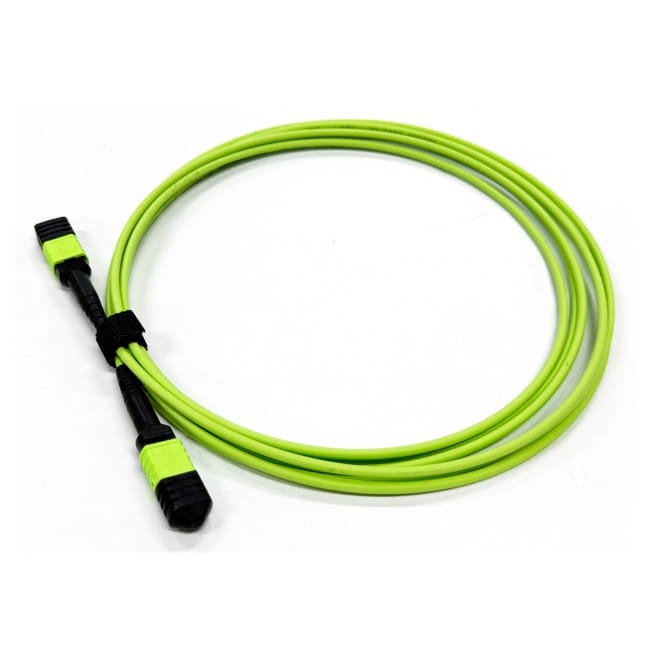
Main features of MTP 16 Cable
- Compact structure: 16 cores are integrated into one optical cable, saving wiring space.
- Single row design: Compared to the 12 core dual row structure, the single row 16 core (1×16) is more conducive to the stability and accuracy of high-speed transmission in APC design.
Core application scenarios
- High Density Data Centers: Used for backbone fiber optic connections between core switches and aggregation layer/core switches within data centers, supporting 400G/800G Ethernet transmission.
- High speed parallel optics connection: MTP 16 cable connects 16 channel high-speed optical modules such as QSFP-DD and OSFP, suitable for optical transmission environments with 8 transmit (TX) and 8 receive (RX) channels.
- MTP 16 to LC Harness Cable: MTP to LC cable sed to split 16 core backbone cables into standard duplex LC connectors, facilitating direct connection between high-speed switches and existing server network cards or existing racks.
- Enterprise backbone cabling: MTP 16 cable are used for enterprise cabling backbone projects, providing high-density fiber optic backbone infrastructure.
Three polarities of MTP 16 Cable
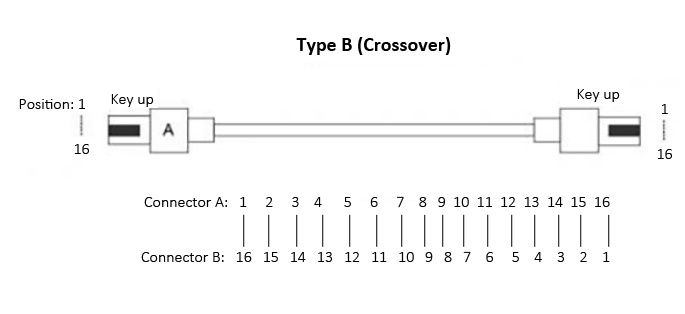
1. Type B (Crossover) – preferred for 800G
In the 800G DR8 module, the left 8 core is usually TX and the right 8 core is RX. MTP type B cables can automatically map the TX arrangement on one end to the RX arrangement on the other end, achieving plug and play functionality.
- Physical features: Both ends of the MTP 16 connector are Key Up/Key Up (key up to key up).
- Signal mapping: The fiber core inside the MTP cable has been completely crossover (core 1 connected to core 16 at the other end, core 2 connected to core 15, and so on).
2. Type A (straight through type)
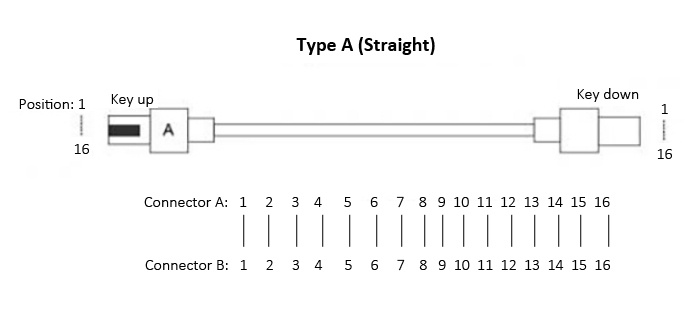
If you directly connect two 800G transceiver module with Type A, it will cause TX to align with TX and RX to align with RX, and the link cannot be established. It is usually only used for complex backbone cabling (with specific adapter modules or jumpers to complete the final flip).
- Physical fetures: Key Up at one end and Key Down at the other end (key up to key down).
- Signal mapping: Core 1 to Core 1, Core 2 to Core 2… Core 16 to Core 16
3. Type C (Pairs crossed)
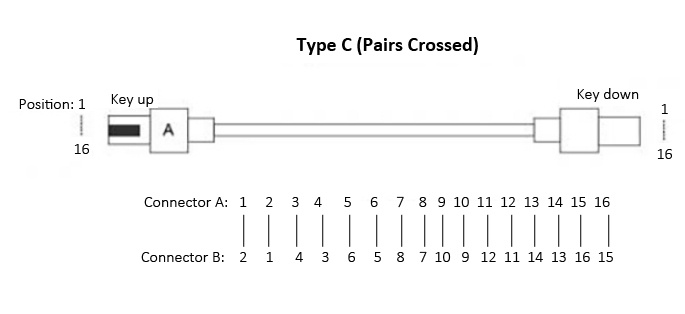
Type C MTP 16 cables are designed for early duplex applications and is completely unsuitable for 8-channel parallel optical systems like 800G.
- Physical features: Key Up at one end and Key Down at the other end (key up to key down).
- Signal mapping: Flip adjacent cores (1 to 2, 2 to 1, 3 to 4, 4 to 3,…, 15 to 15, 16 to 15).
| Polarity type | Key position | Signal mapping (TX/RX) | 800G applicability |
| Type B | Key Up / Key Up | TX \right arrow RX(auto flip) | Recommended solution for module direct connection. |
| Type A | Key Up / Key Down | TX \right arrow TX (not working) | Only used for complex structured cabling systems. |
| Type C | Key Up / Key Down | disorder | Prohibited for use in 800G parallel modules. |
Avoiding pitfalls guide:
- MTP Breakout cable 1 to 2: If you buy an 800G (MPO-16) to 2x 400G (MPO-8) cable, the manufacturer usually has already processed the Type B polarity internally. You only need to confirm that the specification sheet is labeled as “Type B” or “Crossover”, then it is ok.
- Pay attention to male and female connectors: MTP connectors have a difference between “Male” and “Female” connectors. The internal interface of an 800G transceiver module is usually male, so both ends of your cable must be female.
MTP 16 Cable TYPE B Project Cases
In an 800G network, choosing the correct polarity is crucial as it determines whether the optical signal from the transmitter (TX) can accurately enter the receiver (RX). In the 800G parallel transmission system, MTP Type B (MPO Crossover Cable) is currently the most mainstream and recommended standard.
Next, we will take the OSFP 800G DR8 optical module as an example to examine two specific applications of MTP Type B Cable.
1. Point-to-Point Direct Connection
This is the simplest connection method – directly connect the switch and server with a 16 fiber MTP trunk cable.
- Cable: MPO-16 Female to Female, Type B, multimode (OM4) or single-mode (OS2) MTP jumpers are typically used.
- Length: usually between 1-10 meters.
- Advantages:There is no adapter in the middle, and the insertion loss is minimized, making it very friendly for signal sensitive links like 800G.No need to consider complex wiring management.
Notes:
- The cable length must be precise, otherwise there will be a large amount of messy wires piled up behind the cabinet, which will affect heat dissipation.
- If the optical module is damaged or the port is moved, the entire long line may need to be pulled again.
2. Structured Cabling
This application is similar to a wall mounted Ethernet socket. The switch and server are connected to patch panels at the top of the cabinet, and the patch panels are connected to each other through pre laid trunk cables.
- Duplex LC patch cord: Short length 1-3 meters, connects otpical equipment to the optical distribution frame.
- MTP Cassettes / adapters: The MTP cassette with adapters are installed on the distribution frame, providing port transfer.
- MTP trunk cable: a large capacity MTP cables (such as 144 cores) are laid above the cabinet or under the floor.
- Advantages: Daily maintenance only requires plugging and unplugging short duplex lc patch cords, without touching the backbone cables, reducing human damage and high reliability. And the interior of the cabinet is very clean, with good heat dissipation effect.
Notes:
- Accumulated optical loss: Every time it passes through a flange/adapter, the signal will weaken. 800G has strict requirements for power margin, and there should not be too many intermediate transfer points.
- Polarity complexity: Due to multiple intermediate transfers, it is necessary to strictly follow a set of polarity systems (usually full A or full B systems), otherwise TX/RX will be reversed.
| feature | Point to point direct connection | Structured cabling |
| Main cables | 1pc MTP 16 cable | Short patch cord+MTP trunk cable cable+MTP cassette |
| Installation difficulty | Extremely easy | Difficult (requiring professional design) |
| Flexibility | Low (changes require re drawing of long lines) | High (Jumper to switch ports at any time) |
| Heat dissipation impact | Chaotic lines are more likely to block wind | The clearest heat dissipation path |
| Unit price cost | Low | High (increased cost of distribution frame) |
Special Reminder for 800G Network Cabling
For the 800G DR8 scheme, optical loss is the largest variable.
- If you choose “structured cabling”: Be sure to choose MPO conversion modules and adapters with Ultra Low Loss (like MTP Elite Connector). Ordinary level losses may cause frequent disconnections or errors in the 800G link.
- Product selection differences: In point-to-point direct connection, you need to buy MTP Patch Cable; In structured cabling, you need to buy a “MTP Trunk Cable” (with male guide pins) and an “MTP Adapter/Cassette”.