 Skip to content
In the 800G network ecosystem, the attenuation of electrical signals at 800G speed is extremely fast in ordinary copper cables (DAC), and signals over 2 meters will be completely “distorted”. The emergence of 800G OSFP AEC (Active Electrical Cable) has successfully solved the physical limitations of copper media at ultra-high frequencies and is known as the “savior of copper cables”.
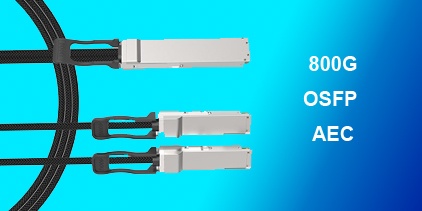
The following is the in-depth technical analysis and application logic of 800G AEC summarized by Yingda, hope it is useful for you.
Core technology: Retimer
Unlike the “pure copper wire” structure of DAC, each connector (plug) of AEC integrates a high-performance DSP/Retimer re timer chip internally.
- Signal reshaping: Though the 800G signal will experience severe distortion after being transmitted 2 meters in copper cable, the AEC chip will amplifies, clock recovers, and effectively eliminates signal jitter on weak and distorted “dirty signals” received, and re emits a “clean” signal.
- Balanced compensation: AEC can automatically compensate for the insertion loss caused by cables, ensuring that the bit error rate (BER) meets the requirements of the data center level.
Why is AEC particularly needed in the 800G era?
In the era of 100G/400G, DAC coaxial cable could still transmit 3-5 meters, but by 800G (PAM4 112G single lane), the transmission limit of DAC has been reduced to about 2 meters.
- Fill in the short distance gap: The most common “cross cabinet” distance in data centers is between 2 meters and 7 meters. Short DAC cable cannot reach it, and AOC optical is too expensive (high power consumption), AEC just fills the gap between performance and cost.
- Wiring “slimming”: In order to maintain signal quality, the 800G OSFP DAC has extremely thick copper cores (such as 26AWG) that are as hard as steel bars. AEC, with chip compensation, can use finer copper cores (such as 30/32AWG), reducing wire diameter by about 30% -50%. It is as soft as ordinary optical cables and can travel longer paths along the edge of the rack without damage, indirectly improving the coverage of physical deployment and greatly relieving the heat dissipation pressure behind the cabinet.
- Gearbox function: Some high-end AEC chips also have Gearbox (rate conversion) function, which can balance the signal differences between different ports and ensure extremely low bit error rate (BER) during long-distance transmission of 5-7 meters.
Performance trade-off between AEC vs. AOC vs. DAC cable
| Item | 800G DAC (Passive) | 800G AEC (active cable) | 800G AOC (Optical Fiber Cable) |
| transmission distance | <2 meters | 2-7 meters | 2-100 meters |
| Single ended power consumption | ~0.1W | ~5W | ~14W |
| delay | Extremely low (nanosecond level) | Low (with chip processing) | Higher (photoelectric conversion) |
| Cable flexibility | Extremely hard and heavy | Finer and softer | Extremely fine and soft |
| Typical unit price | 1x (baseline) | ~5x | ~10x |
Key application scenario: AI computing power cluster
In the AI intelligent computing center architecture promoted by companies such as NVIDIA, the position of AEC is increasingly prominent:
- Leaf Spine topology: used for interconnecting adjacent switches within the same row of cabinets.
- SmartNIC connection: Connect high-performance server network cards to Top of Rack (ToR) switches, especially when servers are distributed in different cabinets.
- Distributed storage: Provides a high bandwidth, low latency, and low-power link between the all flash array and the network.
Challenges and limitations
Interoperability: Due to the inclusion of chips in AEC SFP cable, there may be compatibility risks between switches from different manufacturers and AEC cables from different brands, requiring rigorous matching testing before deployment.
Power consumption budget: Although more energy-efficient than AOC, the 5W single ended power consumption is still a significant heat dissipation burden on a fully loaded 32/64 port switch.
Conclusion
If you are planning an 800G AI cluster with a connection distance between 3 and 5 meters, AEC OSFP cable is currently the most perfect balance between power consumption, cost, and wiring difficulty.